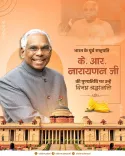
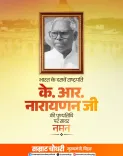
CM Himanta pays tribute to President K. R. Narayanan on Punyatithi
Synopsis
Assam Chief Minister Himanta Biswa Sarma marked the Punyatithi of K. R. Narayanan, India's tenth President and first from a Dalit background, honouring his journey from diplomacy to Rashtrapati Bhavan and his commitment to constitutional values.
Key Takeaways
Narayanan served as India's tenth President from 1997 to 2002 , the first from a Dalit background.
Before the presidency, he had a distinguished career as a diplomat, ambassador, and Vice-Chancellor of Jawaharlal Nehru University .
Narayanan was elected President in 1997 , defeating the ruling coalition's preferred candidate, signalling presidential independence.
Assam CM Himanta Biswa Sarma posted his tribute on 9 November 2026 , Narayanan's death anniversary ( Punyatithi ).
Sarma highlighted Narayanan's 'deep commitment to constitutional values and public service.' Annual cross-party tributes to Narayanan reflect his enduring stature as a symbol of inclusive democracy in India.
A trailblazer who carried a diplomat's instinct and a constitutional scholar's conviction all the way to Rashtrapati Bhavan — Assam Chief Minister Himanta Biswa Sarma on Monday, 9 November 2026 paused to remember K. R. Narayanan, India's tenth President, on his death anniversary.
Sarma wrote: 'From the world of diplomacy to the Rashtrapati Bhavan, K. R. Narayanan ji carried with him a deep commitment to constitutional values and public service. Remembering him on his Punyatithi today.'
From Kerala's paddy fields to the republic's highest office
Kocheril Raman Narayanan charted one of independent India's most remarkable ascents. Born into a Dalit family in Uzhavoor, Kerala, he won a scholarship to the London School of Economics, entered the Indian Foreign Service, and served as ambassador to multiple countries before returning to academia as Vice-Chancellor of Jawaharlal Nehru University. His journey into electoral politics followed, and in 1997 he was elected President of India — the first person from a Dalit background to hold the office — defeating the ruling coalition's preferred candidate, an early signal of the independence he would bring to the role.A presidency defined by constitutional rigour
In office from 1997 to 2002, Narayanan was no ceremonial figurehead. He used the presidential platform to articulate a vision of inclusive democracy, speaking often on the importance of protecting marginalised communities and upholding constitutional guarantees. His diplomatic background — decades spent representing India abroad — gave his pronouncements on governance a rare depth that commanded cross-party respect. Indian political leaders across the spectrum observe his Punyatithi (death anniversary) each 9 November as a moment to reaffirm those values. Sarma's tribute fits that established pattern while also reflecting his own role as a senior BJP leader and convenor of the North-East Democratic Alliance (NEDA) — a reminder that constitutional remembrance carries its own quiet political weight. Narayanan's life remains a touchstone for conversations about representation, merit, and the possibilities embedded in India's constitutional design — a legacy that outlasts any single government or era.Point of View
From a Dalit household to the republic's highest office, carries a symbolism that transcends party lines. For a senior NDA figure who also heads NEDA, such remembrances serve both as genuine homage and as soft affirmations of inclusive governance. The timing, amid routine governance cycles in Assam, underscores how presidential legacy remains a live rhetorical resource in Indian politics.
NationPress
9 Nov 2026
Frequently Asked Questions
Who was K. R. Narayanan?
K. R. Narayanan was the tenth President of India, serving from 1997 to 2002. He was the first person from a Dalit background to hold the office and had earlier served as a diplomat, ambassador, and Vice-Chancellor of Jawaharlal Nehru University.
When did K. R. Narayanan die?
K. R. Narayanan passed away on 9 November 2005. His death anniversary, observed as his Punyatithi, falls on 9 November each year.
Why is K. R. Narayanan historically significant?
Narayanan was the first President of India from a Dalit background, elected in 1997. He used the presidential office to champion inclusive democracy and constitutional values, and his diplomatic and academic career made him one of India's most respected public figures.
Who is Himanta Biswa Sarma?
Himanta Biswa Sarma is the Chief Minister of Assam and a senior BJP leader. He also serves as the convenor of the North-East Democratic Alliance (NEDA), which coordinates BJP-aligned governments across north-eastern India.