Gadkari pays tribute to freedom fighter H. N. Kunzru
Synopsis
Union Minister Nitin Gadkari marked the birth anniversary of freedom fighter Hriday Nath Kunzru on 1 October 2026, saluting the Constituent Assembly member and Servants of India Society leader whose democratic legacy shaped early republican India.
Key Takeaways
Minister Nitin Gadkari paid tribute to freedom fighter H.
Kunzru on his birth anniversary, 1 October 2026 .
Hriday Nath Kunzru (1887–1978) was a member of the Constituent Assembly of India and a long-serving Rajya Sabha member.
Kunzru was a prominent leader of the Servants of India Society , founded by Gopal Krishna Gokhale .
He represented the moderate, institution-building strand of Indian nationalism, advocating civil liberties and democratic norms.
His public engagement continued well into the post-independence era, making him a distinctive voice in the early republic.
On the birth anniversary of one of India's lesser-celebrated but quietly consequential freedom fighters, Union Road Transport and Highways Minister Nitin Gadkari paused to honour Hriday Nath Kunzru — a man whose decades of public service spanned the twilight of the Raj and the first generations of the Republic.
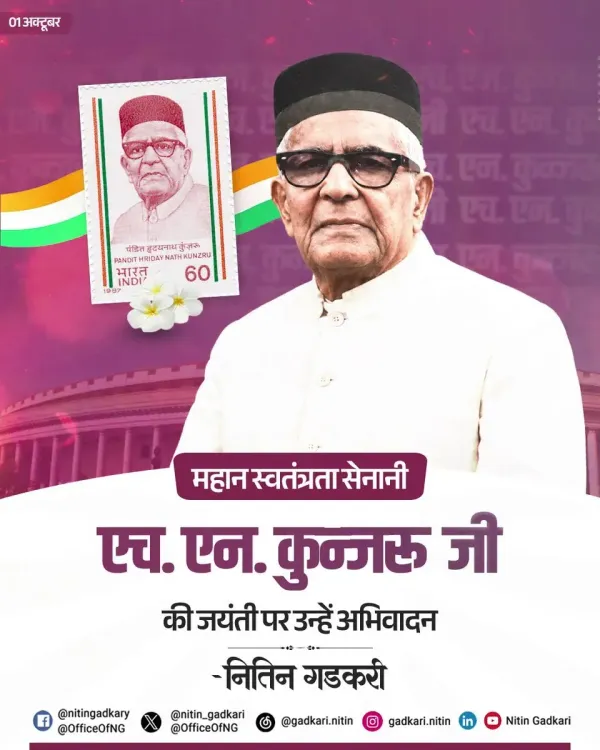
Gadkari posted on X on Thursday, 1 October 2026, offering his salutations on Kunzru's birth anniversary. 'महान स्वतंत्रता सेनानी एच. एन. कुन्जरू जी की जयंती पर उन्हें अभिवादन' — 'Greetings to the great freedom fighter H. N. Kunzru on his birth anniversary' — was the minister's tribute.
Who was H. N. Kunzru?
Hriday Nath Kunzru (1887–1978) was a towering figure in India's nationalist and parliamentary tradition. A prominent leader of the Servants of India Society, he dedicated his life to social reform, constitutional governance, and the advancement of civil liberties long before independence became a certainty.
Kunzru served as a member of the Constituent Assembly of India, contributing to the debates that shaped the republic's foundational law. He later served as a member of the Rajya Sabha for several terms, earning a reputation as one of Parliament's most erudite and independent voices. His commitment to democratic norms and minority rights was consistent across decades of political change.
A legacy that outlasted the independence moment
What distinguished Kunzru from many of his contemporaries was the longevity and consistency of his public engagement. Where others retreated from active life after 1947, he remained a visible conscience of the early republic — raising questions on civil liberties, federalism, and the rights of citizens well into the post-independence era.
His association with the Servants of India Society, founded by Gopal Krishna Gokhale, placed him squarely in the moderate, reform-oriented strand of Indian nationalism — one that prioritised institution-building over agitation. That tradition, often overshadowed by the more dramatic arcs of the independence movement, produced some of India's most durable democratic structures.
On a day when India's political establishment pauses to remember its founding generation, Gadkari's tribute is a reminder that the republic's architecture was built by many hands — not all of them household names.
Point of View
Parliamentary tradition alongside more militant icons. Kunzru's association with constitutional governance and civil liberties gives the tribute a civic, non-partisan texture. For a minister who oversees infrastructure that physically knits the republic together, invoking a man who helped write the republic's rules carries a certain symbolic coherence. The gesture also signals that India's founding generation remains a living political resource, not merely a historical footnote.
NationPress
1 Oct 2026
Frequently Asked Questions
Who was H. N. Kunzru?
Hriday Nath Kunzru (1887–1978) was an Indian freedom fighter, social reformer, member of the Constituent Assembly of India, and a long-serving Rajya Sabha member known for championing civil liberties and democratic norms.
What was the Servants of India Society?
The Servants of India Society was an organisation founded by Gopal Krishna Gokhale in 1905 to train Indians for public service and social reform. Kunzru was one of its prominent leaders.
Why did Nitin Gadkari pay tribute to H. N. Kunzru?
Minister Nitin Gadkari posted the tribute on 1 October 2026 to mark Kunzru's birth anniversary, recognising his contributions as a freedom fighter and constitutional statesman.
Was H. N. Kunzru a member of the Constituent Assembly?
Yes, Hriday Nath Kunzru was a member of the Constituent Assembly of India and participated in debates that shaped the Indian Constitution.
What is H. N. Kunzru remembered for?
Kunzru is remembered for his decades-long commitment to civil liberties, federalism, and democratic governance — both before and after Indian independence — and for his association with the moderate, reform-oriented tradition of Indian nationalism.