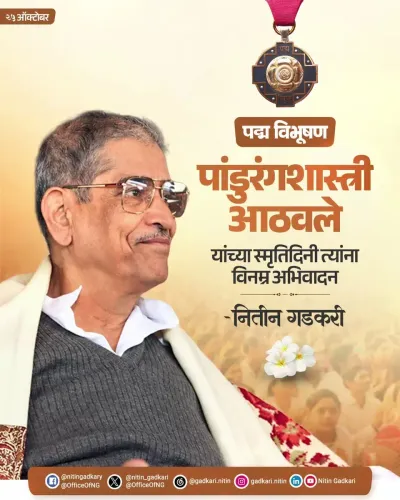
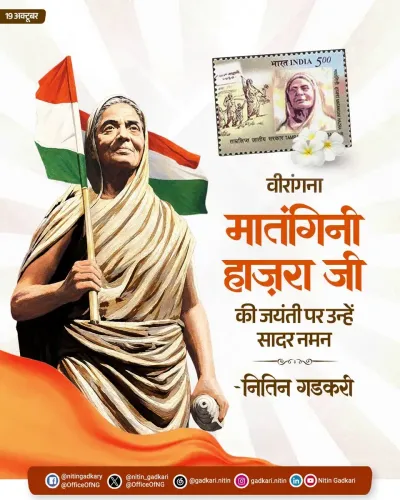
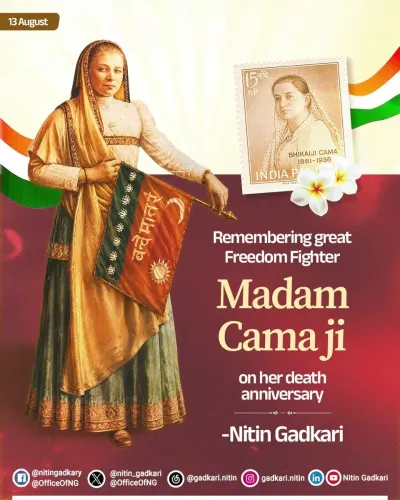
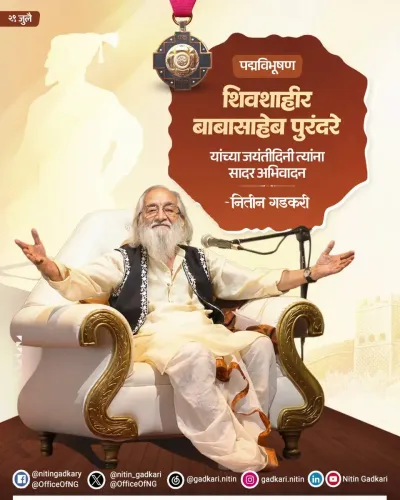
Gadkari pays tribute to Kamaladevi Chattopadhyay on her death anniversary
Synopsis
Union Minister Nitin Gadkari marked the death anniversary of Padma Vibhushan Kamaladevi Chattopadhyay, the celebrated freedom fighter and cultural revivalist who transformed India's handicraft sector post-independence and died in 1988.
Key Takeaways
Nitin Gadkari posted a tribute on X on 29 October 2026 marking Kamaladevi Chattopadhyay's death anniversary.
Kamaladevi was a frontline Indian independence activist and one of the first Indian women to contest a legislative election.
She was awarded the Padma Vibhushan — India's second-highest civilian honour — in 1987 .
She passed away in 1988 , leaving behind a transformative legacy in handicrafts, handloom cooperatives, and performing arts.
Indian political leaders routinely use death anniversaries to publicly reaffirm the legacy of independence-era figures.
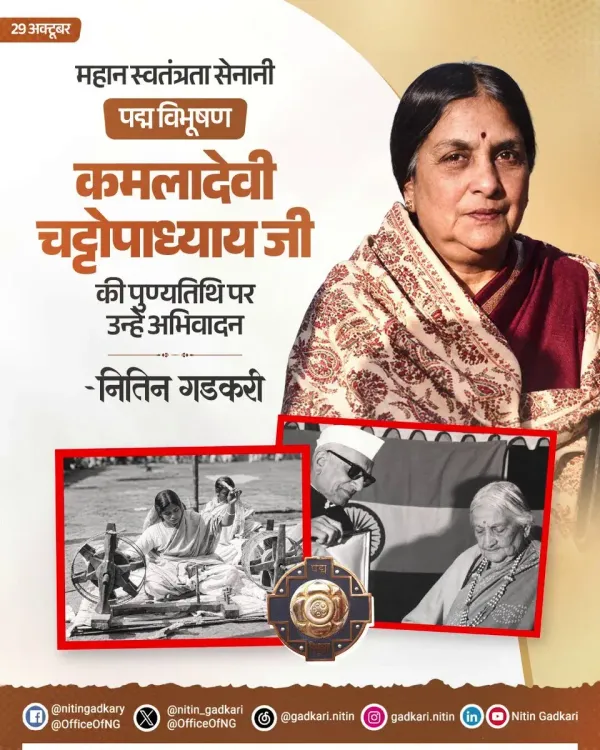
On the death anniversary of one of India's most consequential freedom fighters, Union Road Transport and Highways Minister Nitin Gadkari paused to honour a woman whose contributions stretched far beyond the independence struggle — Padma Vibhushan awardee Kamaladevi Chattopadhyay, remembered on Thursday, 29 October 2026.
Posting on X in Hindi, Gadkari wrote: 'महान स्वतंत्रता सेनानी पद्म विभूषण कमलादेवी चट्टोपाध्याय जी की पुण्यतिथि पर उन्हें अभिवादन' — 'Salutations to the great freedom fighter Padma Vibhushan Kamaladevi Chattopadhyay on her death anniversary.'Who was Kamaladevi Chattopadhyay?
Kamaladevi Chattopadhyay was among the most multi-dimensional figures of India's independence era. A frontline activist in the freedom movement, she defied the conventions of her time — becoming one of the first Indian women to run for a legislative seat, long before it was fashionable or safe. But her legacy refused to stay inside any single lane.
After independence, she turned her energy toward reviving India's endangered craft traditions and performing arts. She is widely credited with rescuing the country's handloom and handicraft sectors from near-oblivion in the decades following partition, channelling refugee artisans into productive cooperatives and institutions that survive to this day. She received the Padma Vibhushan — India's second-highest civilian honour — in 1987, a year before her death in 1988.
A routine tribute with a non-routine subject
Indian ministers marking death anniversaries of independence-era figures on social media is a well-worn tradition. What makes this tribute notable is the stature of the figure being remembered. Kamaladevi's name does not always share the same popular-memory space as contemporaries like Gandhi or Nehru, yet her institutional imprint — on crafts cooperatives, theatre, and women's rights — runs deep in the fabric of independent India.
Remembering her is, in a quiet way, a reminder that the independence movement produced builders as much as fighters — and that some of the most durable building happened far from the headline protests.
Point of View
Inclusive reading of India's freedom struggle. Kamaladevi Chattopadhyay's particular legacy in craft revival and women's agency gives this tribute a cultural dimension beyond standard political commemoration. That a senior BJP leader invokes a figure closely associated with cooperative economics and progressive social reform also signals an effort to claim a wide historical tent. The gesture is largely ceremonial, but the choice of figure is rarely accidental.
NationPress
29 Oct 2026
Frequently Asked Questions
Who was Kamaladevi Chattopadhyay?
Kamaladevi Chattopadhyay was an Indian independence activist, social reformer, and champion of handicrafts and performing arts. She is credited with reviving India's handloom and craft traditions after independence and was awarded the Padma Vibhushan in 1987.
When did Kamaladevi Chattopadhyay die?
Kamaladevi Chattopadhyay passed away in 1988, a year after receiving the Padma Vibhushan, India's second-highest civilian honour.
What award did Kamaladevi Chattopadhyay receive?
She was awarded the Padma Vibhushan in 1987, recognising her lifetime of contributions to India's freedom movement, handicraft revival, and social reform.
Why is Nitin Gadkari paying tribute to Kamaladevi Chattopadhyay?
29 October marks the death anniversary of Kamaladevi Chattopadhyay. Union Minister Nitin Gadkari posted a tribute on X to honour her memory on this occasion.
What is Kamaladevi Chattopadhyay known for?
She is known for her role in the Indian independence movement, being among the first Indian women to contest a legislative election, and for her post-independence work reviving handloom cooperatives, handicrafts, and Indian theatre traditions.