Gadkari pays tribute to tribal icon Jagdev Ram Oraon on death anniversary
Synopsis
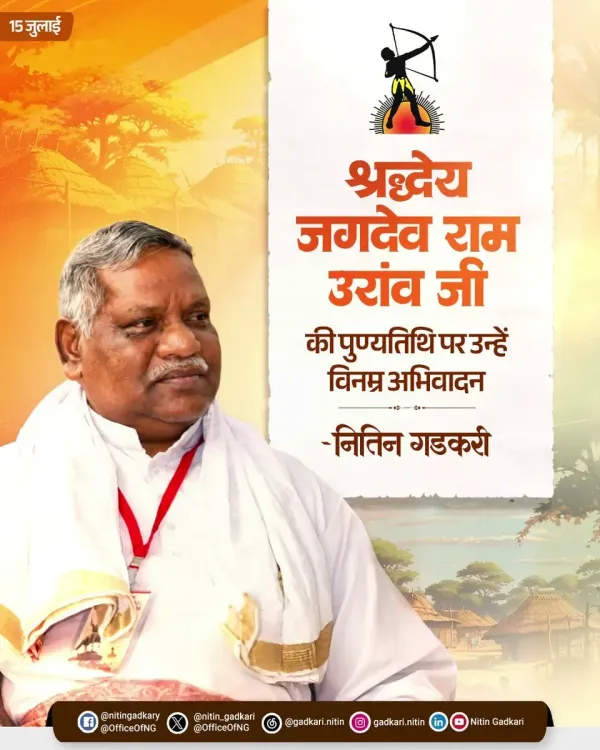
Union Minister Nitin Gadkari on 15 July 2026 honoured Jagdev Ram Oraon, an Adivasi leader from the Bihar-Jharkhand region, on his death anniversary, crediting him with significant contributions to the cultural renaissance and economic empowerment of India's tribal communities.
Key Takeaways
Nitin Gadkari , Union Road Transport and Highways Minister, paid tribute to Jagdev Ram Oraon on his death anniversary on 15 July 2026 .
Gadkari credited Oraon with a 'significant contribution' to the cultural renaissance and economic empowerment of India's tribal communities.
Jagdev Ram Oraon was an Adivasi leader and activist from the Bihar-Jharkhand region associated with the Oraon community , one of India's largest Scheduled Tribe groups.
The tribute aligns with the BJP 's sustained outreach strategy targeting Scheduled Tribe electorates in eastern and central India.
Institutional milestones for tribal welfare include the Ministry of Tribal Affairs (1999) and the formation of Jharkhand state (2000) , both linked to decades of Adivasi agitation.
Union Road Transport and Highways Minister Nitin Gadkari on Wednesday, 15 July 2026, paid tribute to Jagdev Ram Oraon, honouring the tribal leader's contributions to the cultural renaissance and economic empowerment of India's indigenous communities on his death anniversary.
Posting on X, Gadkari wrote — 'Shraddheya Jagdev Ram Oraon ji ka Bharat ke janjatiyon ke saanskritik punarjagaran evam aarthik sashaktikaran mein mahatvapurn yogdan hai' — meaning: 'Revered Jagdev Ram Oraon's contribution to the cultural renaissance and economic empowerment of India's tribal communities is significant.' He offered his respects on the occasion of the leader's punyatithi (death anniversary).
Context
Jagdev Ram Oraon was an Adivasi leader and independence-era activist from the Bihar-Jharkhand region, recognised for his early and sustained advocacy of tribal cultural identity and socio-economic rights. The Oraon community is one of the largest Scheduled Tribe groups in eastern and central India, with a significant concentration in present-day Jharkhand. Oraon's legacy spans efforts to preserve indigenous cultural practices while simultaneously pushing for economic inclusion of marginalised tribal populations.
Policy Backdrop
Institutional recognition of tribal welfare in India gained formal momentum with the creation of the Ministry of Tribal Affairs in 1999, which gave dedicated policy focus to Scheduled Tribe communities. The formation of Jharkhand as a separate state on 15 November 2000 was itself the culmination of decades of tribal-statehood agitation in which figures like Jagdev Ram Oraon played a foundational role. These milestones are frequently cited by political leaders when commemorating tribal icons as evidence of the state's responsiveness to Adivasi aspirations.
The BJP has in recent years intensified its outreach to Scheduled Tribe communities across eastern and central India, a region that includes states with large Adivasi electorates such as Jharkhand, Chhattisgarh, Odisha, and Madhya Pradesh. Senior party leaders regularly use public commemorations of regional tribal figures as part of this broader cultural and political engagement.
Stakeholders and Impact
Tribal communities across Jharkhand and neighbouring states form the primary constituency for commemorations of this kind. Remembrances by Union Ministers carry institutional weight, signalling that the contributions of regional Adivasi leaders are acknowledged at the national level. For the Oraon community specifically, such recognition reinforces the continued relevance of their cultural and political heritage within the national narrative.
Civil society organisations working on tribal rights and cultural preservation also watch such tributes closely, as ministerial statements can sometimes precede or accompany policy announcements related to Scheduled Tribe welfare, education, or land rights — though no specific announcement was attached to this post.
What's Next
State-level commemorative events in Jharkhand around tribal death anniversaries typically draw participation from local political figures and community leaders, and may be accompanied by cultural programmes highlighting Adivasi heritage. At the parliamentary level, upcoming sessions could see references to cultural and economic schemes targeting Scheduled Tribes, particularly as the government continues to position tribal welfare as a core development priority. Gadkari's tribute is part of a sustained pattern of senior BJP leaders publicly honouring Adivasi icons — a trend likely to continue ahead of state electoral cycles in tribal-majority regions.
Point of View
' the post echoes the party's broader framing of Adivasi development — one that links historical identity with present-day welfare schemes. Senior ministerial tributes to regional tribal icons serve a dual function: they signal national recognition of local heroes while reinforcing the party's claim to being the natural custodian of Adivasi heritage. As tribal-majority constituencies remain fiercely contested, such commemorations are unlikely to be merely ceremonial.
NationPress
13 Oct 2026
Frequently Asked Questions
Who was Jagdev Ram Oraon?
Jagdev Ram Oraon was an Adivasi leader and independence-era activist from the Bihar-Jharkhand region, known for advocating the cultural identity and socio-economic rights of the Oraon tribal community, one of India's largest Scheduled Tribe groups.
Why did Nitin Gadkari pay tribute to Jagdev Ram Oraon?
Nitin Gadkari paid tribute on Jagdev Ram Oraon's death anniversary, citing his significant contributions to the cultural renaissance and economic empowerment of India's tribal communities.
What is the Oraon community?
The Oraon are one of India's largest Scheduled Tribe communities, concentrated primarily in Jharkhand, Chhattisgarh, and neighbouring eastern and central Indian states, with a distinct cultural and linguistic identity.
What is the significance of Jharkhand in tribal history?
Jharkhand, formed as a separate state on 15 November 2000, was the outcome of decades of tribal-statehood agitation. It has a large Scheduled Tribe population and remains central to Adivasi political and cultural movements in India.
Why do BJP leaders frequently pay tribute to tribal icons?
Senior BJP leaders regularly commemorate regional Adivasi figures as part of the party's outreach strategy in eastern and central Indian states, where Scheduled Tribe communities form a significant share of the electorate.