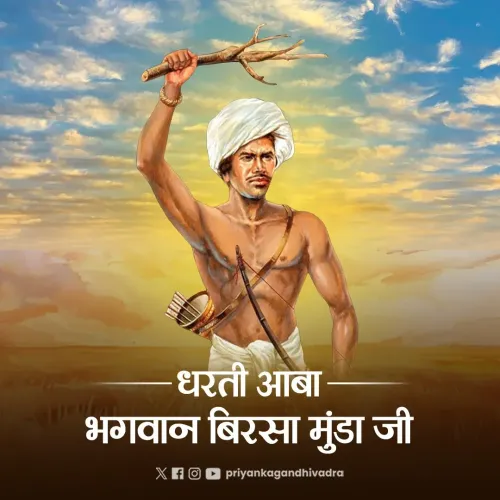
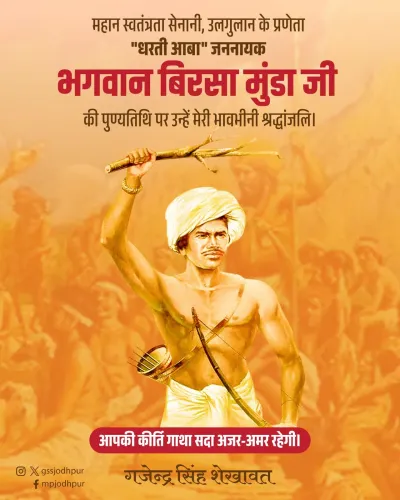
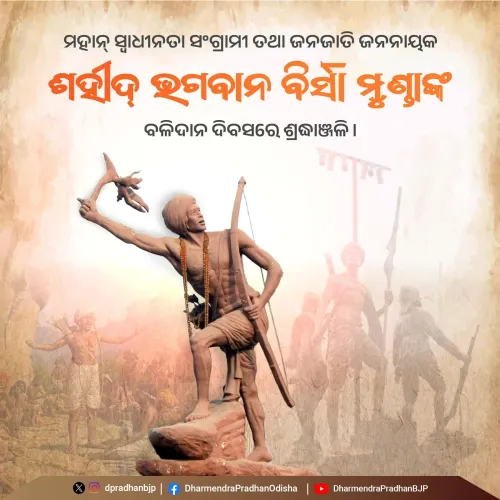
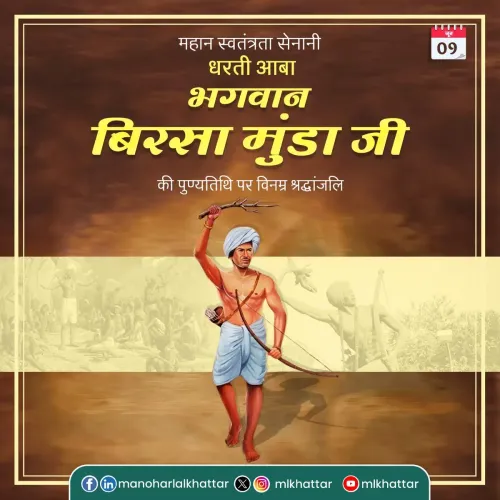
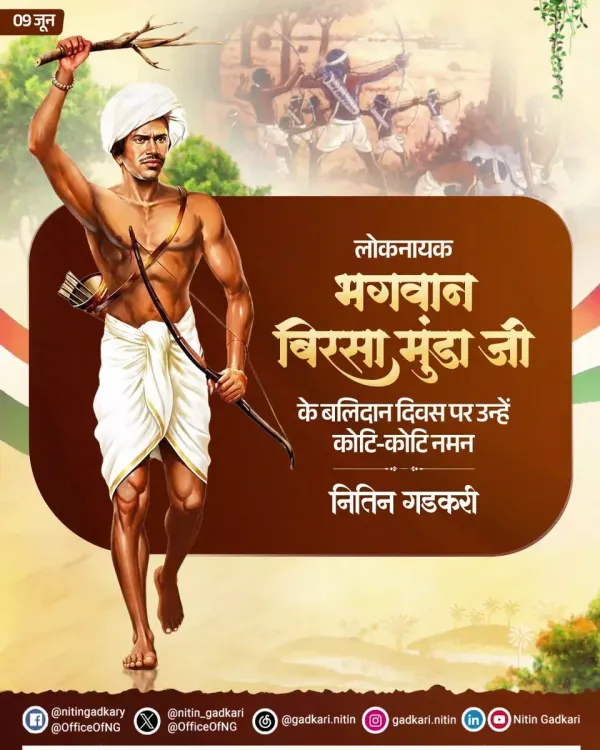
Gadkari pays tribute to Bhagwan Birsa Munda on Balidan Diwas
Synopsis
Union Minister Nitin Gadkari on 9 June 2026 paid homage to Bhagwan Birsa Munda on his martyrdom anniversary, honouring the 19th-century Munda tribal leader's rebellion against British land policies and his lifelong dedication to Adivasi rights and empowerment.
Key Takeaways
Nitin Gadkari posted a Hindi tribute on 9 June 2026 marking the Balidan Diwas of Bhagwan Birsa Munda .
Birsa Munda led the Munda Ulgulan rebellion against British land-alienation policies and died in Ranchi jail in 1900 .
The Union government declared 15 November as Janjatiya Gaurav Divas in 2021 to honour tribal freedom fighters.
Senior BJP leaders regularly mark Birsa Munda 's anniversaries as part of sustained outreach to Adivasi communities.
Adivasi communities constitute approximately 8.6 per cent of India's population, with large concentrations in Jharkhand , Chhattisgarh , and Odisha .
Gadkari's tribute precedes the main tribal commemoration cycle around Janjatiya Gaurav Divas in November .
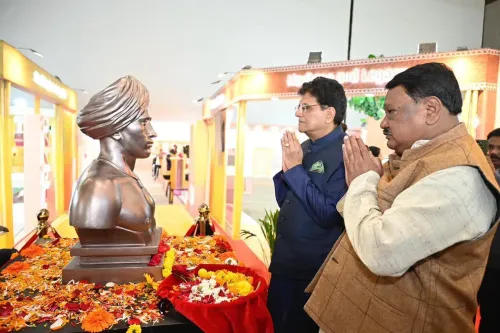
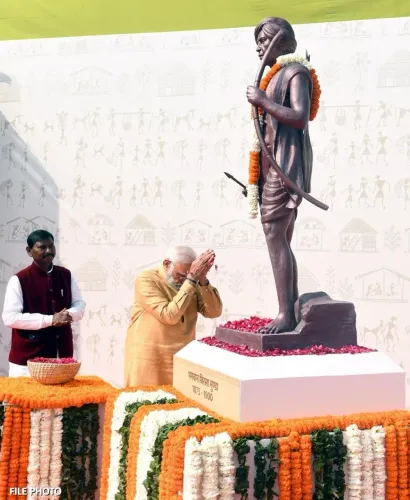
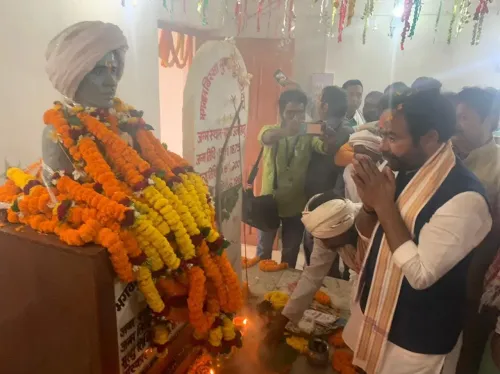
Union Road Transport and Highways Minister Nitin Gadkari on Tuesday, 9 June 2026 paid homage to tribal icon Bhagwan Birsa Munda on his martyrdom anniversary, honouring the 19th-century leader's lifelong struggle for tribal rights and empowerment against British colonial rule.
Context
Gadkari posted his tribute on X in Hindi, writing: 'Angrezon se aadivasi asmita ki ladai ladkar Bhagwan Birsa Munda ji ne apna poora jeevan deshahit aur vanvasi bhaaiyon ke adhikaron ke liye tatha sashaktikaran ke liye samarpit kar diya.' Translated, this reads: 'Fighting the British for tribal identity, Bhagwan Birsa Munda dedicated his entire life to the nation's interest and to the rights and empowerment of his forest-dwelling brothers.' He concluded with the words 'koti koti naman' — a salutation meaning 'countless reverent bows' — and the hashtags #BhagwanBirsaMunda and #भगवान_बिरसा_मुंडा.
Birsa Munda was born in the Munda tribal community of present-day Jharkhand in the late 19th century. He led the Munda Ulgulan — a rebellion against British land-alienation policies and missionary interference in tribal life — before his death in Ranchi jail in 1900 at approximately 25 years of age. He remains a revered figure across Adivasi communities in eastern and central India.
Policy Backdrop
The Union government formally institutionalised the commemoration of tribal heritage in 2021, declaring 15 November — Birsa Munda's birth anniversary — as Janjatiya Gaurav Divas (Tribal Pride Day). The decision was framed as recognition of the contributions of tribal freedom fighters to India's independence movement, placing figures such as Birsa Munda alongside mainstream nationalist icons in the official historical narrative.
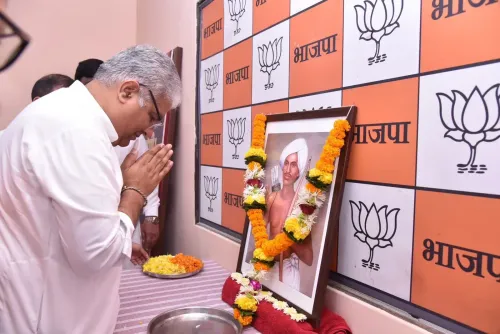
Senior leaders across the ruling BJP have consistently marked both the birth and death anniversaries of Birsa Munda with public tributes. This pattern has run alongside expanded government outreach in Scheduled Areas and states with large Adivasi electorates, including Jharkhand, Chhattisgarh, Odisha, and Madhya Pradesh, since 2014.
Stakeholders and Impact
Adivasi communities — who make up roughly 8.6 per cent of India's population according to the 2011 Census — hold Birsa Munda in near-divine regard, as reflected in the honorific 'Bhagwan' (God) prefixed to his name. His image hangs in the Central Hall of Parliament, a distinction that underscores his cross-party symbolic importance. Tribal groups in Jharkhand, in particular, observe his Balidan Diwas (martyrdom day) with community gatherings and cultural programmes.
Political messaging around Birsa Munda carries electoral weight in states where Scheduled Tribe reserved constituencies are decisive. Tributes from central ministers reinforce the government's positioning on tribal welfare schemes, including those targeting Particularly Vulnerable Tribal Groups (PVTGs).
What's Next
The larger, state-level commemorative calendar centres on Janjatiya Gaurav Divas on 15 November, when central and state governments typically announce or review schemes for tribal development. Observers will watch for any new central allocations or programme expansions targeting PVTG households and forest-rights settlements in the run-up to that date. Gadkari's tribute, issued on the martyrdom anniversary, signals continued high-level political attention to tribal heritage ahead of that cycle.
Point of View
Sustained BJP effort to weave tribal resistance narratives into the mainstream national freedom struggle story — a project that gained formal institutional backing with the creation of Janjatiya Gaurav Divas in 2021. By honouring Birsa Munda on his martyrdom day, senior ministers reinforce the party's positioning as the custodian of Adivasi heritage at a time when Scheduled Tribe constituencies remain electorally pivotal in Jharkhand, Chhattisgarh, and Odisha. The frequency and consistency of such tributes from cabinet-level figures suggests this is coordinated political messaging, not incidental commemoration. The pattern points to a broader arc in which tribal identity politics and welfare-scheme delivery are being fused into a single electoral and governance strategy.
NationPress
21 Sept 2026
Frequently Asked Questions
Who was Bhagwan Birsa Munda and why is he important?
Bhagwan Birsa Munda was a late 19th-century tribal leader from present-day Jharkhand who led the Munda Ulgulan rebellion against British land-alienation policies and died in Ranchi jail in 1900. He is revered as a deity-like figure across Adivasi communities, and his image hangs in the Central Hall of Parliament.
What is Balidan Diwas of Birsa Munda?
Balidan Diwas is the martyrdom anniversary of Bhagwan Birsa Munda, observed on 9 June each year to mark his death in British custody in 1900. Communities across Jharkhand and other tribal regions hold gatherings and cultural programmes on this day.
What is Janjatiya Gaurav Divas?
Janjatiya Gaurav Divas, or Tribal Pride Day, is observed on 15 November — Birsa Munda's birth anniversary — following a Union government declaration in 2021. It honours the contributions of tribal freedom fighters to India's independence movement.
Why does Nitin Gadkari pay tribute to Birsa Munda?
As a senior Union Minister and BJP leader, Gadkari regularly issues public tributes to historical figures on significant anniversaries. Commemorations of Birsa Munda by ruling-party leaders form part of a broader political outreach to Adivasi communities in states with large tribal electorates.
What was the Munda Ulgulan rebellion?
The Munda Ulgulan, meaning 'great tumult' or 'rebellion,' was an uprising led by Birsa Munda in the late 1890s against British land policies that dispossessed tribal communities of their forest rights. It is considered one of the significant tribal resistance movements of the colonial era in India.