Gadkari pays tribute to Pu. La. Deshpande on birth anniversary
Synopsis
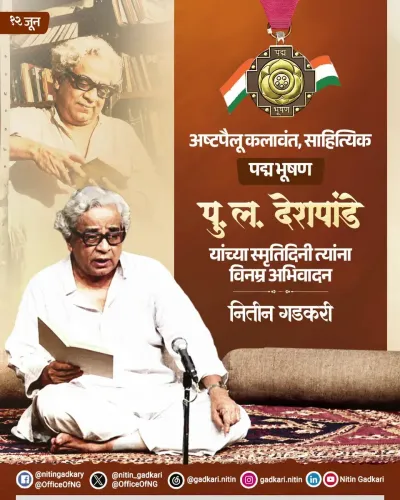
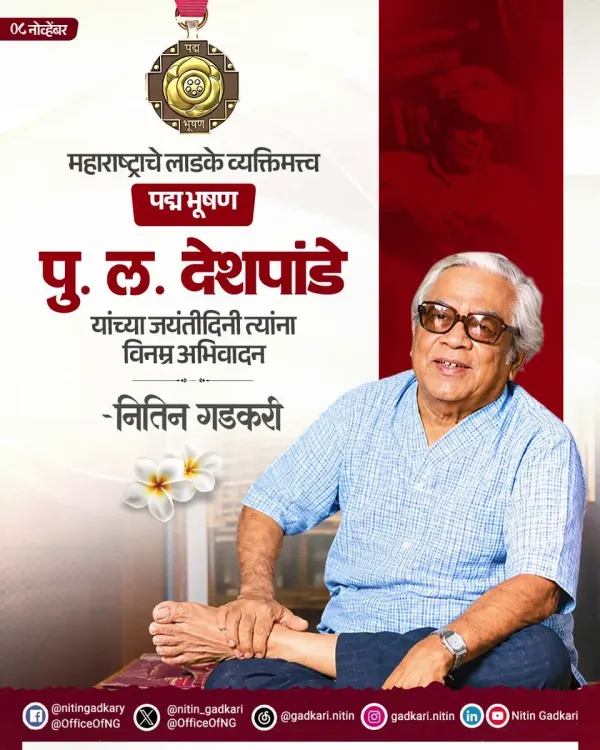
Union Minister Nitin Gadkari marked the birth anniversary of legendary Marathi polymath Pu. La. Deshpande on 8 November, honouring the Padma Bhushan and Maharashtra Bhushan laureate as an eight-faceted artist and Maharashtra's beloved personality.
Key Takeaways
Union Minister Nitin Gadkari posted a Marathi tribute to Pu.
Deshpande on his birth anniversary on 8 November 2026 .
Deshpande ( 1919–2000 ) was a writer, playwright, actor, musician, and humorist widely regarded as Maharashtra's most beloved cultural figure.
He was honoured with the Padma Bhushan , Sahitya Akademi Award , Sangeet Natak Akademi Award , and Maharashtra Bhushan during his lifetime.
Gadkari described him as an 'अष्टपैलू कलावंत' — an eight-faceted or all-round artist.
The tribute reflects a consistent practice of Union ministers acknowledging India's regional literary and cultural icons on significant anniversaries.
On the birth anniversary of one of Maharashtra's most beloved cultural figures, Union Road Transport and Highways Minister Nitin Gadkari offered a heartfelt salute to Pu. La. Deshpande — the writer, actor, musician, and humorist whose wit and warmth defined Marathi cultural life for generations.
Gadkari's post, shared on 8 November, paid homage in Marathi: 'जयंतीदिनी त्यांना अभिवादन' — 'a salute to him on his birth anniversary' — listing the towering honours Deshpande received across his lifetime: the Padma Bhushan, the Sahitya Akademi Award, the Sangeet Natak Akademi Award, and the Maharashtra Bhushan, Maharashtra's highest civilian honour.
The man Maharashtra called 'Pu. La.'
Purushottam Lakhsman Deshpande (1919–2000) was far more than any single label could hold. He wrote plays, novels, and essays; performed as an actor and a musician; and above all, he made Maharashtra laugh — with a rare warmth that never cut, never condescended. His sketches of ordinary Maharashtrian life, from the bumbling neighbour to the small-town dreamer, became cultural touchstones that Marathi households still quote by heart.
His literary output ranged from the beloved character sketches in Vyakti ani Valli to travel writing, radio plays, and film scores. The breadth of that output is precisely why Gadkari's post calls him an 'अष्टपैलू कलावंत' — an 'eight-faceted artist', the Marathi equivalent of a true polymath.
Why a BJP minister's Marathi tribute carries weight
Gadkari, himself a Nagpur-born Maharashtrian and a senior BJP leader, is one of the party's most prominent Marathi-speaking faces at the national level. His tribute sits within a broader, consistent pattern of Union ministers marking the birth anniversaries of regional cultural icons — a practice that reinforces the Centre's acknowledgement of India's linguistic and artistic diversity without crossing into policy territory.
For Maharashtra's Marathi literary community and cultural audiences, the gesture is a reminder that Pu. La. Deshpande's legacy remains a living reference point — not archived history, but a shared inheritance that crosses party lines and generations.
Pu. La. may have left in 2000, but every November, Maharashtra proves he never really did.
Point of View
A key electoral state. The choice to post in Marathi, name all four major awards, and use the affectionate term 'Maharashtra's beloved personality' is deliberate cultural signalling to a Marathi-speaking base. More broadly, such anniversary tributes by Union ministers form part of a soft-power pattern — using social media to acknowledge India's diverse literary and artistic heritage without legislative or budgetary commitment. Pu. La. Deshpande's cross-party appeal makes him a particularly safe and resonant choice for any politician seeking to connect with Maharashtrian sentiment.
NationPress
8 Nov 2026
Frequently Asked Questions
Who was Pu. La. Deshpande?
Pu. La. Deshpande (1919–2000), full name Purushottam Lakhsman Deshpande, was a celebrated Marathi writer, playwright, actor, musician, and humorist widely regarded as Maharashtra's most beloved cultural personality.
What awards did Pu. La. Deshpande receive?
He received the Padma Bhushan, the Sahitya Akademi Award, the Sangeet Natak Akademi Award, and the Maharashtra Bhushan — Maharashtra's highest civilian honour — among other distinctions.
Why did Nitin Gadkari pay tribute to Pu. La. Deshpande?
Gadkari posted a tribute on 8 November to mark Pu. La. Deshpande's birth anniversary, honouring his legacy as a multifaceted Marathi artist and cultural icon.
What does 'Ashtapailu Kalavant' mean in Marathi?
'अष्टपैलू कलावंत' means an eight-faceted or all-round artist — a term used to describe someone accomplished across multiple creative disciplines, which Gadkari applied to Pu. La. Deshpande.
When is Pu. La. Deshpande's birth anniversary?
Pu. La. Deshpande was born on 8 November 1919, and his birth anniversary is observed annually on that date by Marathi cultural communities across Maharashtra and beyond.