Is There a Greater Anti-National Act Than Vote Manipulation?
Synopsis
In a fiery Lok Sabha debate, Rahul Gandhi criticized RSS for attempting to seize control of India's institutions, declaring vote manipulation as the greatest anti-national act. He raised critical questions about the Election Commission's integrity, linking it to a broader concern over the erosion of democracy. This discussion highlights ongoing tensions between opposition and ruling parties in India.
Key Takeaways
Rahul Gandhi critiques RSS's influence.
Vote manipulation seen as anti-national.
Concerns about Election Commission's integrity raised.
Institutional capture spans education and investigative agencies.
Democratic safeguards under scrutiny amidst political tensions.
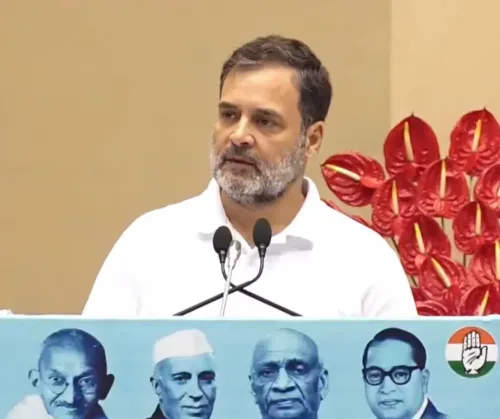
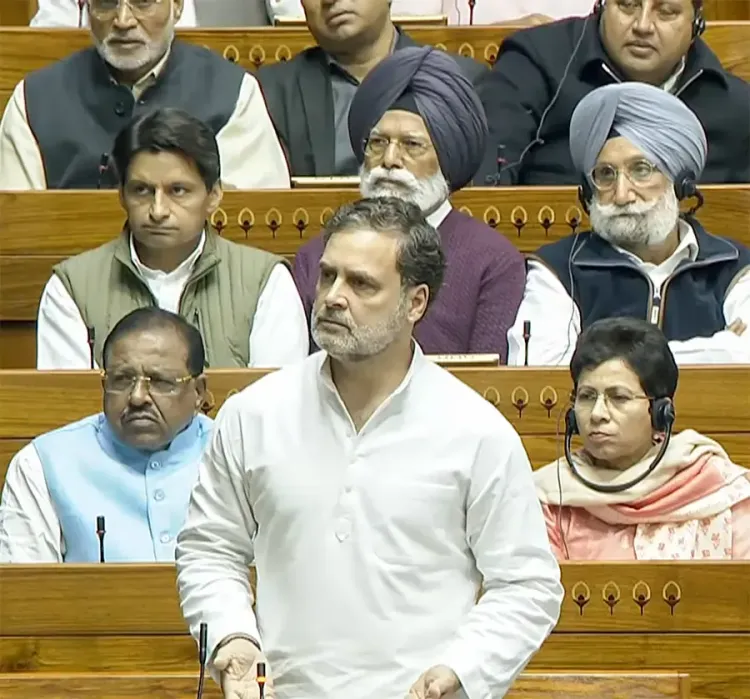
New Delhi, Dec 9 (NationPress) The Lok Sabha was engulfed in a heated debate as Congress MP Rahul Gandhi launched a scathing critique of the Rashtriya Swayamsevak Sangh (RSS), accusing it of deliberately attempting to dominate India's institutions. He stated that there is “no greater anti-national act than vote manipulation.”
During a discussion focused on electoral reforms, Opposition Leader Rahul Gandhi emphasized that “everything in India today has stemmed from the vote, and the RSS is on a mission to seize that power.”
His comments sparked loud protests from members of the ruling party, which led Speaker Om Birla to step in several times to maintain decorum. Gandhi accused the RSS, in alliance with the Bharatiya Janata Party (BJP), of eroding democratic institutions, starting with the Election Commission of India (ECI).
He identified three key areas of institutional takeover: education, investigative agencies, and the Election Commission.
To substantiate his allegations, he posed three critical questions: why was the Chief Justice of India removed from the selection panel for Election Commissioners? Why did the government grant unprecedented immunity to Election Commissioners in December 2023? And why is CCTV footage from polling stations disposed of after 45 days? He argued that these actions undermine transparency and facilitate manipulation.
“Currently, the Election Commission of India is colluding with those in power to influence elections,” he stated, questioning why both the Prime Minister and Home Minister are so keen on determining who serves as Election Commissioner.
He further asserted that investigative bodies like the Enforcement Directorate (ED), National Investigation Agency (NIA), and Central Bureau of Investigation (CBI) have been compromised, with bureaucrats being appointed to target dissenting voices.
In a poignant moment, Gandhi referenced history, recalling the assassination of Mahatma Gandhi on January 30, 1948, arguing that the RSS agenda began following the death of the Father of the Nation, aiming to dismantle his vision of an equitable India where institutions belonged to the populace. “These are uncomfortable truths that must be articulated,” he insisted amidst objections from the treasury benches regarding his comments on the RSS.
His statements were met with sharp rebuke from Parliamentary Affairs Minister Kiren Rijiju, who claimed Gandhi was deviating from the topic of electoral reforms. “He isn’t addressing anything relevant to electoral reforms,” Rijiju insisted, urging the Speaker to remind Gandhi to stay on topic.
Speaker Om Birla also interjected, advising Gandhi to keep his remarks focused on electoral reforms rather than making broad accusations against institutions.
Rahul Gandhi contended that the comprehensive capture of India’s institutional framework is part of a long-term strategy, citing universities as a case in point, alleging that “Vice Chancellors are appointed based not on merit or scientific inclination but on ideological loyalty.”
According to Gandhi, this manipulation results in a skewed electoral process, with campaigns designed to align with the Prime Minister’s agenda and irregularities such as a Brazilian woman appearing 22 times on the voter list in Haryana.
Despite ongoing interruptions, Gandhi maintained that these are truths that need to be brought to light. His remarks highlighted the opposition's concerns regarding the integrity of democratic safeguards, while the government insisted that the discussion should remain centered on electoral reforms.
Point of View
It is essential to recognize the gravity of Rahul Gandhi's statements regarding the RSS and the Election Commission. His allegations reflect a deep-seated concern among opposition parties about the integrity of democratic processes in India. While maintaining a balanced view, it is crucial to acknowledge the ongoing debates around electoral reforms and the potential impact on governance. The nation must remain vigilant in safeguarding democratic values and institutions.
NationPress
3 Oct 2026
Frequently Asked Questions
What did Rahul Gandhi accuse the RSS of?
Rahul Gandhi accused the RSS of systematically attempting to dominate India's institutions and declared that vote manipulation is the greatest anti-national act.
What areas did Gandhi identify as being affected by institutional capture?
Gandhi highlighted education, investigative agencies, and the Election Commission as key areas impacted by institutional capture.
What questions did Gandhi pose regarding the Election Commission?
He questioned the removal of the Chief Justice from the selection panel for Election Commissioners, the immunity granted to Election Commissioners, and the destruction of CCTV footage from polling stations.
How did the ruling party respond to Gandhi's remarks?
Members of the ruling party protested his statements, prompting Speaker Om Birla to intervene multiple times to maintain order during the debate.
What broader implications did Gandhi suggest regarding the capture of institutions?
Gandhi suggested that the wholesale capture of India's institutional framework is part of a long-term strategy, affecting the electoral process and democratic integrity.