Giriraj Singh Challenges Rahul Gandhi to Read RSS's History of National Service
Synopsis
Union Textiles Minister Giriraj Singh challenged Rahul Gandhi on the eve of Independence Day to study the RSS's history of national service, citing volunteer contributions during the 1971 war and Wayanad's flood and landslide disasters as evidence of the Sangh's century-long dedication to India.
Key Takeaways
Union Textiles Minister Giriraj Singh directly challenged Rahul Gandhi over his criticism of the Rashtriya Swayamsevak Sangh .
Singh cited RSS volunteer service during the 1971 Indo-Pakistani War as a key example of the Sangh's national contribution.
The Wayanad landslides and floods in Kerala were also referenced as evidence of the RSS's disaster-relief role.
Singh stated it would take Rahul Gandhi ' 100 years ' to understand the Sangh's dedication to the nation.
The post was published on August 14, 2026 — the eve of Independence Day — amplifying its political and symbolic weight.
The exchange continues a recurring BJP-Congress dispute over the RSS's historical and contemporary role in Indian public life.
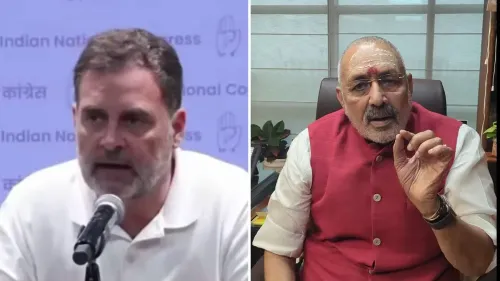
A sharp political salvo landed on the eve of Independence Day when Union Textiles Minister Giriraj Singh turned directly on Congress leader Rahul Gandhi, daring him to confront the Rashtriya Swayamsevak Sangh's century-long record of service before questioning the organisation's credentials.
Singh's post, in Hindi, pulled no punches: 'Rahul Gandhi, sangh par sawaal uthaane se pehle desh seva ka itihas padhne ki himmat to dikhaiye!' — 'Rahul Gandhi, before raising questions about the Sangh, at least show the courage to read the history of national service!' He then anchored his challenge to two concrete reference points: the 1971 Indo-Pakistani War and the devastating Wayanad landslides and floods in Kerala, arguing that RSS volunteers had placed their lives on the line at both moments. 'It will take you 100 years to understand the Sangh's dedication to the nation,' Singh wrote.
The 1971 War and Wayanad: Two Pillars of Singh's Argument
The 1971 war — the conflict that led to the creation of Bangladesh — is a recurring touchstone in BJP and RSS circles, where the Sangh's volunteer network is credited with auxiliary support roles during the campaign. Wayanad, the Kerala hill district that has suffered repeated and severe landslide and flood disasters in recent monsoon seasons, is invoked here as evidence of the RSS's contemporary disaster-relief footprint. Singh frames these not as isolated episodes but as proof of an unbroken tradition of what he calls 'rashtra-samarpan' — total dedication to the nation.
BJP vs Congress: A Recurring Battle Over the RSS's Legacy
This broadside fits a well-worn pattern. BJP ministers and spokespersons routinely respond to Congress criticism of the RSS with pointed defences of the organisation's claimed contributions to national life — in war, in disaster, and in social service. Rahul Gandhi has been one of the more persistent voices questioning the Sangh's role in India's independence movement and its relationship to the state. Singh's post signals that the ruling party intends to keep that argument alive, and to press it hard on the symbolically loaded eve of Independence Day, August 15.
The timing is deliberate. A challenge issued on the night of August 14 — when patriotism is at its most publicly visible — forces the opposition to either respond and risk appearing to litigate the RSS's legacy on Independence Day itself, or stay silent and cede the narrative ground.
Point of View
Emotionally resonant events (a victorious war, a natural disaster), Singh attempts to make any criticism of the RSS look like a dismissal of volunteer sacrifice. The exchange reflects a broader BJP strategy of defending the Sangh not just ideologically but through a narrative of tangible national contribution, a frame that is harder for the opposition to counter than a purely political rebuttal.
NationPress
29 Sept 2026
Frequently Asked Questions
Why did Giriraj Singh attack Rahul Gandhi over the RSS?
Singh challenged Rahul Gandhi to study the RSS's history of national service before criticising the organisation, citing RSS volunteer contributions during the 1971 war and Wayanad disasters as evidence.
What did Giriraj Singh say about the RSS and the 1971 war?
Singh argued that RSS volunteers placed their lives on the line during the 1971 Indo-Pakistani War, presenting this as a defining example of the Sangh's dedication to India.
What is the RSS's claimed role in the Wayanad disaster?
BJP leaders, including Singh, have cited RSS volunteers as active participants in relief work during the Wayanad landslide and flood disasters that have struck the Kerala district in recent years.
When did Giriraj Singh post this challenge to Rahul Gandhi?
The post was published on August 14, 2026 , the eve of India's Independence Day, giving the political challenge added symbolic timing.
What is the BJP-Congress dispute over the RSS about?
Congress leaders, including Rahul Gandhi, have periodically questioned the RSS's role in India's independence movement and its relationship with the state, while BJP leaders defend the Sangh's record of social service, disaster relief, and auxiliary national support.