Giriraj Singh calls opposition's EVM row 'opportunist politics', plans Begusarai march
Synopsis
Union Textiles Minister Giriraj Singh invoked the JP Movement to contrast principled democratic protest with what he called opportunist opposition politics over EVMs, and announced a 'Pratikar Padyatra' in Begusarai on 2 November 2026.
Key Takeaways
Union Textiles Minister Giriraj Singh posted on 1 November 2026 contrasting the 1974-75 JP Movement with current opposition protests.
He accused the opposition of spreading 'anarchy' by questioning EVMs and invoking 'regime change' after electoral defeats.
Singh called economic blockades and agitation-based confusion 'opportunist politics, not democratic protest.' A 'Pratikar Padyatra' (counter march) is scheduled in Begusarai, Bihar on 2 November 2026 .
Singh reaffirmed the BJP government's commitment to governance, poor welfare, and national service under PM Narendra Modi .
Opposition parties have questioned EVM reliability periodically since their national rollout in 2004 ; BJP has consistently defended them.
A padyatra in Begusarai and a sharp rebuke of the opposition — Union Textiles Minister Giriraj Singh drew a pointed contrast on Sunday, 1 November 2026, between the historic JP Movement of 1974-75 and what he described as the current opposition's 'desperate anarchism' born of electoral defeat.
Posting in Hindi on X, Singh argued that the Jayaprakash Narayan-led movement was a principled fight for democracy and press freedom, whereas today's opposition — he contended — is raising doubts about EVMs (Electronic Voting Machines) and invoking 'regime change' not out of democratic conviction, but out of frustration at the ballot box. 'ईवीएम पर सवाल उठाकर और रिजीम चेंज के नाम पर अराजकता फैलाने का प्रयास' — 'raising questions on EVMs and attempting to spread anarchy in the name of regime change' — was his exact charge.
JP Movement vs today's protests: Singh draws the line
The invocation of Jayaprakash Narayan is politically loaded. The 1974-75 JP Movement galvanised students and citizens against the Indira Gandhi government on grounds of corruption and authoritarianism, culminating in the imposition of the Emergency (1975-77) and eventually the 1977 general elections that swept Congress from power. Singh's argument is that lending the JP Movement's moral prestige to today's protests is historically dishonest — and that voters can see through it.
'Economic blockades and spreading confusion in the name of agitation is not democratic protest — it is opportunist politics,' he wrote. The phrasing signals a deliberate BJP effort to flip the opposition's democratic-legitimacy argument on its head: you are not JP Narayan, you are his antithesis.
'Pratikar Padyatra' rolls through Begusarai on 2 November
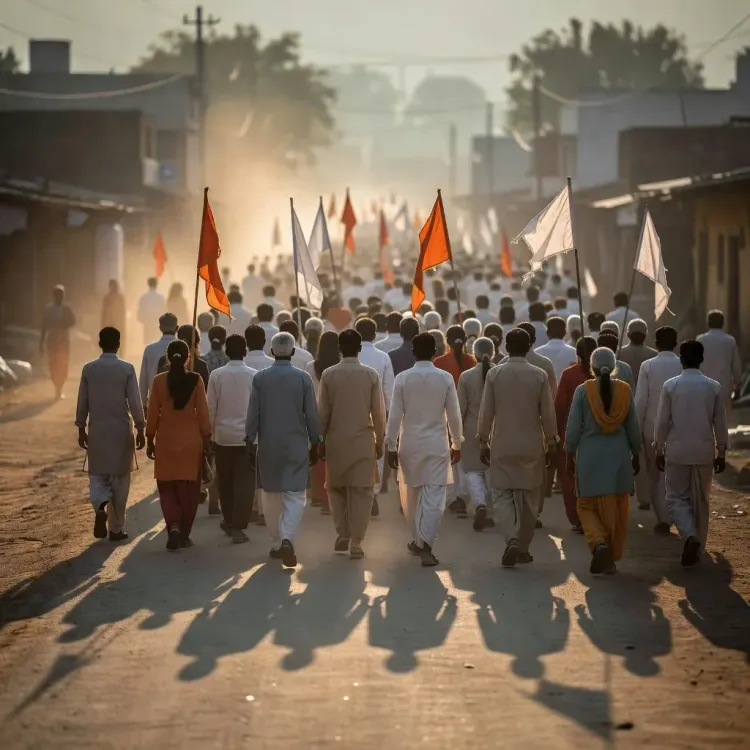
Singh announced that a 'Pratikar Padyatra' (counter march) will be held in Begusarai on Monday, 2 November 2026, as a direct response to what he termed the opposition's 'dual character and anti-development agenda.' Begusarai — often called Bihar's 'Lenin-nagar' for its Left political history — is Singh's own Lok Sabha constituency, making the choice of venue a pointed home-ground statement.
Opposition parties have periodically questioned EVM reliability since their nationwide rollout from 2004 onwards; BJP leaders have consistently defended the machines and the Election Commission's processes. Singh's post fits a well-established pattern, but the specific framing around JP Movement heritage — and the mobilisation of a public march — raises the register beyond routine social-media sparring.
Modi governance as the counter-narrative
Singh closed his post with an affirmation of purpose: 'Under the leadership of respected Prime Minister Shri Narendra Modi Ji, the resolve for national service, welfare of the poor, and good governance will continue uninterrupted.' The formulation is standard BJP messaging, but its placement — as a direct pivot after attacking the opposition — frames the march not just as a protest against critics, but as an active endorsement rally for the government's welfare agenda in a state where poverty-alleviation schemes carry significant political weight.
Bihar watches closely. Whether the Pratikar Padyatra generates counter-mobilisation from opposition groups in Begusarai will be the first test of how far this rhetorical battle translates into street-level politics.
Point of View
Singh is converting online messaging into ground mobilisation in a constituency with a historically strong Left presence, signalling that the BJP sees electoral optics in Bihar as live and contested. The JP Movement invocation is a high-stakes rhetorical gamble: it appropriates the moral authority of a foundational democratic moment while branding current protesters as its betrayers. How the opposition responds — on the streets and in the public discourse — will reveal whether Singh's framing resonates beyond the BJP base.
NationPress
1 Nov 2026
Frequently Asked Questions
What is the Pratikar Padyatra announced by Giriraj Singh?
The 'Pratikar Padyatra' is a counter march announced by Union Textiles Minister Giriraj Singh to be held in Begusarai, Bihar on 2 November 2026, as a response to what he described as the opposition's anti-development agenda and opportunist politics over EVM doubts.
What did Giriraj Singh say about the JP Movement?
Singh argued that the JP Movement of 1974-75 was a genuine fight for democracy and press freedom, and that comparing today's opposition protests — which he linked to electoral frustration and EVM allegations — to JP Narayan's legacy is historically dishonest.
Why is the BJP criticising EVM doubts raised by the opposition?
BJP leaders, including Giriraj Singh, argue that questioning EVMs after electoral defeats is 'opportunist politics' rather than principled democratic protest, and that the Election Commission's processes are credible. This has been a recurring BJP position since the nationwide EVM rollout from 2004.
What is Begusarai known for in Bihar politics?
Begusarai is a Lok Sabha constituency in Bihar represented by Giriraj Singh since 2019. It has a historically strong Left political tradition and is sometimes called Bihar's 'Lenin-nagar,' making it a symbolically significant venue for a BJP counter-mobilisation march.
What is 'regime change' politics that Giriraj Singh referred to?
Giriraj Singh used the phrase 'regime change' to characterise what he sees as opposition efforts to delegitimise election results and spread public unrest, arguing this amounts to an attempt to overturn democratic mandates through agitation rather than the ballot box.