Giriraj Singh hails India's $110 bn green revenue milestone
Synopsis
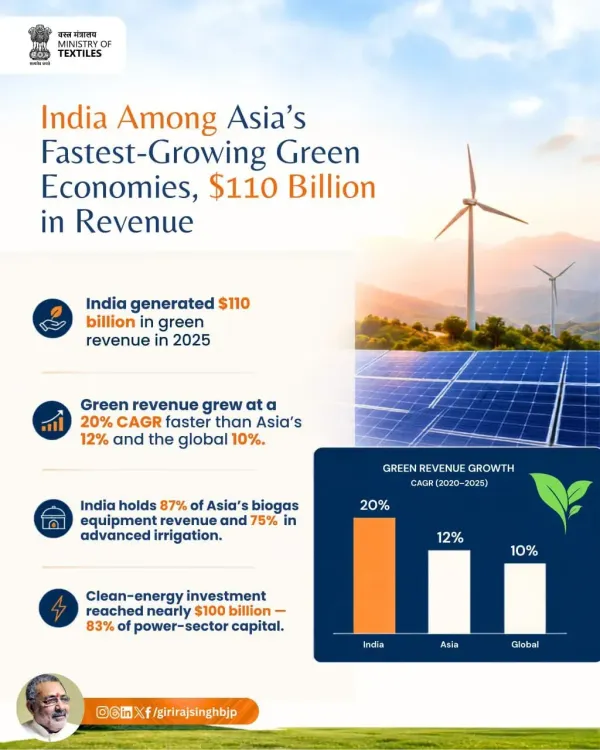
Union Textiles Minister Giriraj Singh has highlighted India's $110 billion green revenue and 20 per cent growth rate on X, attributing the milestone to PM Modi's leadership and linking it to the Viksit Bharat 2047 vision for a developed India.
Key Takeaways
Union Textiles Minister Giriraj Singh posted on 2 July 2026 citing India's $110 billion green revenue and 20 per cent growth rate in clean energy.
The post credits PM Narendra Modi 's leadership and ties the achievement to the Viksit Bharat 2047 national development vision.
India's Panchamrit strategy, announced at COP26 in 2021 , targets 500 GW of non-fossil fuel capacity by 2030 and net-zero by 2070 .
The National Green Hydrogen Mission , launched in 2023 with a Rs 19,744 crore outlay, underpins India's ambition to become a green hydrogen export hub.
The $110 billion figure and 20 per cent growth rate cited in the post have not been independently verified from official audited data as of the post date.
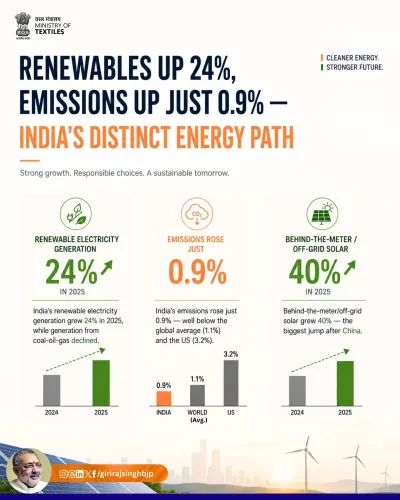
Union Textiles Minister Giriraj Singh on Thursday, 2 July 2026 credited Prime Minister Narendra Modi's leadership for India recording $110 billion in green revenue and a 20 per cent growth rate, calling it a marker of the country's rising global stature in clean energy and sustainable development.
Context
Posting on X, Singh wrote — 'स्वच्छ ऊर्जा और हरित विकास के क्षेत्र में भारत लगातार नए कीर्तिमान स्थापित कर रहा है' ('India is continuously setting new records in the field of clean energy and green development'). He attributed the achievement to Modi's stewardship and framed it as momentum toward the Viksit Bharat 2047 vision — the government's goal of transforming India into a developed nation by the centenary of independence.
The post carried hashtags #GreenGrowth, #CleanEnergy, #SustainableDevelopment, #NewIndia, and #ViksitBharat2047, signalling alignment with the ruling party's long-term economic and ecological messaging.
Policy Backdrop
India's clean energy push has deep policy roots. At COP26 in 2021, the government announced its Panchamrit strategy, committing to 500 GW of non-fossil fuel capacity by 2030 and net-zero emissions by 2070. These pledges set the legislative and investment architecture within which green revenue growth is now being tracked.
In 2023, the government launched the National Green Hydrogen Mission with an outlay of Rs 19,744 crore, targeting scaled domestic production and export potential. India has also steadily climbed global rankings in installed renewable capacity, propelled by large-scale solar and wind auctions backed by supportive tariff and land-use frameworks.
Stakeholders and Impact
The figures cited by Singh, if borne out, would represent a significant economic co-benefit alongside emission reduction — a narrative the government has consistently advanced to counter arguments that climate action imposes economic costs. Renewable energy developers, green hydrogen investors, and export-oriented clean-tech manufacturers stand to gain visibility and policy attention as these numbers enter public discourse.
For Bihar and other states with growing solar and agri-energy linkages, ministerial amplification of green growth data can also translate into investor interest and state-level scheme alignment, even where the minister's primary portfolio — textiles — does not directly intersect with clean energy.
What's Next
The government is expected to present updated renewable capacity addition figures through the annual Economic Survey, while revised green hydrogen tender outcomes for 2024-25 remain closely watched by the sector. Singh's post suggests that green growth metrics will continue to feature prominently in BJP's political communication ahead of any major policy or electoral cycle, reinforcing the Viksit Bharat 2047 framework as the overarching national narrative.
Point of View
Not just portfolio-specific communication. The $110 billion figure and 20 per cent growth rate, if verified by official sources, would represent a significant milestone, but their current circulation through social media posts rather than formal data releases invites scrutiny. This pattern of metric-driven nationalism — tying renewable achievements to civilisational ambition — is likely to intensify as India approaches key climate review milestones under its Panchamrit commitments.
NationPress
1 Oct 2026
Frequently Asked Questions
What did Giriraj Singh say about India's green energy growth?
Giriraj Singh posted on X that India has recorded $110 billion in green revenue with a 20 per cent growth rate, crediting PM Modi's leadership and calling it progress toward the Viksit Bharat 2047 vision.
What is Viksit Bharat 2047?
Viksit Bharat 2047 is the Indian government's vision to transform India into a fully developed nation by 2047, the centenary of independence, incorporating green growth, infrastructure, and economic targets.
What is India's Panchamrit climate strategy?
Announced at COP26 in 2021, India's Panchamrit strategy includes achieving 500 GW of non-fossil fuel energy capacity by 2030 and reaching net-zero emissions by 2070.
What is the National Green Hydrogen Mission?
Launched in 2023 with an outlay of Rs 19,744 crore, the National Green Hydrogen Mission aims to scale domestic green hydrogen production and position India as a global export hub.
Why is a Textiles Minister commenting on clean energy?
Cabinet ministers frequently amplify government-wide policy achievements on social media regardless of their specific portfolio, as part of coordinated political communication around flagship programmes like Viksit Bharat 2047.