Giriraj Singh flags $433 bn clean industry opportunity
Synopsis
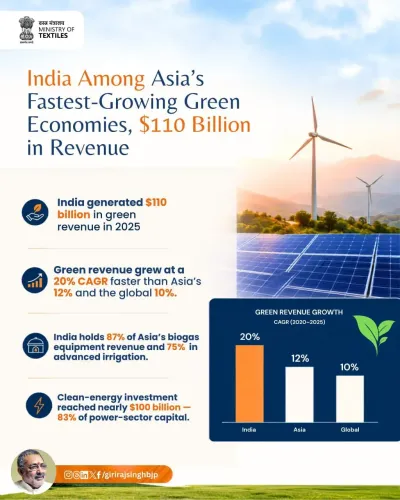
Union Textiles Minister Giriraj Singh on June 9, 2026, highlighted a report projecting a $433 billion investment opportunity in India's clean industry pipeline, signalling government interest in positioning India as a global hub for green capital and sustainable manufacturing.
Key Takeaways
Union Textiles Minister Giriraj Singh shared a report on June 9, 2026 projecting a $433 billion investment opportunity in India's clean industry pipeline.
India committed to net-zero emissions by 2070 at COP26 in Glasgow in November 2021 , providing the policy foundation for clean industrial growth.
Key sectors in the pipeline include green hydrogen , renewable energy equipment , and sustainable textiles .
The post was shared via the NaMo App , indicating deliberate amplification through BJP's own digital platform.
Stakeholders watching the report include clean technology investors , green manufacturers , and multilateral development banks tracking India's energy transition.
Upcoming Union Budget allocations and climate finance negotiations will be key indicators of whether the projected opportunity translates into concrete policy action.
Union Textiles Minister Giriraj Singh on Tuesday, June 9, 2026, shared a report highlighting a potential $433 billion investment opportunity in India's clean industry pipeline, amplifying the findings via the NaMo App on his official X account.
Context
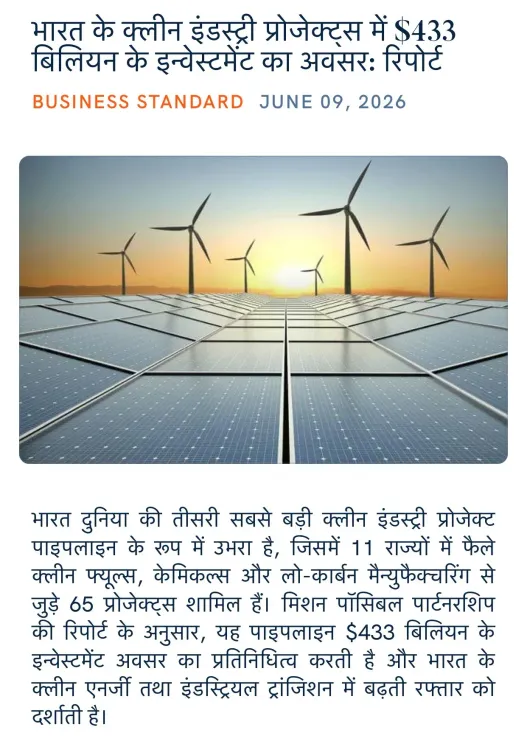
The minister shared a link to a report projecting that India's clean industry projects represent a $433 billion investment opportunity, framing the country as a major destination for green capital. The post, written in Hindi, described this as an 'इन्वेस्टमेंट का अवसर' ('investment opportunity') for clean industry projects in India. The amplification by a senior Union Cabinet minister signals the government's interest in elevating this narrative at the national level.
Policy Backdrop
India committed to achieving net-zero emissions by 2070 at the COP26 climate summit in Glasgow in November 2021. Since then, successive Union Budgets and production-linked incentive schemes have sought to align domestic and foreign capital with low-carbon industrial growth. Sectors such as green hydrogen, renewable energy equipment, and sustainable textiles have been identified as priority corridors for this transition.
The textiles sector, which Giriraj Singh oversees as Union Minister, is itself undergoing a sustainability push, with global buyers increasingly demanding green supply chains from Indian manufacturers. The minister's decision to highlight a clean industry investment report underscores the convergence between his portfolio and the broader climate-industrial agenda.
Stakeholders and Impact
The primary beneficiaries of a $433 billion clean industry pipeline would include domestic green manufacturers, clean technology investors, and state governments competing to attract sustainable industrial projects. Foreign institutional investors and multilateral development banks tracking India's energy transition would also be closely watching such projections. For workers and communities in industrial belts, a shift toward clean manufacturing could mean new employment patterns tied to low-carbon value chains.
The report's findings, if borne out, would represent one of the largest green investment opportunities in any single emerging market. India's combination of a large domestic market, competitive manufacturing costs, and existing renewable energy infrastructure makes it a credible candidate for such capital flows, analysts have noted in the broader context of global clean energy realignment.
What's Next
Attention will now turn to whether the Union Budget and upcoming climate finance negotiations translate this projected opportunity into concrete policy commitments — including allocations for green hydrogen corridors, sustainable textiles missions, and renewable manufacturing incentives. India's ability to absorb and deploy green capital at scale will depend on regulatory clarity, grid infrastructure, and the speed of environmental clearances for clean industry projects. The trajectory of such investments will also serve as a key indicator of how seriously India is tracking toward its 2070 net-zero pledge in the near term.
Point of View
Signalling that the BJP government wants to be seen as a steward of India's clean industrial transition ahead of climate and budget cycles. Giriraj Singh's choice to share this via the NaMo App, the party's own digital platform, suggests the messaging is as much about political branding as it is about policy intent. The $433 billion figure, if it gains traction, could become a reference point in upcoming budget discussions around green hydrogen and sustainable textiles. Ultimately, the gap between projected opportunity and actual capital deployment will define whether this amplification translates into durable industrial policy.
NationPress
24 Oct 2026
Frequently Asked Questions
What is the $433 billion clean industry investment opportunity in India?
A report cited by Union Textiles Minister Giriraj Singh projects that India's pipeline of clean industry projects represents a $433 billion investment opportunity, reflecting the country's push toward low-carbon manufacturing aligned with its net-zero goals.
What is India's net-zero target and when was it announced?
India pledged to achieve net-zero emissions by 2070, a commitment made at the COP26 climate summit held in Glasgow in November 2021.
Why did Giriraj Singh share a clean industry report?
As Union Textiles Minister and a senior BJP leader, Giriraj Singh shared the report to highlight India's green investment potential, signalling government interest in attracting domestic and foreign capital into clean industry sectors.
How does the textiles sector relate to India's clean industry push?
India's textiles sector, overseen by Minister Giriraj Singh, is under growing pressure from global buyers to adopt sustainable supply chains, making it a key part of the country's broader clean manufacturing transition.
What sectors are part of India's clean industry pipeline?
India's clean industry pipeline includes green hydrogen production, renewable energy equipment manufacturing, and sustainable textiles, all of which have been supported through production-linked incentive schemes and successive Union Budgets.