Giriraj Singh Hails Kargil Heroes, Cites Defence Indigenisation
Synopsis
On Kargil Vijay Diwas, Union Textiles Minister Giriraj Singh linked the 1999 martyrs' sacrifice to India's defence self-reliance drive, citing INS Mahendragiri, Pinaka guided rockets, and Kusha missile tests as milestones under the Atmanirbhar Bharat framework.
Key Takeaways
Giriraj Singh posted on July 26, 2026 — Kargil Vijay Diwas — connecting the 1999 martyrs' sacrifice to India's ongoing defence modernisation.
He cited INS Mahendragiri , a Project 17A indigenous stealth frigate, as a symbol of naval indigenisation.
The Pinaka Long Range Guided Rocket , developed by DRDO , was highlighted as evidence of advancing domestic strike capability.
Singh also referenced a successful test of the Kusha missile , a medium-range surface-to-air system under domestic development.
The post frames defence self-reliance under Atmanirbhar Bharat as the most fitting tribute to Kargil's fallen soldiers.
Union Textiles Minister Giriraj Singh on Sunday, July 26, 2026 — Kargil Vijay Diwas — paid tribute to the soldiers who died in the 1999 Kargil conflict, linking their sacrifice to India's accelerating push for self-reliant defence manufacturing. Singh pointed to recent indigenous milestones, including the INS Mahendragiri warship, the Pinaka Long Range Guided Rocket, and the Kusha missile, as proof of the country's growing strategic autonomy.
Context
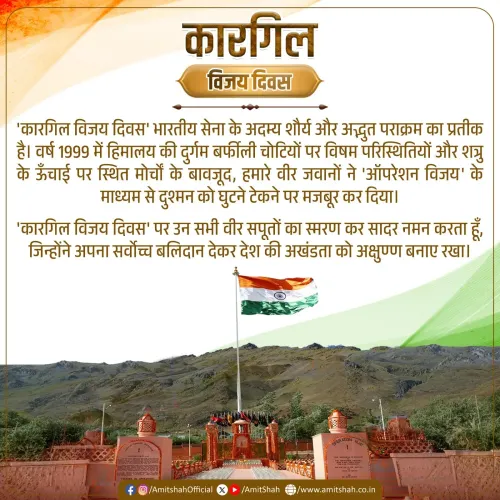
Kargil Vijay Diwas is observed every year on July 26 to mark India's victory in the high-altitude conflict with Pakistan in 1999, when Indian armed forces recaptured strategic peaks in the Kargil sector of Jammu and Kashmir. The day is a national occasion for political leaders across the spectrum to honour the fallen and reaffirm the country's security commitments. Singh's post, written in Hindi, stated: 'Kargil Vijay Diwas hamein un amar balidanon ki yaad dilata hai, jinhone Bharat ka mastak garv se ooncha kiya' — 'Kargil Vijay Diwas reminds us of those immortal sacrifices that held India's head high with pride.'
The minister went on to say that today's India is not merely remembering those sacrifices but is 'continuously strengthening its defence power' alongside that remembrance. He described indigenous systems as 'proof' of the direction India is moving in.
Policy Backdrop
Singh's remarks sit squarely within the Atmanirbhar Bharat (Self-Reliant India) framework, launched in May 2020, which set ambitious targets for domestic defence production and sought to reduce India's historically high dependence on foreign arms imports. The policy has since driven a series of indigenisation milestones across the army, navy, and air force.
INS Mahendragiri is part of the Project 17A stealth frigate programme, representing one of the Indian Navy's most significant indigenisation efforts in surface combatants. The Pinaka multi-barrel rocket launcher, developed by the Defence Research and Development Organisation (DRDO), has undergone successive upgrades since the early 2010s, with guided long-range variants substantially improving the Indian Army's stand-off strike capability. The Kusha missile, referenced by Singh as having completed a successful test, is a medium-range surface-to-air missile system under DRDO development.
Stakeholders and Impact
The primary beneficiaries of the indigenisation push are the Indian armed forces, who gain operationally relevant systems produced domestically, reducing supply-chain vulnerabilities. Defence public sector undertakings and private manufacturers under the defence industrial corridor programme also stand to gain from increased domestic orders as import substitution deepens.
For veterans and families of Kargil martyrs, ministerial statements that couple remembrance with visible capability upgrades carry symbolic weight, framing sacrifice as a catalyst for national resolve rather than a closed chapter of history. Singh's hashtags #KargilVijayDiwas and #सैन्य_शक्ति (Military Strength) signal that the message is aimed at a broad Hindi-speaking audience on the anniversary.
What's Next
Further DRDO trials and formal induction ceremonies for guided rocket systems and naval vessels are expected in the coming months, each of which is likely to generate fresh political commentary on India's self-reliance trajectory. Parliamentary sessions will also provide a platform for debates on whether indigenisation targets under Atmanirbhar Bharat are being met on schedule.
As India marks 27 years since the Kargil victory, the political consensus — cutting across party lines — of honouring those sacrifices through capability-building rather than commemoration alone appears to be deepening, with successive defence milestones being woven into the national narrative around the anniversary.
Point of View
Pinaka, and Kusha — rather than offering generic tribute, the post moves beyond ceremonial remembrance into a policy-signalling register. That a senior textiles minister, rather than a defence portfolio holder, is amplifying these defence milestones underscores how central the self-reliance theme has become to the broader BJP political messaging apparatus. The timing also sets up a recurring political rhythm: each Kargil anniversary becomes a ledger where new indigenous defence achievements are tallied against the 1999 sacrifice.
NationPress
26 Jul 2026
Frequently Asked Questions
What is Kargil Vijay Diwas and why is it celebrated on July 26?
Kargil Vijay Diwas is celebrated on July 26 every year to mark India's victory in the 1999 Kargil conflict , when Indian forces recaptured Pakistani-occupied peaks in Jammu and Kashmir. The date marks the official declaration of the operation's success.
What is INS Mahendragiri?
INS Mahendragiri is an indigenously built stealth frigate under the Indian Navy's Project 17A programme, designed and constructed in India as part of the country's naval self-reliance drive.
What is the Pinaka rocket system?
Pinaka is a multi-barrel rocket launcher system developed by DRDO for the Indian Army. Its long-range guided variant significantly extends the army's stand-off precision strike capability using domestically developed technology.
What is the Kusha missile?
The Kusha missile is a medium-range surface-to-air missile system being developed by DRDO to bolster India's indigenous air defence capability, referenced by Giriraj Singh as having completed a successful test.
What is Atmanirbhar Bharat in defence?
Atmanirbhar Bharat , launched in May 2020 , is a national initiative to boost domestic defence manufacturing, reduce arms import dependence, and build strategic self-reliance through indigenous design and production of military platforms.