Giriraj Singh pays tribute to Sharda Act architect Har Bilas Sharda
Synopsis
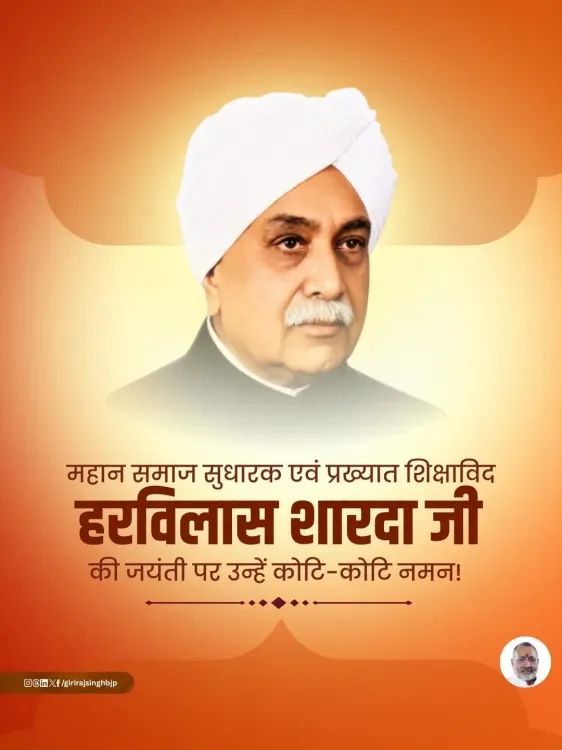
Union Textiles Minister Giriraj Singh paid tribute on X to social reformer Har Bilas Sharda on his birth anniversary, calling him the architect of the 1929 Sharda Act against child marriage and praising his contribution to education and social reform in India.
Key Takeaways
Union Textiles Minister Giriraj Singh paid tribute to social reformer Har Bilas Sharda on his birth anniversary.
The post described Sharda as the architect of the Sharda Act, which targeted child marriage.
The Child Marriage Restraint Act was passed by the Imperial Legislative Council in September 1929.
Sharda (1867-1955) was an Arya Samaj leader and member of the Central Legislative Assembly from Rajasthan.
The 1929 law was later superseded by the Prohibition of Child Marriage Act, 2006.
Union Textiles Minister Giriraj Singh on Wednesday paid floral tributes to social reformer and educationist Har Bilas Sharda on his birth anniversary, hailing him as the architect of the landmark Sharda Act that legislated against child marriage in colonial India. In a post on X, the senior BJP leader and Lok Sabha MP from Begusarai described the reformer as a powerful voice against social evils.
'Countless salutations on the birth anniversary of the great social reformer and renowned educationist Har Bilas Sharda ji, the architect of the Sharda Act, who raised a powerful voice against evil practices like child marriage,' the minister wrote, originally in Hindi. He added that Sharda's 'atulniya yogdan' (incomparable contribution) to the fields of social reform and education would continue to inspire generations.
Context
The tribute marks the birth anniversary of Har Bilas Sharda (1867-1955), a jurist, parliamentarian and Arya Samaj leader from Rajasthan who became one of the most influential social reformers in the run-up to Indian independence. Sharda served in the Central Legislative Assembly and used his platform to push for legal reforms targeting entrenched social practices.
His most enduring legacy is the Child Marriage Restraint Act, which Indian legislative history has come to know simply as the Sharda Act. Minister Singh's post explicitly anchors the reformer's memory to that single piece of legislation, framing it as a foundational moment in India's long campaign against child marriage.
Policy backdrop
The Child Marriage Restraint Act was passed by the Imperial Legislative Council in September 1929 after sustained advocacy by Sharda and allied reformers. It is widely regarded as the first central legislation in India to set a statutory minimum age of marriage, and it preceded a succession of later reforms that progressively raised those thresholds.
The Act has since been superseded by the Prohibition of Child Marriage Act, 2006, which strengthened enforcement provisions and made certain child marriages voidable at the option of the minor party. The legislative arc from 1929 to 2006 remains a frequently cited example of how colonial-era social reform laws have been progressively modernised by independent India's Parliament.
Stakeholders and impact
Posts of this kind, by sitting Union ministers, serve a dual function: they honour a historical figure while implicitly reaffirming the government's commitment to the social cause he championed. The primary beneficiaries of the legal architecture Sharda helped build remain women and girls, particularly in regions where child marriage persists despite legal prohibition.
For social reformers, educators and women's rights organisations, anniversaries such as this offer an annual reference point to renew public conversation. The Arya Samaj, with which Sharda was closely associated, also figures prominently in narratives around 19th and early 20th century social reform in northern and western India.
What's next
Indian ministers across parties routinely mark the birth anniversaries of pre-independence reformers through official social-media posts, linking contemporary political messaging to the lineage of social legislation enacted in the 1920s and 1930s. Minister Singh's tribute fits squarely within that pattern.
Observers will watch for any parliamentary debates or state-level enforcement drives concerning the Prohibition of Child Marriage Act, 2006 that may be announced around the anniversary period, as well as for renewed focus on girls' education — the second strand of Sharda's legacy that the minister chose to highlight.
Point of View
Giriraj Singh aligns the BJP's messaging with a legislative tradition that predates independence and cuts across ideological lines. The choice of Har Bilas Sharda — an Arya Samaj reformer from Rajasthan — also subtly anchors the party's social-reform credentials in a Hindu reformist lineage, even as the substantive law has since been replaced by the 2006 statute.
NationPress
21 Oct 2026
Frequently Asked Questions
Who was Har Bilas Sharda?
Har Bilas Sharda (1867-1955) was an Indian social reformer, educationist and Arya Samaj leader from Rajasthan who served in the Central Legislative Assembly and is best known as the architect of the 1929 Child Marriage Restraint Act.
What is the Sharda Act?
The Sharda Act is the popular name for the Child Marriage Restraint Act, 1929, the first central legislation in India to set a statutory minimum age of marriage, named after its main proponent Har Bilas Sharda.
Is the 1929 Sharda Act still in force?
No. The 1929 Child Marriage Restraint Act has been superseded by the Prohibition of Child Marriage Act, 2006, which strengthened penalties and made certain child marriages voidable.
What did Giriraj Singh say about Har Bilas Sharda?
Giriraj Singh called Har Bilas Sharda a great social reformer and renowned educationist who raised a powerful voice against child marriage, and said his contributions to social reform and education would continue to inspire.
When is Har Bilas Sharda's birth anniversary observed?
Har Bilas Sharda's birth anniversary is observed annually and is marked by tributes from political leaders, social reform organisations and Arya Samaj groups.