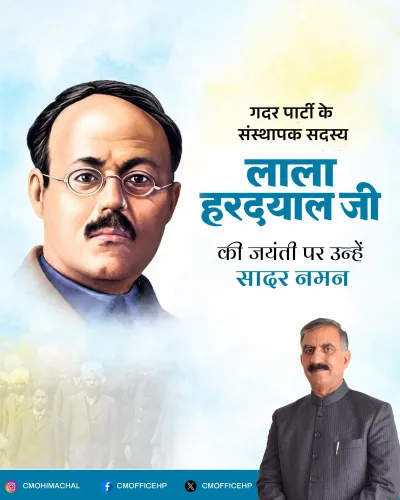
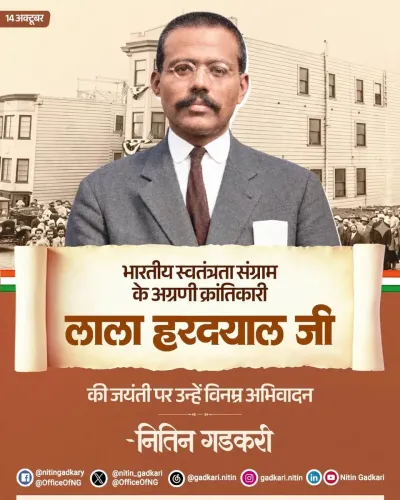
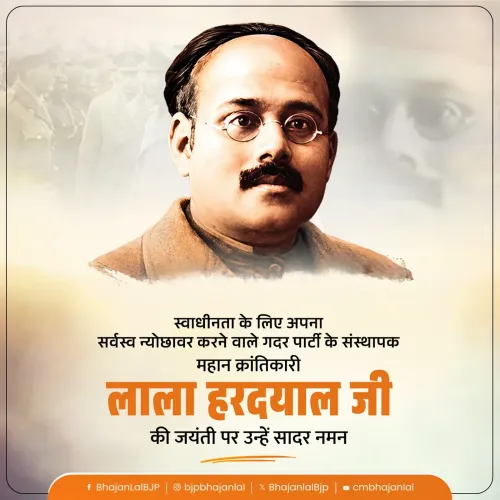
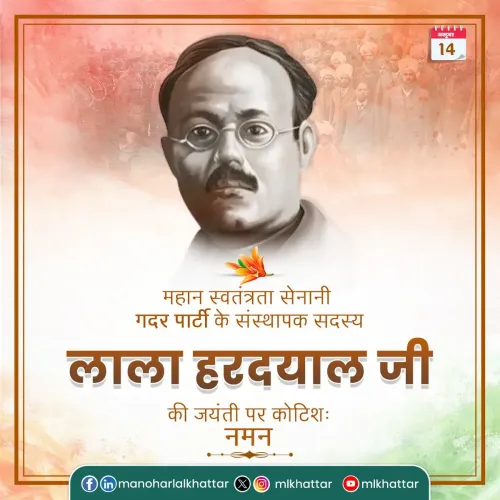
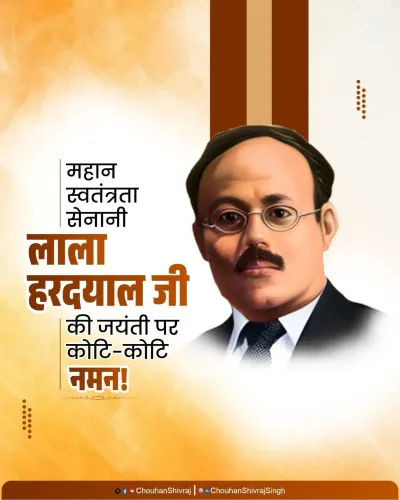
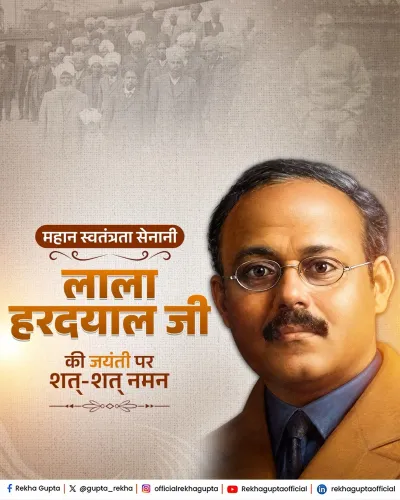
Giriraj Singh pays tribute to Lala Har Dayal on birth anniversary
Synopsis
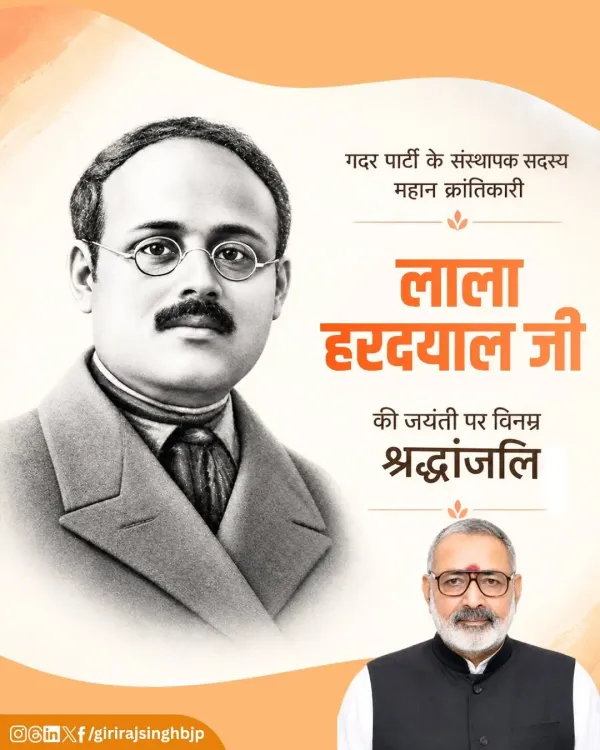
Union Textiles Minister Giriraj Singh honoured Lala Har Dayal, founder of the 1913 Ghadar Party, on his birth anniversary, calling his contribution to India's freedom struggle unparalleled and a lasting source of national inspiration.
Key Takeaways
Union Textiles Minister Giriraj Singh posted a tribute to Lala Har Dayal on his birth anniversary on October 14, 2026 .
Har Dayal was born in 1884 and became one of India's most prominent revolutionary freedom fighters.
He co-founded the Ghadar Party in San Francisco in 1913 to mobilise overseas Indians against British colonial rule.
Singh described Har Dayal's contribution as 'unparalleled' and said his patriotism would continue to inspire Indians.
BJP ministers regularly commemorate figures from India's armed nationalist movements alongside the mainstream freedom struggle.
On the birth anniversary of one of India's boldest revolutionary minds, Union Textiles Minister Giriraj Singh paused to honour the man who took India's freedom struggle to the streets of San Francisco — Lala Har Dayal, founder of the Ghadar Party, on Wednesday, October 14, 2026.
In his post, the minister offered a respectful salute — 'saadar naman evam vinamra shraddhanjali' (a respectful bow and humble homage) — to the revolutionary, writing that Har Dayal's 'unparalleled contribution and patriotism for the freedom of Mother India will always inspire the countrymen.'
The revolutionary who carried India's cause to California
Born in 1884, Lala Har Dayal charted an extraordinary path from Delhi's scholarly circles to the radical underground of overseas Indian activism. Brilliant, restless, and uncompromising, he gave up a promising academic career to dedicate himself entirely to the cause of independence. The British were never comfortable with him on any continent.
In 1913, he co-founded the Ghadar Party in San Francisco alongside Indian expatriates — labourers, students, and exiles — who had carried their resentment of colonial rule across oceans. The party's name, drawn from the Hindi word for 'mutiny' or 'revolt', was a deliberate invocation of 1857. Its newspaper reached Indian soldiers and workers from Canada to the Philippines, calling them home to rise against the British. It was a transnational insurrection, organised in newsprint and whisper networks, long before the internet existed.
Armed nationalism alongside the mainstream movement
The tribute fits a pattern familiar in Indian political life: BJP leaders regularly mark the birth and death anniversaries of pre-independence revolutionaries — particularly those from the Ghadar movement and other armed nationalist traditions — as part of a broader, deliberate effort to keep their legacies current in national memory. These figures, who operated outside the Congress-led mainstream, occupy a distinct but equally revered lane in India's freedom movement narrative.
Har Dayal represents that lane at its most dramatic — an intellectual who chose the barricade over the lecture hall, and whose work across the United States and Europe forced the British colonial establishment to track his movements across two hemispheres.
On a birth anniversary, the remembrance is brief. But the life it commemorates was anything but.
Point of View
Working-class character also carries quiet resonance in a moment when India's diaspora politics are increasingly prominent. These anniversary posts are routine in form, but deliberate in purpose.
NationPress
14 Oct 2026
Frequently Asked Questions
Who was Lala Har Dayal?
Lala Har Dayal was an Indian revolutionary born in 1884 who co-founded the Ghadar Party in San Francisco in 1913 to organise overseas Indians against British colonial rule. He is remembered as one of India's most intellectually accomplished and radical freedom fighters.
What was the Ghadar Party?
The Ghadar Party was a revolutionary organisation founded in 1913 by Indian expatriates in San Francisco . Its name means 'mutiny' or 'revolt' and it published a newspaper to mobilise Indian soldiers, labourers, and students worldwide to return home and fight against British rule.
Why did Giriraj Singh post a tribute to Lala Har Dayal?
October 14 marks the birth anniversary of Lala Har Dayal . Union Textiles Minister Giriraj Singh posted a tribute on X to honour his contribution to India's freedom movement, a practice common among BJP leaders on such anniversaries.
When was Lala Har Dayal born?
Lala Har Dayal was born in 1884 . His birth anniversary falls on October 14 , which is when Union Minister Giriraj Singh posted this tribute in 2026.
Where was the Ghadar Party founded?
The Ghadar Party was founded in San Francisco, United States , in 1913 by Lala Har Dayal and fellow Indian expatriates seeking to end British colonial rule in India.