Sonowal pays tribute to Assamese literary icon Lakshminath Bezbaruah
Synopsis
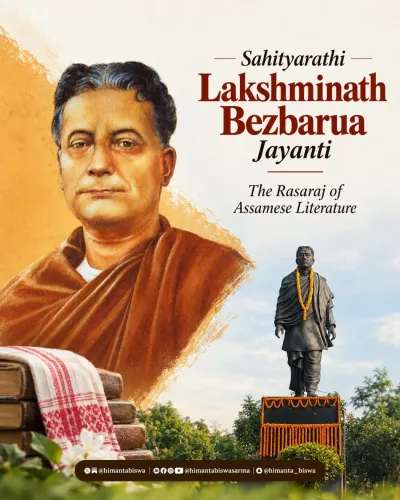
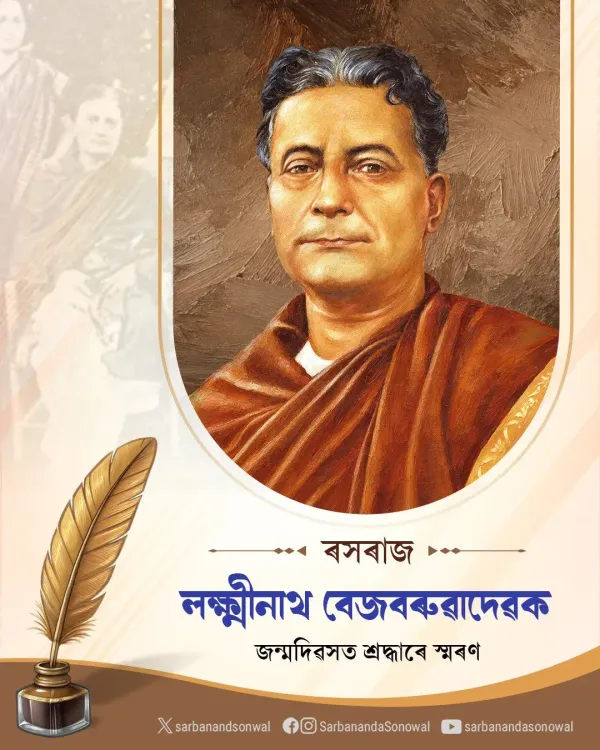
Union Minister Sarbananda Sonowal remembered Assamese literary giant Lakshminath Bezbaruah on his birth anniversary, calling the Rasaraj a helmsman of Assamese cultural awakening and praising his legacy of nationalism, satire, and social consciousness.
Key Takeaways
Union Ports Minister Sarbananda Sonowal posted an Assamese-language tribute to Lakshminath Bezbaruah on 14 October 2026 , his birth anniversary.
Bezbaruah (1864–1938) , known as Rasaraj , is considered the father of modern Assamese prose, excelling in poetry, drama, short stories, essays, and satire.
Sonowal credited Bezbaruah with giving Assamese language 'a powerful foundation' and instilling 'self-confidence and self-respect' in Assamese society.
The minister highlighted Bezbaruah's work in enriching Assamese thought and cultural consciousness across generations.
As a former Assam Chief Minister, Sonowal regularly marks regional literary anniversaries to underline his cultural ties to the Northeast.
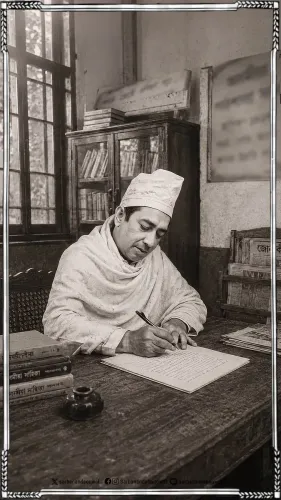
On the birth anniversary of Rasaraj Lakshminath Bezbaruah, Union Ports and Shipping Minister Sarbananda Sonowal paused to honour one of the towering architects of Assamese language and literature, offering a heartfelt remembrance on Wednesday, 14 October 2026.
Writing in Assamese, Sonowal recalled Bezbaruah as 'অসমীয়া জাতি আৰু ভাষা-সাহিত্যৰ জাগৰণৰ অন্যতম কাণ্ডাৰী' — 'one of the foremost helmsmen of the awakening of the Assamese nation and its language and literature.' He credited the literary legend with giving Assamese language and literature a powerful foundation through extraordinary talent, a deep sense of nationalism, and social consciousness.
The man who shaped a language and a people
Lakshminath Bezbaruah (1864–1938), revered by the honorific Rasaraj (King of Wit), is widely regarded as the father of modern Assamese prose. Across poetry, short stories, plays, essays, and satirical writing, he did something rare: he used the printed word not just to entertain, but to forge a collective identity for Assamese speakers at a time when the language itself was under pressure.
Sonowal noted that through these varied literary forms, Bezbaruah 'enriched the thought and consciousness of Assamese society' and instilled 'self-confidence and self-respect' in the national life of the Assamese people — a formulation that resonates as much today as it did in the late colonial era.
Sonowal, Assam's voice in Delhi's corridors
As a former Chief Minister of Assam and a senior BJP leader now serving at the Centre, Sonowal has consistently used public platforms to spotlight 19th- and 20th-century Assamese icons — a deliberate signal of his continued bond with the state's cultural fabric even as he steers national maritime policy from New Delhi.
The minister closed his tribute with a forward-looking note: that Bezbaruah's priceless creations will, 'generation after generation, keep reminding us of our responsibility toward Assamese language and culture.' It is at once a remembrance and a quiet call to duty.
Point of View
These gestures function as an ongoing thread of connection. More broadly, the framing of Bezbaruah as a symbol of 'self-confidence and self-respect' echoes the BJP's wider cultural-nationalist vocabulary, giving a literary tribute a quietly political undertone without crossing into overt partisanship.
NationPress
14 Oct 2026
Frequently Asked Questions
Who was Lakshminath Bezbaruah?
Lakshminath Bezbaruah (1864–1938), known by the title Rasaraj or King of Wit, was a pioneering Assamese writer credited with shaping modern Assamese prose through poetry, short stories, plays, essays, and satire. He is widely regarded as the father of modern Assamese literature.
Why is Lakshminath Bezbaruah called Rasaraj?
Bezbaruah earned the honorific Rasaraj, meaning 'King of Wit,' for his exceptional command of humour and satire, which he used to comment on Assamese society and culture during the colonial era.
What did Sarbananda Sonowal say about Bezbaruah?
Sonowal called Bezbaruah 'one of the foremost helmsmen of the awakening of the Assamese nation and its language and literature,' crediting him with instilling self-confidence and self-respect in Assamese society through his extraordinary literary work.
When is Lakshminath Bezbaruah's birth anniversary?
Lakshminath Bezbaruah's birth anniversary falls on 14 October. In 2026, Union Minister Sarbananda Sonowal marked the occasion with a public tribute on social media.
What is Sarbananda Sonowal's connection to Assam?
Sarbananda Sonowal is a senior BJP leader and former Chief Minister of Assam who now serves as Union Minister of Ports, Shipping and Waterways. He regularly uses public platforms to highlight Assamese cultural figures and anniversaries.