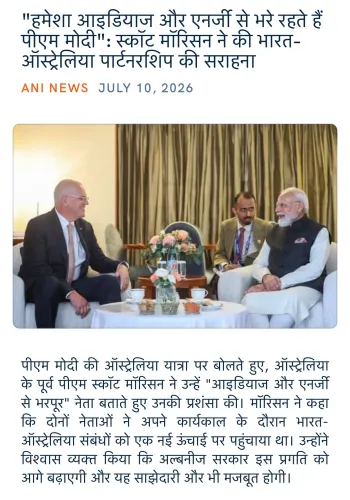
Giriraj Singh highlights PM Modi's Australia visit impact

Synopsis
Union Textiles Minister Giriraj Singh has highlighted PM Modi's Australia visit as a catalyst for new cooperation in culture, education, and business, building on the 2022 ECTA and years of deepening India-Australia ties under the Indo-Pacific framework.
Key Takeaways
Union Textiles Minister Giriraj Singh flagged PM Modi's Australia visit on 12 July 2026 as opening new directions for bilateral cooperation.
The post emphasised three pillars: culture, education, and business collaboration.
India and Australia signed the Economic Cooperation and Trade Agreement (ECTA) in April 2022 , liberalising tariffs and enabling expanded trade and education links.
PM Modi's 2014 visit to Australia was the first standalone Indian PM visit in 28 years , marking a reset in bilateral ties.
The Indian diaspora in Australia numbers over 7 lakh people, forming a key people-to-people bridge between the two nations.
The textiles sector, overseen by Singh's ministry, stands to benefit from improved bilateral trade terms with Australia.
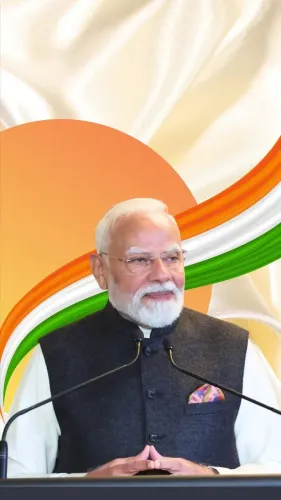
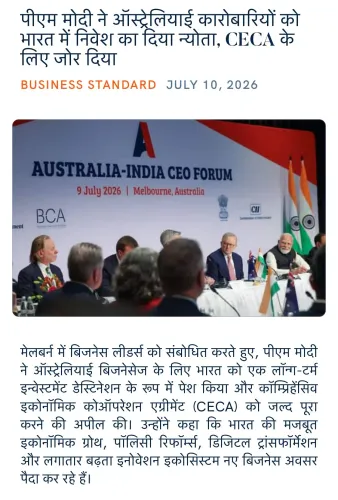
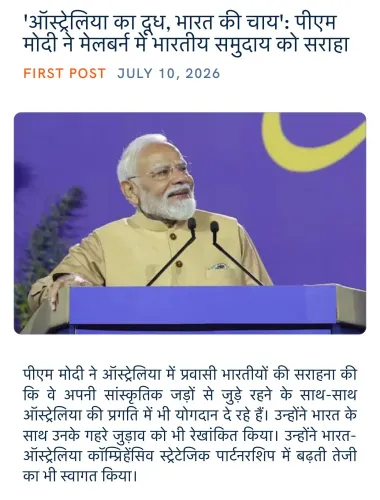
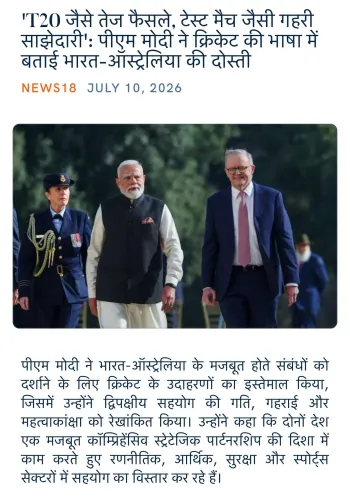
Union Textiles Minister Giriraj Singh on Sunday, 12 July 2026 shared a post on X highlighting how Prime Minister Narendra Modi's visit to Australia is opening new avenues for cooperation in culture, education, and business between the two nations.
Singh shared the update via the NaMo App, pointing to what he described as a fresh direction — 'संस्कृति, शिक्षा और बिजनेस सहयोग को नई दिशा' (new direction for culture, education, and business cooperation) — emerging from Modi's Australian engagement.
Context
India and Australia have steadily deepened bilateral ties over the past decade. PM Modi's first standalone visit to Australia in 2014 was the first by an Indian prime minister in 28 years, resetting a relationship that had long operated below its potential. Since then, the two countries have moved from a largely defence-and-diaspora footing to a broader strategic and economic partnership.
The India-Australia Economic Cooperation and Trade Agreement (ECTA), signed in April 2022, formalised this shift by liberalising tariffs on goods and services, creating a legal framework for expanded business and education linkages. The current visit builds on that foundation.
Policy Backdrop
India-Australia ties are anchored in the Quad framework — alongside the United States and Japan — which positions the relationship within a broader Indo-Pacific security and economic architecture. Beyond defence, both governments have invested in people-to-people links, including student mobility and diaspora engagement, as pillars of the partnership.
The ECTA opened preferential access for Indian textiles, pharmaceuticals, and gems among other sectors, while Australian universities gained easier pathways to recruit Indian students. Singh's ministry, which oversees the textiles sector, has a direct stake in the trade dimensions of any bilateral progress.
Stakeholders and Impact
Three communities stand to benefit most from the directions flagged by Singh. Business councils in both countries have been pushing for faster ECTA implementation and deeper investment flows. Students and universities see potential in expanded research collaborations and recognition of qualifications. Cultural organisations, including the large Indian diaspora in Australia estimated at over 7 lakh people, stand to gain from stronger institutional ties.
For the textiles sector specifically, improved trade terms with Australia represent an opportunity to expand garment and fabric exports, an area the ministry has been actively promoting under schemes aimed at boosting India's share of global textile trade.
What's Next
Observers will watch for follow-up announcements on education mobility schemes, business council outcomes, and parliamentary updates on ECTA implementation in the weeks after the visit. Any new bilateral agreements on research collaboration or investment facilitation would signal the depth of progress made during the engagement.
The visit underlines India's broader diplomatic posture of using high-level engagements to convert strategic goodwill into concrete sectoral gains — a pattern that has defined Modi's foreign policy outreach across the Indo-Pacific.
Point of View
Reinforcing the government's narrative of active foreign policy delivering economic dividends. The specific mention of culture, education, and business — rather than defence or security — signals an effort to broaden the public perception of India-Australia ties beyond strategic jargon. For Singh personally, flagging the business and trade angle aligns with his ministerial brief on textiles, a sector with real export stakes in the ECTA. The post fits a broader arc in which the ruling party uses bilateral visits to project economic competence ahead of domestic political cycles.
NationPress
12 Jul 2026
Frequently Asked Questions
What is PM Modi's Australia visit about in 2026?
PM Modi's Australia visit in 2026 focuses on deepening bilateral cooperation in culture, education, and business, building on the foundation laid by the 2022 India-Australia Economic Cooperation and Trade Agreement (ECTA).
What is the India-Australia ECTA?
The India-Australia Economic Cooperation and Trade Agreement (ECTA), signed in April 2022, is an interim trade pact that liberalised tariffs on goods and services, creating a framework for expanded business, textiles export, and education linkages between the two countries.
Why did Giriraj Singh post about PM Modi's Australia visit?
As Union Textiles Minister and a senior BJP leader, Giriraj Singh shared the update to highlight the diplomatic and economic dimensions of the visit, particularly its implications for trade and business cooperation relevant to his ministerial portfolio.
What is India's relationship with Australia in the Quad?
India and Australia are both members of the Quad alongside the United States and Japan, a grouping focused on Indo-Pacific security and economic cooperation that has helped elevate bilateral ties beyond their earlier defence-and-diaspora focus.
How large is the Indian diaspora in Australia?
The Indian diaspora in Australia is estimated at over 7 lakh people, making it one of the largest and fastest-growing migrant communities there, and a significant bridge for people-to-people ties between the two nations.