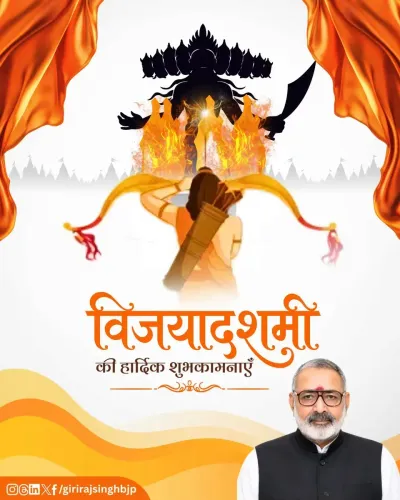
Giriraj Singh invokes Vijayadashami to target 'appeasement politics'
Synopsis
On Vijayadashami 2026, Union Textiles Minister Giriraj Singh called on citizens to unite against 'appeasement politics' and 'divisive forces', drawing on Dussehra's symbolism of vanquishing evil — a move that fits the BJP's long-running festival-cycle political messaging.
Key Takeaways
Giriraj Singh posted a Vijayadashami message on 21 October 2026 calling national-security compromise 'unacceptable.' He invoked the Dussehra metaphor of burning adharma to frame political opponents as 'divisive forces.' The post renewed use of the phrase 'tukde-tukde gang' , a recurring BJP rhetorical label for perceived anti-national voices.
BJP leaders have consistently aligned national-security messaging with major Hindu festivals since at least 2014 .
No specific policy announcement or scheme was referenced; the post is explicitly political and rhetorical in nature.
Opposition reactions and any coordinated follow-up from other BJP ministers will be the key signals to watch.
On the occasion of Vijayadashami 2026, Union Textiles Minister Giriraj Singh sharpened his political pitch — drawing a direct line between the festival's symbolism of vanquishing evil and what he called the need to decisively defeat 'divisive forces' in Indian public life.
Posting on Wednesday, 21 October 2026, the senior BJP leader and Lok Sabha MP from Begusarai, Bihar, wrote in Hindi: 'देश की सुरक्षा से समझौता स्वीकार्य नहीं!' — 'Compromise on the nation's security is unacceptable!' He called on citizens to unite against those who practice 'appeasement politics' and what he termed the 'tukde-tukde gang' — a phrase BJP leaders have long deployed as a label for voices they accuse of threatening national unity.
The Dussehra metaphor at the heart of the message
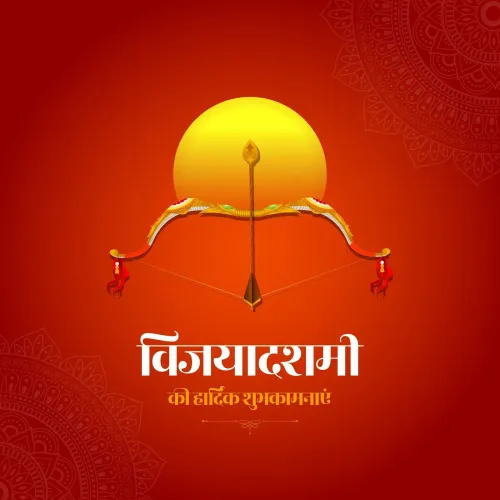
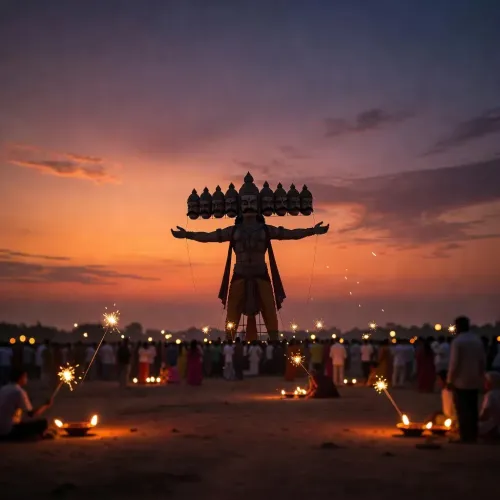
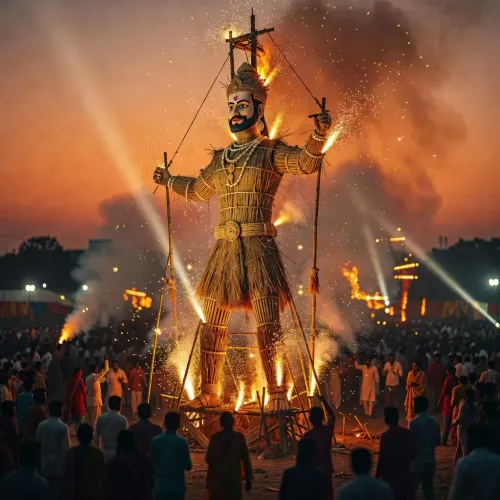
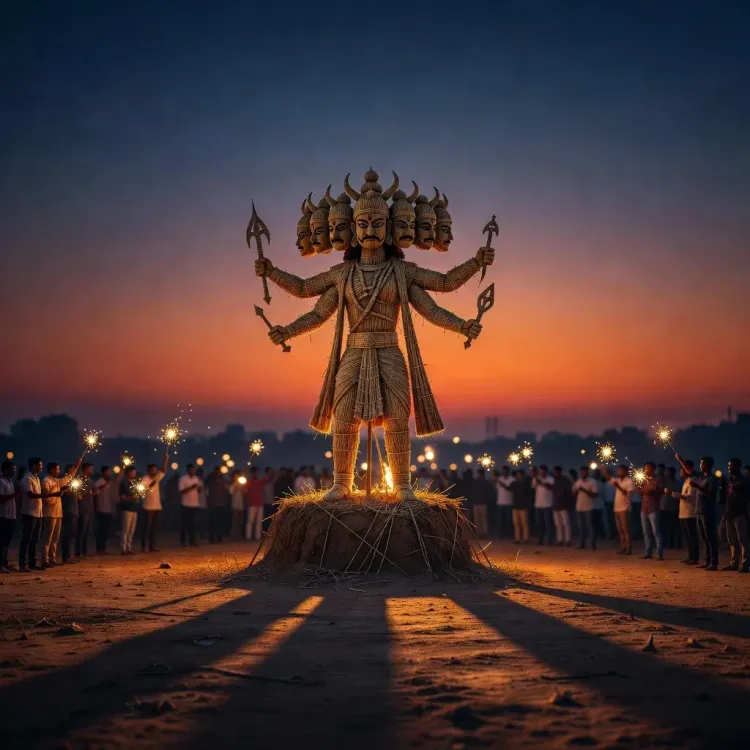
Vijayadashami, celebrated across India as the day Lord Ram vanquished the demon king Ravana, is traditionally read as the triumph of righteousness over adharma (unrighteousness). Singh invoked precisely that imagery: 'Just as Vijayadashami carries the message of the end of adharma, so too should the people deliver a decisive answer by completely burning down these divisive forces.'
The effigy-burning metaphor is deliberate and culturally loaded. By superimposing a political adversary onto Ravana, the message frames the upcoming political contest — whether electoral or rhetorical — as a moral reckoning, not merely a policy disagreement.
A recurring BJP playbook around festival cycles
This kind of messaging is not improvised. BJP leaders have consistently anchored national-security and unity narratives to the Hindu festival calendar since at least 2014, using Dussehra, Navratri, and Republic Day as amplification windows. Singh's post fits squarely in that pattern — pairing a culturally resonant moment with a call to consolidate voters around security and anti-appeasement themes.
The phrase 'tukde-tukde gang' originated in 2016 during protests at Jawaharlal Nehru University in New Delhi and has since become a recurring BJP rhetorical device against opposition figures and civil-society critics the party accuses of anti-national sympathies. Its reappearance in a Vijayadashami post signals that the minister intends it as a live electoral and cultural weapon, not a historical reference.
What the opposition and political watchers will track
Expect opposition parties — particularly the INDIA bloc — to push back, likely framing the statement as festival-season divisiveness rather than a security argument. Whether other senior BJP ministers amplify Singh's framing in the coming days will indicate whether this represents individual positioning or a coordinated party message ahead of any upcoming assembly cycles.
Giriraj Singh has long been one of the BJP's most combative communicators. His Vijayadashami post is a reminder that in Indian politics, every major festival doubles as a megaphone — and the volume is rising.
Point of View
The challenge is responding without appearing to defend the label. The broader pattern suggests this is coordinated messaging, not a one-off — making the next 48 hours of BJP ministerial communications worth watching closely.
NationPress
21 Oct 2026
Frequently Asked Questions
What did Giriraj Singh say on Vijayadashami 2026?
On 21 October 2026 , Giriraj Singh posted that compromise on national security is unacceptable and called for unity against 'appeasement politics' and the 'tukde-tukde gang', using Dussehra's symbolism of vanquishing evil to frame the message.
What is the 'tukde-tukde gang' that Giriraj Singh referred to?
The phrase 'tukde-tukde gang' originated during 2016 protests at Jawaharlal Nehru University and has been used by BJP leaders as a label for individuals or groups they accuse of harbouring anti-national sentiments.
Why do BJP leaders link Vijayadashami to political messaging?
BJP leaders have consistently used the Hindu festival calendar — especially Dussehra — since at least 2014 to amplify national-security and unity themes, framing political contests in terms of the festival's symbolism of good defeating evil.
Who is Giriraj Singh?
Giriraj Singh is the Union Minister of Textiles, a senior BJP leader, and Lok Sabha MP from Begusarai, Bihar , known for being one of the party's most assertive public communicators.
What is Vijayadashami and why is it politically significant?
Vijayadashami (Dussehra) marks the victory of Lord Ram over the demon king Ravana , symbolising the triumph of righteousness over evil — a narrative BJP leaders frequently adapt to frame political opposition in moral terms.