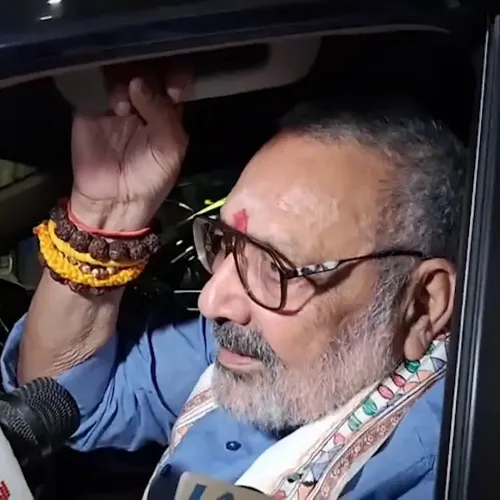
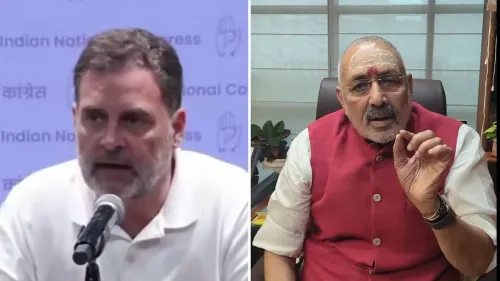
Giriraj Singh targets Rahul Gandhi over Vietnam trip
Synopsis
Union Textiles Minister Giriraj Singh took to X on 22 October 2026 to allege that Rahul Gandhi, after orchestrating failed domestic protests and 'vote-theft drama', has left for Vietnam to conspire with anti-national forces — escalating BJP's political offensive against the Congress leader.
Key Takeaways
Giriraj Singh posted a sharply worded attack on Rahul Gandhi on 22 October 2026 , accusing him of inciting domestic unrest before travelling to Vietnam .
The minister alleged Gandhi staged a 'vote-theft drama' and led violent protests before departing once those moves 'proved useless'.
Singh accused Gandhi of heading abroad to 'hatch a new conspiracy with anti-national forces' — without specifying any named group or event.
The shahzada ('prince') label, a long-standing BJP rhetorical device against Gandhi, featured centrally in the post.
The research notes that all specific claims in the post fall outside verifiable records and should be read as political allegations, not established facts.
Congress had not issued a formal public response at the time of publication.
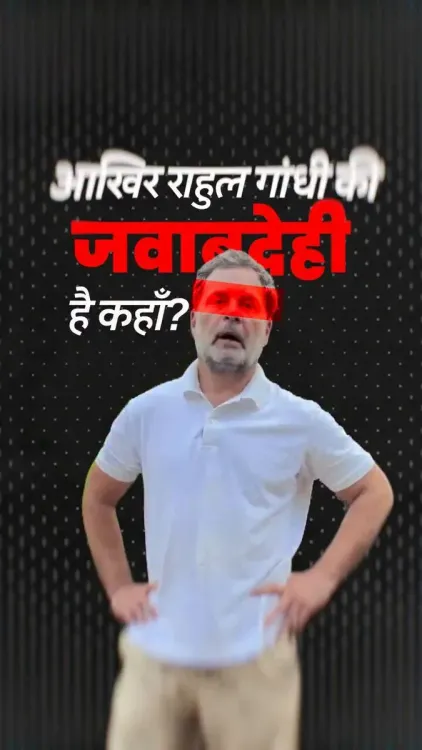
When the street protests stalled and the political pressure failed to land, Union Textiles Minister Giriraj Singh had a sharp question ready: where did Congress's 'shahzada' go? On Thursday, 22 October 2026, the senior BJP leader fired a pointed salvo on X, accusing Rahul Gandhi of orchestrating domestic unrest and then departing for Vietnam once every gambit fell flat.
Posting in Hindi, Giriraj Singh alleged that the Congress leader had 'created an atmosphere of chaos across the country, staged the drama of vote-theft, and took charge of violent protests' — only to grow 'tired, defeated and bored' and flee to Vietnam. The minister's punchline was blunter still: 'When every move here proved useless, he has now gone abroad to hatch a new conspiracy with anti-national forces.'The 'shahzada' taunt and BJP's standard playbook
The term shahzada — 'prince' — has been the BJP's preferred shorthand for Rahul Gandhi for over a decade, designed to paint him as a dynastic heir insulated from electoral accountability. Giriraj Singh's post slots neatly into that frame, amplifying it with a foreign-travel angle: the implication that overseas trips by opposition leaders serve a strategic, destabilising purpose rather than personal or diplomatic ones.
This is a well-worn rhetorical pattern in Indian politics. Senior ruling-party figures regularly use a leader's international travel — especially to countries with which India has complex ties — to suggest external meddling. The charge rarely requires specifics; the geography does the work.
Vietnam as the political backdrop
Vietnam maintains active diplomatic, trade and defence ties with India, making it an unlikely stage for anti-India intrigue by any objective measure. Yet the mere mention of a foreign destination in this framing is enough to trigger the 'anti-national forces' allegation. Congress had not issued an immediate on-record response to the minister's post at the time of publication.
Such exchanges tend to escalate when opposition street movements lose momentum — a period when the ruling side pivots from defending its record to attacking the credibility of those who challenged it. Whether parliamentary proceedings pick up the thread remains to be watched closely.
The clock on a Congress counter-punch has already started ticking.
Point of View
Loose enough to be unfalsifiable. This kind of rhetoric typically marks a phase where street pressure on the government has visibly eased, allowing the ruling side to shift from defence to aggressive narrative-setting. Whether Congress chooses to absorb the blow or escalate will signal how much electoral oxygen remains in whatever protest cycle preceded this post.
NationPress
22 Oct 2026
Frequently Asked Questions
What did Giriraj Singh say about Rahul Gandhi and Vietnam?
Giriraj Singh posted on X on 22 October 2026 alleging that Rahul Gandhi, after failing to sustain domestic protests and 'vote-theft' claims, travelled to Vietnam to conspire with what he called 'anti-national forces'.
Why does BJP call Rahul Gandhi 'shahzada'?
'Shahzada' means 'prince' in Hindi-Urdu and has been used by BJP leaders for years to characterise Rahul Gandhi as a dynastic political heir who benefits from the Congress family legacy rather than earned electoral merit.
Did Rahul Gandhi actually travel to Vietnam in October 2026?
Giriraj Singh's post alleges a Vietnam visit, but the specific claims in the post have not been independently verified from available records at the time of this report.
Is Rahul Gandhi's foreign travel legally or constitutionally restricted?
No. Members of Parliament in India are free to travel abroad. Allegations about foreign visits are a political argument, not a legal or constitutional matter.
How has Congress typically responded to BJP's 'anti-national' allegations against Rahul Gandhi?
Congress leaders have historically dismissed such charges as deflection from governance failures, framing them as evidence that the BJP feels threatened by Gandhi's political campaign rather than addressing substantive policy criticism.