Gita Gopinath warns AI boom faces valuation correction amid $1 trillion spend
Synopsis
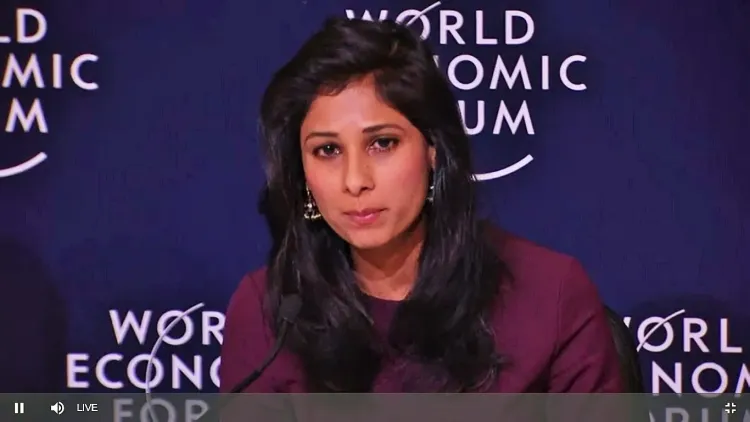
One of the world's most respected economists is ringing the alarm on AI valuations. Gita Gopinath, former IMF chief economist, says a correction is not just possible but personally expected — and warns that a collapse in US AI-driven wealth effects could push American growth to zero or below, with ripple effects across South Korea, Taiwan, and beyond.
Key Takeaways
Gita Gopinath , former IMF chief economist and Harvard professor, warned on 8 November 2026 that a global AI valuation correction is likely.
Nearly $1 trillion is projected to be invested globally in AI infrastructure in 2026 alone, primarily in the US , South Korea , and Taiwan .
She cautioned that in a hypercompetitive AI landscape, most firms cannot generate profits sufficient to justify their current valuations.
A sharp AI correction could drag US economic growth to zero or negative territory, given its reliance on AI-driven wealth effects.
Nvidia's circular capital flow — investing in AI labs that buy its own chips — was cited as a specific systemic risk.
Gopinath also warned professionals against 'cognitive surrender' — over-reliance on AI tools at the expense of independent thinking.
Former International Monetary Fund (IMF) chief economist Gita Gopinath has cautioned that the global artificial intelligence (AI) investment surge is heading toward a potential valuation correction, warning that companies pouring hundreds of billions into the technology may struggle to recoup their outlays in an intensely competitive market. Her remarks, made on 8 November 2026, have drawn fresh attention to the sustainability of AI-era valuations.
The Core Warning
Speaking on entrepreneur Raj Shamani's podcast, Gopinath — also a Harvard University professor — said she personally believes a reckoning is coming, even if its timing remains unpredictable. 'I personally think that there will be a correction. It's impossible to tell when that correction will happen,' she said.
Her concern centres on the scale of capital being deployed. Nearly $1 trillion is projected to be spent globally on AI infrastructure and development in 2026 alone, with the bulk of that flowing into the United States, South Korea, and Taiwan. Gopinath argued that at that level of investment, the returns simply may not add up.
Why Profits May Not Justify the Investment
'It's hard to explain how each of these labs and companies who are investing close to a trillion dollars now globally in AI just in 2026 will be able to make the kind of profits that are needed to recover that investment,' she said.
Gopinath further flagged the structural problem of hypercompetition. 'In a hypercompetitive landscape, it remains difficult to see how all competing firms can generate sufficient profits to justify their current valuations. A significant market correction in AI valuations could heavily impact the US economy — which relies heavily on AI-driven wealth effects — potentially dropping US growth to zero or negative territory,' she warned.
This comes amid sustained investor enthusiasm for AI stocks, with major indices in the US and Asia having logged multi-year highs partly on the back of AI-related earnings optimism. Critics and analysts have periodically drawn comparisons to the dot-com bubble of the late 1990s, and Gopinath's remarks lend fresh credibility to that concern.
The Nvidia Circular Risk
Gopinath offered a specific example to illustrate how interconnected — and therefore fragile — the AI ecosystem has become. She pointed to Nvidia, the listed chipmaker whose valuations have been closely tied to AI infrastructure demand, noting that the firm invests in AI labs, which in turn spend that capital purchasing Nvidia chips.
'If Nvidia were to collapse or any one of the AI labs were to collapse, that would have implications for Nvidia,' she said. The circular nature of this capital flow, she stressed, means a correction in one part of the AI ecosystem could rapidly spread across the broader market.
She also noted that high interconnectivity between major AI markets — the US, Taiwan, and South Korea — means a downturn in any one major player could ripple globally with speed.
Caution on 'Cognitive Surrender'
Beyond macroeconomic risks, Gopinath also addressed the workforce implications of AI adoption. She urged young professionals to resist what she called 'cognitive surrender' — the tendency to rely blindly on AI tools such as ChatGPT or Claude at the expense of developing independent analytical and problem-solving skills.
Notably, the warning arrives at a moment when enterprise AI adoption is accelerating sharply and several large technology firms are reporting record capital expenditure on data centres and model training. How markets respond to any early signs of earnings underdelivery from AI investments will be a critical test of whether Gopinath's correction scenario materialises.
Point of View
It deserves more than a news cycle. The deeper issue she surfaces — the circular capital structure linking Nvidia, AI labs, and chip revenues — is a classic bubble mechanic that mainstream financial coverage has largely glossed over. The question is not whether AI will transform the economy; it likely will. The question is whether today's valuations are priced on transformation timelines that are measured in decades, not quarters. If US growth does tip negative on an AI correction, the second-order impact on Indian IT — structurally exposed to US discretionary tech spend — could be sharper than markets are currently pricing.
NationPress
8 Nov 2026
Frequently Asked Questions
What did Gita Gopinath say about the AI investment boom?
Gita Gopinath, former IMF chief economist, warned that the global AI investment boom is approaching a potential valuation correction, arguing that it is hard to see how companies investing close to $1 trillion in AI in 2026 will generate profits sufficient to recover that outlay. She said she personally believes a correction will occur, though the timing is uncertain.
How much is being invested globally in AI in 2026?
Nearly $1 trillion is projected to be spent globally on AI infrastructure and development in 2026 alone, with the heaviest flows going into the United States, South Korea, and Taiwan. Gopinath argued this scale of investment is difficult to justify given the competitive dynamics of the AI industry.
Why did Gopinath single out Nvidia as a risk?
Gopinath highlighted Nvidia as an example of circular capital risk — the company invests in AI labs, which then use those funds to purchase Nvidia chips, creating a self-reinforcing loop. She warned that if Nvidia or any major AI lab were to collapse, it would have immediate knock-on consequences for the other, spreading a correction across the broader ecosystem.
What impact could an AI correction have on the US economy?
Gopinath warned that a significant AI valuation correction could drag US economic growth to zero or negative territory, given the US economy's heavy reliance on AI-driven wealth effects. She also noted that high interconnectivity between AI markets in the US, Taiwan, and South Korea means any such downturn could rapidly ripple worldwide.
What is 'cognitive surrender' and why did Gopinath raise it?
'Cognitive surrender' refers to the tendency of professionals to rely blindly on AI tools such as ChatGPT or Claude instead of developing independent problem-solving and analytical skills. Gopinath raised it as a caution for young professionals navigating an AI-transformed workforce, urging them to treat AI as an aid rather than a replacement for critical thinking.