Can the Government Really Triple the Cooperative Sector's Contribution to National GDP?
Click to start listening
Synopsis
The Earth Summit 2025–26 opens in Gandhinagar, where Union Minister Amit Shah outlines ambitious plans to enhance India's rural economy and triple the cooperative sector's impact on GDP. With participation from thousands, the summit aims to drive innovation and empowerment across rural India.
Key Takeaways
- Focus on rural economy: The summit aims to empower rural innovation to enhance productivity.
- Tripling GDP contribution: The government plans to significantly increase the cooperative sector's economic impact.
- Digital integration: Launch of NABARD's 'Sahakar Saathi' digital suite for cooperative banks.
- Future summits: The next Earth Summit will be held in Delhi, pushing further initiatives.
- Broad participation: Over 10,000 delegates, including corporates and startups, attended the summit.
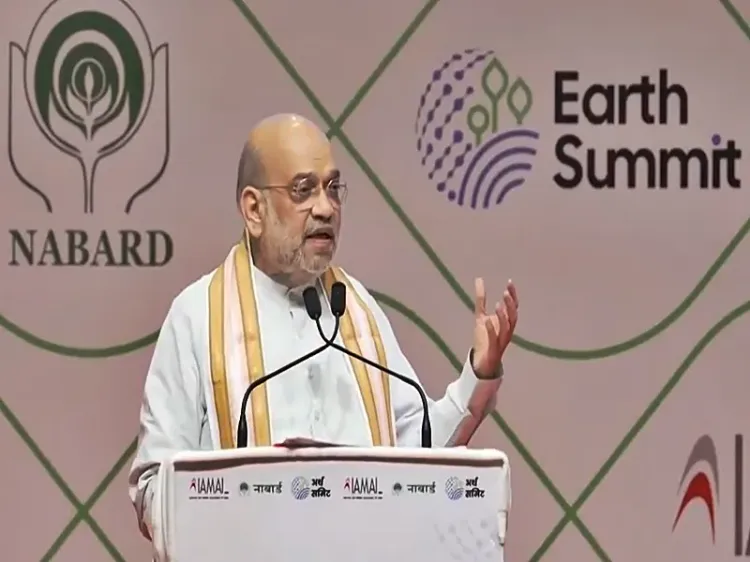
Gandhinagar, Dec 5 (NationPress) - On Friday, Union Home and Cooperation Minister Amit Shah, alongside Gujarat Chief Minister Bhupendra Patel, officially opened the two-day Earth Summit 2025–26 at Mahatma Mandir.
In his address, Shah emphasized that the Earth Summit series aims to establish India's rural economy as a vital component of the national economy.
This summit, organized in collaboration with NABARD and the Internet and Mobile Association of India (IAMAI), includes an extensive expo that dignitaries inaugurated before touring various stalls.
Notably, this second edition is taking place in Gujarat, the birthplace of Mahatma Gandhi, who believed that India's progress is incomplete without the upliftment of its rural areas.
Shah highlighted that the sectors of agriculture, animal husbandry, and cooperation have been overlooked for decades post-Independence.
He noted that since 2014, under the leadership of Prime Minister Narendra Modi, these sectors have seen a revival.
To enhance their development, the total budget allocated to the Ministries of Rural Development, Agriculture, and Cooperation has surged threefold, from Rs 1.02 lakh crore in 2014 to over Rs 3.15 lakh crore in 2025–26.
Shah reiterated the nation’s commitment that by the time India marks a century of Independence, it should emerge as a global leader in all sectors. This vision for a fully developed India is achievable only when every citizen is empowered. To facilitate this, the government plans to set up at least one cooperative society in each panchayat and aims to boost the number of active cooperative members to over 50 crore, thereby tripling the cooperative sector’s contribution to India's GDP.
Under the theme "Empowering Rural Innovation for Global Change", Shah stated that productive discussions, actionable solutions, and grassroots innovations can improve rural productivity, enhance citizen welfare, and build long-term economic durability. He expressed optimism that the summit's results would tackle significant structural issues faced by the rural economy.
He announced that the third edition of the Earth Summit is scheduled for next year in Delhi, after which a detailed roadmap for bolstering India's rural economy and cooperative movement will be rolled out nationwide. The summit has already attracted more than 10,000 delegates, 1,200 corporates, 500 expert speakers, 300 startups, 250 exhibitors, and over 50 investors, along with more than 30 workshops and masterclasses.
Shah also launched NABARD's 'Sahakar Saathi' digital suite as part of the Sahakar Saathi initiative, offering over 13 modern services, including Sahakar Setu and Sangrah Saathi, which aim to unify rural, district, and urban cooperative banks under a single digital framework. He stated that this will provide cooperative banks with technology comparable to private banks, aiding in loan recovery, legal documentation, KYC compliance, and future services like e-Kisan Credit Cards.
Discussing successful initiatives in Gujarat's Banaskantha and Panchmahal districts, Shah mentioned the 'Cooperation Among Cooperatives' model, which has significantly increased low-cost deposits by having all cooperative societies keep their funds with cooperative banks. After refining policies, this model will be applied nationwide.
He also mentioned India's swift progress in natural farming, now embraced by 49 lakh farmers. To legitimize their products globally, the government is developing a national organic testing network in collaboration with India Organics and Amul Organics.
India is projected to capture over 20 percent of the global organic market by 2030 and 40 percent by 2035, he noted.
Shah highlighted that Cooperative Taxi services, currently being trialed in Delhi with over 51,000 driver registrations, are expected to become the nation's largest taxi network within two years. Cooperative Insurance services will follow, generating employment opportunities at the village level.
Gujarat Chief Minister Bhupendra Patel described the summit as timely and in line with the state's objectives of strengthening rural economies through agriculture, innovation, human development, and cooperative strength.
He showcased Gujarat’s initiatives in financial inclusion, circular economy, green growth, climate resilience, natural farming, dairy development, and rural progress led by women—all embodying the cooperative ethos envisioned by India's first Cooperation Minister, Amit Shah.
At the event, several significant releases were introduced, including the 'Sahakar Saathi' digital services, NABARD's State Focus Paper for Gujarat 2026–27, and the NABARD-BCG research report titled "The Future of Rural Banking".
The ceremony was attended by senior officials from both the Central and state governments, leaders from cooperative banking, industry representatives, and a large audience of farmers and cooperative sector stakeholders.
Point of View
A crucial pillar for rural development. As India moves towards its centenary of independence, the focus on empowering citizens and enhancing rural economies is commendable. Such initiatives will play a significant role in shaping a sustainable and inclusive future for the nation.
NationPress
05/12/2025
Frequently Asked Questions
What is the Earth Summit 2025–26?
The Earth Summit 2025–26 is an initiative aimed at enhancing India's rural economy and cooperative sector, featuring discussions and workshops to foster innovation and empowerment.
Who inaugurated the Earth Summit?
The Earth Summit was inaugurated by Union Home and Cooperation Minister Amit Shah and Gujarat Chief Minister Bhupendra Patel.
What are the goals of the government regarding the cooperative sector?
The government aims to establish at least one cooperative society in every panchayat and increase active cooperative members to over 50 crore, tripling the sector’s contribution to India's GDP.
What significant services were launched at the summit?
NABARD's 'Sahakar Saathi' digital suite was launched, providing modern services to unify cooperative banks under one digital platform.
When will the next Earth Summit take place?
The third edition of the Earth Summit is scheduled for next year in Delhi.