CM Bhupendra Patel Leads Gujarat's Biodiversity Drive
Synopsis
The Chief Minister's Office of Gujarat on 22 May 2026 reaffirmed CM Bhupendra Patel's commitment to biodiversity conservation and ecosystem balance, highlighting the state's resolve to protect and enrich its diverse wildlife and natural habitats under the 'Gujarat Always Ahead' banner.
Key Takeaways
The Chief Minister's Office of Gujarat posted on 22 May 2026 reaffirming the state's biodiversity conservation commitment.
Chief Minister Bhupendra Patel is identified as the driving force behind Gujarat's nature-balance initiatives.
Gujarat's biodiversity assets include the Gir Forest National Park , home to the world's only wild Asiatic lion population, and extensive coastal mangroves.
The state's approach operates within India's Biological Diversity Act of 2002 and national commitments under the Convention on Biological Diversity .
Forest communities and wildlife conservationists are the primary stakeholders affected by Gujarat's biodiversity policies.
Further scheme announcements or protected-area expansions are anticipated as part of the ongoing 'Gujarat Always Ahead' communications series.
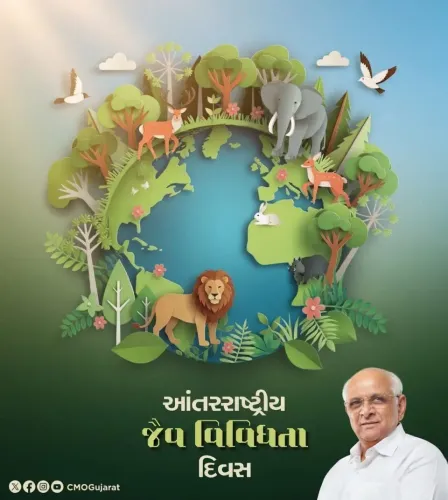
The Chief Minister's Office of Gujarat on Friday, 22 May 2026 highlighted the state government's commitment to preserving and nurturing diverse ecosystems under the leadership of Chief Minister Bhupendra Patel, reaffirming Gujarat's resolve to maintain nature's balance through biodiversity conservation and enrichment.
The post, shared under the hashtag #અગ્રેસર_ગુજરાત ('Gujarat Always Ahead'), invited citizens to learn about the state's latest steps toward protecting its rich flora and fauna. The message underscored the Patel administration's positioning of ecological stewardship as a core pillar of Gujarat's governance model.
Context
The Gujarati-language post translates broadly as: 'Gujarat, always ahead! Come, let us know the news of a Gujarat committed to maintaining nature's balance through the conservation and enrichment of diverse biodiversity under the leadership of Chief Minister Shri Bhupendra Patel.' The accompanying video, shared without a detailed caption, is understood to document the state's ongoing biodiversity initiatives. Gujarat hosts some of India's most significant wildlife assets. The Gir Forest National Park and Wildlife Sanctuary, notified as a protected area in 1965 and later expanded, remains the world's only natural habitat of the Asiatic lion. Beyond Gir, the state's coastline supports extensive mangrove ecosystems, and its inland wetlands serve as critical stopover points for migratory birds.Policy Backdrop
India's Biological Diversity Act of 2002 established the statutory framework under which state biodiversity boards operate, mandating conservation plans and community participation. Gujarat's biodiversity governance sits within this national architecture, with the state required to maintain biodiversity management committees at the local level and contribute to species recovery programmes. Gujarat has consistently pursued what its administration describes as a twin-track development model — advancing industrial and infrastructure growth while simultaneously expanding protected areas and habitat restoration efforts. This approach mirrors India's commitments under the Convention on Biological Diversity, to which the country is a signatory, and aligns with national biodiversity action plans that call for measurable increases in protected-area coverage.Stakeholders and Impact
Forest-dependent communities living on the periphery of protected zones stand at the centre of any biodiversity policy shift. Conservation gains in Gujarat have historically required negotiating the livelihoods and land-use rights of these populations alongside wildlife protection imperatives. Wildlife conservationists and environmental researchers have long monitored Gujarat's record on species recovery, particularly for the Asiatic lion, the Indian wild ass in the Little Rann of Kutch, and coastal marine biodiversity. Positive signals from the state government are typically welcomed by this constituency, though independent verification of on-ground outcomes remains essential. The broader public, too, has a stake: Gujarat's ecosystems underpin agricultural water cycles, coastal livelihoods, and the tourism economy centred on Gir and other sanctuaries.What's Next
The Chief Minister's Office is expected to release further details — potentially including scheme announcements, protected-area expansions, or biodiversity audit findings — as part of the broader 'Gujarat Always Ahead' communications series. Observers will watch for Gujarat's participation in national environmental forums and any new project clearances or sanctuary notifications that give concrete shape to the commitment signalled in this post. If the state follows through with measurable policy actions, it could strengthen Gujarat's profile as a model for balancing rapid economic development with ecological responsibility — a narrative with resonance both domestically and in India's international climate diplomacy.Point of View
Species population data, community benefit-sharing — will determine whether the messaging holds up to scrutiny.
NationPress
6 Oct 2026
Frequently Asked Questions
What is Gujarat doing for biodiversity conservation in 2026?
The Gujarat government under Chief Minister Bhupendra Patel has reaffirmed its commitment to protecting and enriching the state's diverse ecosystems, as highlighted by the Chief Minister's Office on 22 May 2026. Specific new measures are expected to be detailed in forthcoming announcements under the 'Gujarat Always Ahead' initiative.
Which wildlife sanctuaries are located in Gujarat?
Gujarat's most prominent protected area is the Gir Forest National Park and Wildlife Sanctuary , the sole natural habitat of the Asiatic lion. The state also hosts the Little Rann of Kutch Wild Ass Sanctuary, several coastal marine protected areas, and numerous bird sanctuaries.
What is the Biological Diversity Act 2002 and how does it apply to Gujarat?
India's Biological Diversity Act of 2002 created the statutory framework for state biodiversity boards and local biodiversity management committees. Gujarat operates under this framework, which requires the state to document, conserve, and sustainably use its biological resources while ensuring community participation.
Who is Bhupendra Patel and what is his role in Gujarat's environment policy?
Bhupendra Patel has served as Chief Minister of Gujarat since September 2021 . His administration has positioned biodiversity conservation and ecosystem management as part of Gujarat's overall development model, pairing industrial growth with habitat protection efforts.
What does 'Agressor Gujarat' or 'Agraesar Gujarat' mean?
The Gujarati phrase અગ્રેસર ગુજરાત translates to 'Gujarat Always Ahead' or 'Gujarat at the Forefront.' It is used by the state government as a branding slogan to highlight Gujarat's progress across sectors including governance, development, and now environmental stewardship.