Gujarat reshapes Porbandar Forest Division as Asiatic lions reclaim Barda after 143 years
Synopsis
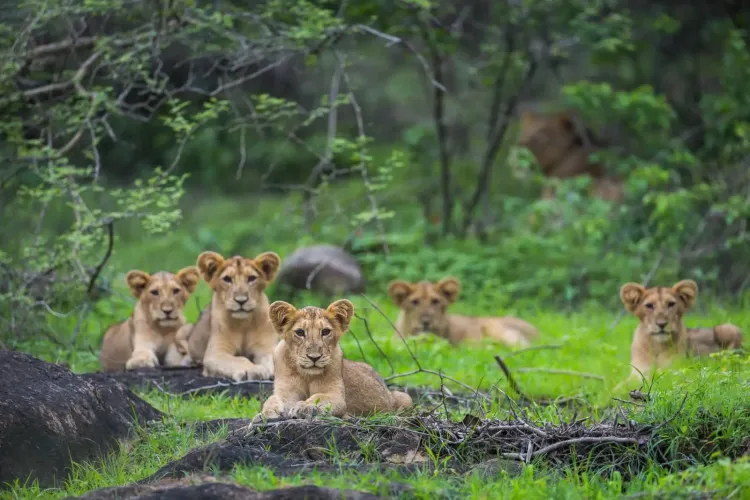
For the first time in 143 years, Asiatic lions have returned to Barda forest — and Gujarat's government is now restructuring its entire Porbandar Forest Division to keep pace. The reorganisation into seven ranges, with new beats, staff, and territorial transfers, signals that the state is treating this not as a wildlife curiosity but as a permanent conservation reality requiring serious administrative muscle.
Key Takeaways
The Gujarat government reorganised the Porbandar Forest Division on 29 September , effective immediately, in response to Asiatic lions returning to Barda forest after 143 years .
The division now has seven ranges , including the Porbandar Range ( 6,840.84 hectares , 80 villages ) and Ranavav Range ( 13,051.25 hectares , 27 villages ).
305.94 hectares from the Jamnagar Forest Division have been transferred to the Bhanvad Range of the Porbandar division, covering 4 villages in Devbhumi Dwarka district .
Two Assistant Conservators of Forests have been provisioned, with one vacant post transferred from Kevadia .
The division will continue under the Junagadh Wildlife Circle , with vehicles, weapons, wireless equipment, and other assets to be redistributed.
The Gujarat government has reorganised the Porbandar Forest Division, overhauling its range and beat structure to bolster field-level administration as Asiatic lions re-establish a presence in Barda forest — their first in 143 years. The Forest and Environment Department announced the restructuring on Tuesday, 29 September, saying the changes took effect immediately upon publication of the government resolution.
What the Reorganisation Covers
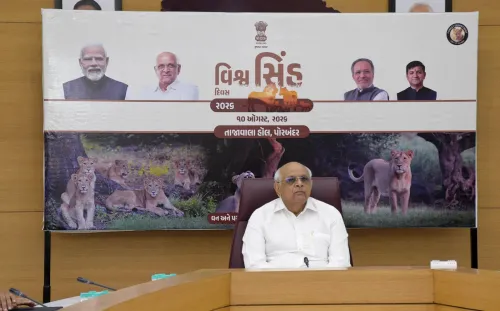
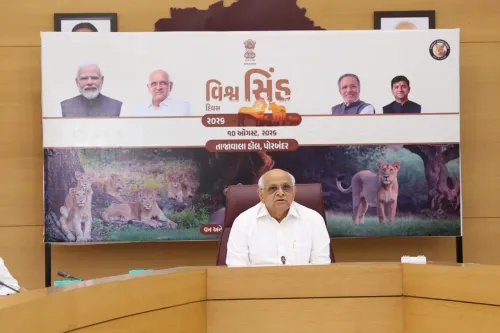
Approved under Chief Minister Bhupendra Patel, the revamped structure redraws administrative control over forest ranges, beats, officers, staff, and departmental resources across Porbandar district. The stated objective is sharper field-level accountability for forest conservation, wildlife management, and lion rehabilitation in Barda.
Under the new arrangement, the Porbandar Range will span 6,840.84 hectares across 80 villages, divided into beats covering Porbandar City, Gosabara, Moker, Visavada, Kantela, Madhavpur, and Satiya. The Ranavav Range will cover 13,051.25 hectares and 27 villages, with areas including Godana, Bileshwar, Savdivadar, and Ranavav distributed among its beats.
Key Territorial Transfers
The restructuring includes a significant boundary adjustment: 305.94 hectares from the RFW Bhatia Range of the Jamnagar Forest Division will be transferred to the Bhanvad Range of the Porbandar Forest Division. The transferred area covers four villages — Kandarda Jogna, Sajdiyala, Juna, and Jambusar — in Bhanvad taluka of Devbhumi Dwarka district.
Additionally, the Kutiyana Range, Porbandar Social Forestry Range, and Ranavav Social Forestry Range will be brought under the Porbandar Forest Division, giving it a total of seven ranges.
Administrative and Staffing Changes
To support the expanded structure, two Assistant Conservators of Forests have been provisioned. Assistant Conservator of Forests-1 will oversee the Porbandar, Porbandar Social Forestry, and Ranavav Social Forestry ranges, while Assistant Conservator of Forests-2 will manage the Ranavav, Bhanvad, and Kutiyana ranges along with the Mobile Squad (T.A.) Range.
One vacant Assistant Conservator of Forests post from the two sanctioned posts at Kevadia will be transferred to the Porbandar Forest Division. The division will continue to function under the Junagadh Wildlife Circle, with a Deputy Conservator of Forests overseeing the division. The reorganisation also involves the redistribution of vehicles, weapons, walkie-talkies, wireless equipment, records, computers, furniture, and other departmental assets.
Why the Lions' Return Makes This Significant
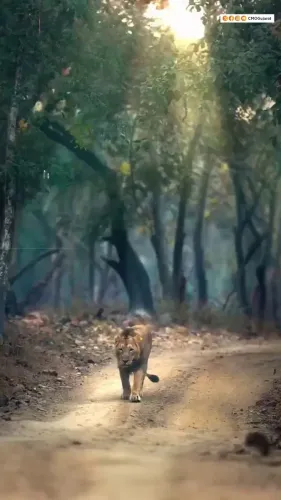
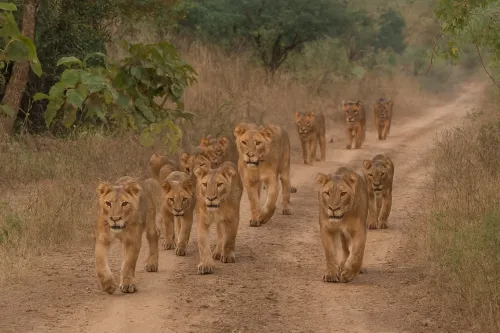
The administrative overhaul is directly tied to the natural return of Asiatic lions to Barda Wildlife Sanctuary after 143 years — a development widely regarded as a conservation milestone for the species, whose only wild population has historically been confined to the Gir forest in Saurashtra. This comes amid broader efforts by the Gujarat government to expand the lions' range and reduce dependence on a single habitat, which wildlife experts have long flagged as a vulnerability for long-term species survival.
Notably, the Barda sanctuary, located roughly 100 kilometres from Gir, had been identified as a potential secondary habitat for years. The lions' natural dispersal into the area has now prompted a formal administrative response to ensure the forest infrastructure can support coexistence and monitoring.
What Comes Next
With the resolution in immediate effect, forest departments will begin the transfer and redistribution of staff and assets. Wildlife managers will be expected to operationalise monitoring protocols for the lion population in Barda under the reorganised beat structure. The long-term success of the restructuring will hinge on whether the expanded administrative framework translates into effective on-ground wildlife management — a question that conservationists and wildlife authorities will be watching closely in the months ahead.
Point of View
Adequate monitoring technology, and genuine human-wildlife conflict protocols in a landscape that has been lion-free for over a century. With Gir's lion population under sustained pressure from habitat saturation and disease risk, Barda's success as a secondary habitat is not just a local conservation story — it is a national insurance policy for the species. The government would do well to treat it as such.
NationPress
29 Sept 2026
Frequently Asked Questions
Why have Asiatic lions returned to Barda forest after 143 years?
Asiatic lions have naturally dispersed into Barda Wildlife Sanctuary, located roughly 100 kilometres from Gir, after an absence of 143 years. Wildlife experts attribute this to increasing lion population pressure in Gir, which has prompted natural range expansion into adjacent habitats like Barda.
What changes has the Gujarat government made to the Porbandar Forest Division?
The Gujarat government has reorganised the Porbandar Forest Division into seven ranges, redrawing beats, transferring 305.94 hectares from the Jamnagar Forest Division, and provisioning two Assistant Conservators of Forests. The restructuring also redistributes staff, vehicles, weapons, and wireless equipment across the division.
When did the Porbandar Forest Division reorganisation take effect?
The government resolution took effect immediately upon its publication on 29 September. No phased timeline was specified; departments are expected to begin staff and asset transfers promptly.
Which areas are now covered under the reorganised Porbandar Forest Division?
The division now covers seven ranges: Porbandar, Ranavav, Bhanvad, Kutiyana, Porbandar Social Forestry, Ranavav Social Forestry, and the Mobile Squad (T.A.) Range. It also absorbs 305.94 hectares from the Jamnagar Forest Division covering four villages in Devbhumi Dwarka district.
Why does the Asiatic lion's presence in Barda matter for conservation?
Barda represents the first secondary wild habitat for Asiatic lions outside Gir in over a century, reducing the species' dependence on a single forest. Wildlife experts have long flagged the concentration of all wild Asiatic lions in one location as a major vulnerability — making Barda's colonisation a significant step toward long-term species resilience.