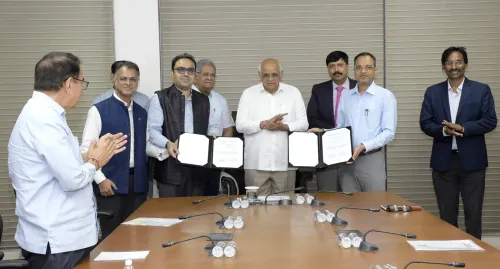
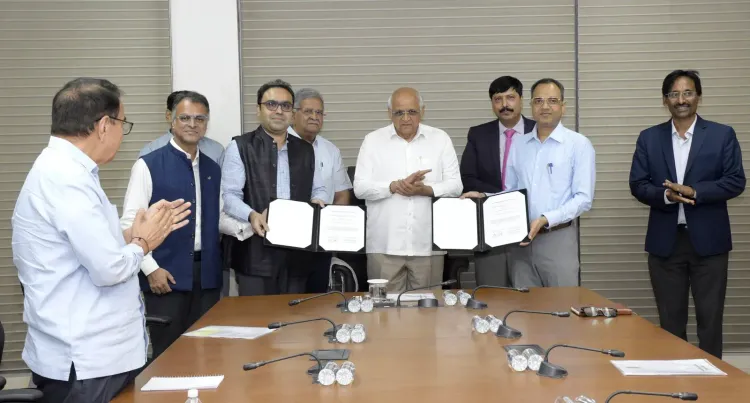
CM Bhupendra Patel Signs ₹1 Lakh Crore HUDCO MoU for Gujarat Infrastructure
Synopsis
Gujarat Chief Minister Bhupendra Patel has signed a ₹1 lakh crore long-term financing MoU with HUDCO and partnered with IIM Ahmedabad for project studies, targeting Ahmedabad Metro Phases 2 and 3, new expressways, sports infrastructure, and Dholera SIR development under PM Modi's Viksit Bharat vision.
Key Takeaways
Gujarat signed a strategic MoU with HUDCO for ₹1 lakh crore in long-term financing on 17 June 2026 .
Funds are earmarked for Ahmedabad Metro Phases 2 and 3 , new expressways, sports infrastructure, and Dholera SIR development.
IIM Ahmedabad has been engaged to conduct pre-feasibility studies, detailed project reports, and impact assessments.
The initiative is framed under PM Narendra Modi 's Viksit Bharat@2047 vision for a developed India.
Dholera SIR , part of the Delhi-Mumbai Industrial Corridor , is among India's largest planned greenfield smart cities.
Release of IIM-A feasibility reports and subsequent tendering timelines are the next key milestones to watch.
Gujarat Chief Minister Bhupendra Patel announced on Wednesday, 17 June 2026 that the state government has signed a strategic memorandum of understanding with HUDCO for ₹1 lakh crore in long-term financing to accelerate a suite of mega-infrastructure projects across the state. The projects include Ahmedabad Metro Phases 2 and 3, new expressways, world-class sports infrastructure, and modern development at Dholera Special Investment Region (SIR). Simultaneously, the government has partnered with IIM Ahmedabad to conduct pre-feasibility studies, detailed project reports, and impact assessments for these initiatives.
Context
CM Patel framed the MoU explicitly within Prime Minister Narendra Modi's Viksit Bharat vision, which targets a fully developed India by 2047. The announcement positions Gujarat as an early mover in translating that national ambition into state-level capital expenditure. In his post, Patel wrote that the financing would 'give a massive boost to Gujarat's urban transformation, infrastructure, and comprehensive economic growth.'
The dual partnership — one financial, one academic — signals a structured approach: HUDCO provides the capital pipeline while IIM-A provides the analytical rigour to ensure 'effective and structured execution,' as the Chief Minister put it.
Policy Backdrop
HUDCO, the Housing and Urban Development Corporation, is a central public-sector undertaking with a mandate to provide long-term financing for urban and regional development. Gujarat has previously leveraged HUDCO alongside state budgets to scale metro, expressway, and SIR projects, a pattern consistent with the broader PM Gati Shakti and National Infrastructure Pipeline frameworks.
Ahmedabad Metro Phase 1 was sanctioned under the Atal Mission for Rejuvenation and Urban Transformation, with central assistance approved in 2014–15. Phases 2 and 3 represent planned corridor extensions that would deepen connectivity across the city. Dholera SIR, notified in 2009 as part of the Delhi-Mumbai Industrial Corridor, has seen successive master plans and land-pooling notifications from the Gujarat government and remains one of India's most ambitious greenfield smart-city projects.
IIM Ahmedabad's role in conducting pre-feasibility studies and impact assessments adds an institutional credibility layer, ensuring that project reports meet the standards required for central approvals and private investment mobilisation.
Stakeholders and Impact
Urban commuters in Ahmedabad stand to benefit most immediately from Metro Phase 2 and 3 extensions, which would reduce pressure on road networks and cut commute times. Industrial investors eyeing Dholera SIR — which is designed to host semiconductor, electronics, and advanced manufacturing units — could see trunk infrastructure timelines firmed up once IIM-A's feasibility reports are adopted.
Infrastructure developers and construction firms are likely to watch the MoU closely, as ₹1 lakh crore in committed long-term financing represents a substantial forward order book for the sector. The expressway component, though not individually named in the announcement, suggests connectivity upgrades linking industrial and urban nodes across the state.
What's Next
The immediate milestones to watch are the release of IIM Ahmedabad's pre-feasibility reports and the subsequent cabinet approvals or tendering timelines for Ahmedabad Metro Phase 2 and Dholera trunk infrastructure. Tranche-wise disbursement schedules under the HUDCO agreement have not yet been made public.
If the structured execution framework holds, Gujarat's approach — pairing a central PSU financing anchor with premier academic oversight — could serve as a template for other states seeking to front-load capital expenditure under the Viksit Bharat agenda ahead of 2047.
Point of View
And its framing under Viksit Bharat is a deliberate political signal ahead of the 2047 centenary target. Pairing a central PSU funding guarantee with IIM Ahmedabad's analytical oversight is an attempt to pre-empt the cost-overrun and feasibility criticism that has dogged large Indian infrastructure projects. The Dholera SIR inclusion is particularly significant: the greenfield city has been in planning for over a decade and needs visible capital commitment to attract anchor investors. If IIM-A's reports translate into swift cabinet and tendering action, this MoU could mark a genuine inflection point for Gujarat's urban-industrial corridor ambitions.
NationPress
19 Sept 2026
Frequently Asked Questions
What is the Gujarat HUDCO MoU about?
The Gujarat government signed a ₹1 lakh crore long-term financing MoU with HUDCO on 17 June 2026 to fund mega-infrastructure projects including Ahmedabad Metro Phases 2 and 3, new expressways, sports infrastructure, and development at Dholera SIR.
What is Dholera SIR and why is it important?
Dholera Special Investment Region is a planned greenfield smart city in Gujarat, notified in 2009 under the Delhi-Mumbai Industrial Corridor. It is designed to host advanced manufacturing, electronics, and semiconductor industries and is one of India's most ambitious urban-industrial projects.
What is HUDCO's role in Gujarat infrastructure?
HUDCO, the Housing and Urban Development Corporation, is a central government PSU that provides long-term financing for urban and regional development. Under this MoU it will channel ₹1 lakh crore to Gujarat's infrastructure projects.
Why is IIM Ahmedabad involved in Gujarat infrastructure projects?
IIM Ahmedabad has been partnered to conduct rigorous pre-feasibility studies, detailed project reports, and impact assessments to ensure structured and effective execution of the vision projects announced under the MoU.
What is the Viksit Bharat vision and how does this MoU relate to it?
Viksit Bharat is Prime Minister Narendra Modi's vision for a fully developed India by 2047. The Gujarat government has anchored this MoU within that framework, positioning the ₹1 lakh crore financing as a state-level contribution to achieving the national development target.