Gujarat targets all 14,650 panchayats under Atmanirbhar self-reliance drive
Synopsis
Gujarat wants every one of its 14,650 gram panchayats to generate its own revenue and shed dependence on government grants — a scale-up from just 71 currently selected under the Centre's Atmanirbhar Panchayat Programme. The Gandhinagar workshop signals that this is no longer a pilot; it is a statewide mandate with NABARD and HUDCO already deploying project support.
Key Takeaways
Gujarat has set a target to make all 14,650 gram panchayats financially self-reliant under the Atmanirbhar Panchayat Programme .
Only 71 panchayats from Gujarat have been selected in the programme's first phase, against eligibility thresholds of ₹50 lakh (gram) and ₹1 crore (taluka) in own revenue.
The one-day workshop in Gandhinagar on 9 June brought together officials from the Ministry of Panchayati Raj , NABARD , and HUDCO .
NABARD is promoting models including rural haats, agri-produce storage, and small-scale industries to generate panchayat income.
HUDCO will provide infrastructure support, technical guidance, and financial planning to participating panchayats.
The drive is framed as part of the broader Atmanirbhar Bharat 2047 vision ahead of India's centenary of independence.
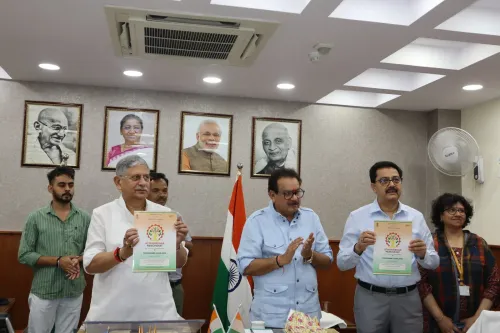
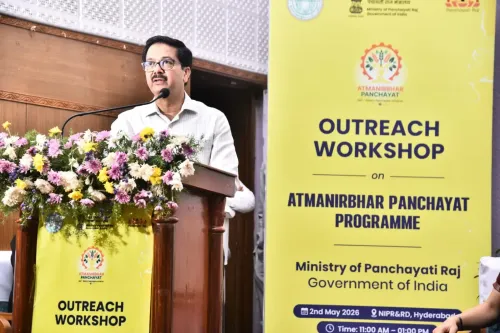
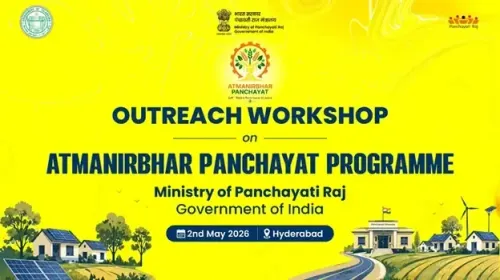
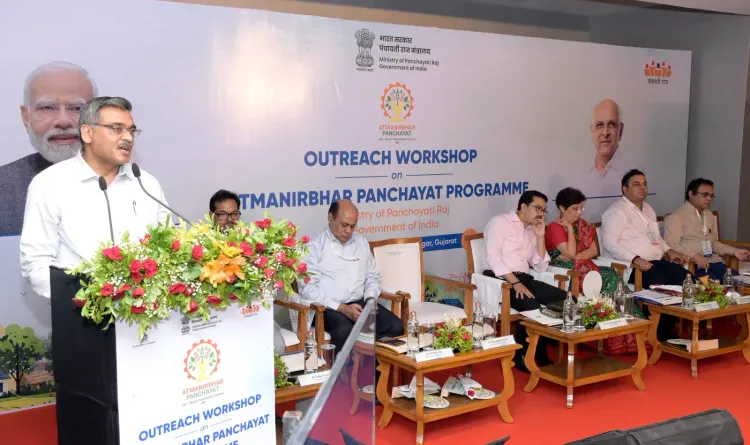
Gujarat has set an ambitious goal to transform all 14,650 gram panchayats in the state into financially self-reliant institutions under the Centre's Atmanirbhar Panchayat Programme, with senior officials from the Ministry of Panchayati Raj, the Gujarat government, NABARD, and HUDCO convening in Gandhinagar on Tuesday, 9 June to chart a roadmap for reducing rural local bodies' dependence on government grants.
The vision was laid out at a one-day state-level outreach workshop where officials stressed that panchayats must build independent revenue streams if the broader goal of Atmanirbhar Bharat 2047 is to be realised at the grassroots.
What the Programme Covers
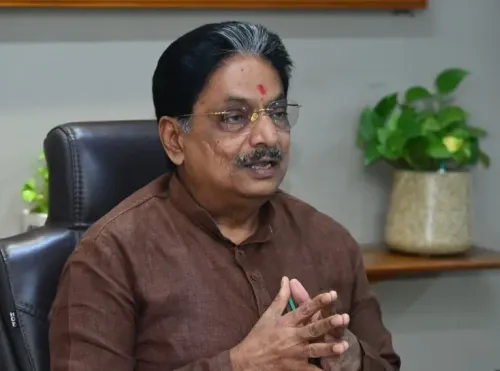
Vivek Bharadwaj, Secretary of the Ministry of Panchayati Raj, told the gathering that the next phase of India's self-reliance journey must be driven from the village level. 'Panchayats must now work towards becoming self-reliant by creating revenue-generating opportunities through various local projects and initiatives. The Ministry of Panchayati Raj will provide technical guidance to help implement such projects,' he said.
Bharadwaj cited geographical and cultural assets — the Indian Standard Time Line, the Tropic of Cancer, coastal regions, and the Statue of Unity — as examples of resources that, with innovative planning, could generate substantial employment and revenue through tourism-linked activities. He noted that several gram and block panchayats across the country were already generating significant revenue through such initiatives.
Gujarat's Ambition Beyond the First 71
Dhananjay Dwivedi, Principal Secretary of Gujarat's Panchayat Department, acknowledged that 71 panchayats from the state had already been selected under the Ministry's programme — but made clear that this was a floor, not a ceiling. 'Gujarat should not limit itself to these 71 panchayats,' he said. 'Under the guidance of Chief Minister Bhupendra Patel, joint efforts must be made to transform all 14,000-plus panchayats in the state into Atmanirbhar Panchayats.'
Dwivedi noted that the initial selection criteria required a gram panchayat income of at least ₹50 lakh or a taluka panchayat income of at least ₹1 crore, but urged officials not to treat those thresholds as barriers. 'A panchayat currently generating ₹49 lakh or ₹95 lakh can achieve the target with a little more effort,' he said.
Role of NABARD and HUDCO
NABARD Regional Manager Dr. Pradeep said the institution had prepared development plans and detailed project reports to help panchayats establish sustainable income sources. Models being promoted include rural haats, filtered drinking water facilities, storage and processing of agricultural produce, small-scale industries, warehouse construction, and commodity-based enterprises.
HUDCO official Vimal Kumar Sharma said the organisation was fully committed to supporting gram panchayats with infrastructure facilities, technical guidance, and financial planning. HUDCO will also organise workshops and training programmes focused on technical, financial, and project management aspects.
Implementation and Outreach
Additional Development Commissioner Gaurav Dahiya confirmed that 71 gram panchayats in Gujarat had been selected in the first phase, with the long-term goal of making all 14,650 gram panchayats self-reliant. He said efforts were under way to strengthen budgeting and financial management systems in rural local governments, drawing comparisons with urban local bodies.
The workshop was conducted in hybrid mode, with elected representatives and officials from gram and taluka panchayats across Gujarat joining via video conferencing. Attendees included Ministry of Panchayati Raj Joint Secretary Mukta Shekhar, District Development Officers, Taluka Development Officers, Talati-cum-Mantris, Sarpanches, and NABARD representatives. A live demonstration of the Atmanirbhar Panchayat Portal was also conducted.
With sectoral models now being piloted and a state-wide rollout targeted, Gujarat's push could serve as a replicable blueprint for other large states seeking to wean rural local bodies off grant dependency ahead of India's centenary of independence in 2047.
Point of View
But the gap between 71 and 14,650 is not just numerical — it is structural. Most gram panchayats in India lack the land assets, tourist draw, or administrative capacity to replicate the models being showcased. The ₹50 lakh own-revenue threshold that defined the first cohort already screens out the majority of rural local bodies. Without a differentiated strategy for low-resource panchayats — not just inspiration from the Statue of Unity — the programme risks becoming a showcase for the already-capable. The harder question, which the Gandhinagar workshop did not publicly answer, is how panchayats in rain-shadow districts or tribal belts generate independent revenue when their economic base is thin to begin with.
NationPress
26 Oct 2026
Frequently Asked Questions
What is the Atmanirbhar Panchayat Programme?
The Atmanirbhar Panchayat Programme is a Central government initiative under the Ministry of Panchayati Raj aimed at making gram panchayats financially self-sufficient by helping them build their own revenue sources and reduce dependence on government grants. Panchayats are selected based on income thresholds — ₹50 lakh for gram panchayats and ₹1 crore for taluka panchayats.
How many panchayats from Gujarat have been selected so far?
71 gram panchayats from Gujarat have been selected in the first phase of the Atmanirbhar Panchayat Programme. However, state officials have set a broader goal of making all 14,650 gram panchayats in Gujarat self-reliant under this initiative.
What revenue models are being promoted for gram panchayats?
NABARD is promoting models such as rural haats, filtered drinking water facilities, storage and processing of agricultural produce, small-scale industries, warehouse construction, and commodity-based enterprises to help panchayats generate sustainable income.
What role will HUDCO play in the programme?
HUDCO will provide infrastructure support, technical guidance, and financial planning assistance to gram panchayats. It will also help design revenue-generating projects, assess technical feasibility, prepare project reports, assist in obtaining funding, and organise training workshops on financial and project management.
How does this connect to Atmanirbhar Bharat 2047?
State officials framed the panchayat self-reliance drive as an essential building block of the Atmanirbhar Bharat 2047 vision, which targets a fully developed India by the centenary of independence. Officials argued that the Union and state governments alone cannot achieve that goal without financially empowered district, taluka, and gram panchayats actively contributing to local development.