Gujarat schools: written permission must for visitors, filming banned without nod
Synopsis
Gujarat has formalised one of the stricter school-access frameworks among Indian states, requiring written principal approval for every external visitor and criminalising unauthorised filming of students. The nine-point circular explicitly cites the Supreme Court's privacy ruling and the POCSO Act — turning what was often informal school-gate discretion into a legally enforceable protocol.
Key Takeaways
The Gujarat Education Department issued a nine-point circular on 21 October 2026 regulating entry of external visitors to all government schools.
Prior written permission from the principal is mandatory before any visitor enters classrooms, labs, libraries, hostels or playgrounds.
Photography, videography, audio recording, interviews and live streaming involving students or teachers require the principal's explicit written approval.
The circular invokes Article 21 of the Constitution, the K.
Puttaswamy privacy ruling and NCPCR school safety guidelines as its legal basis.
Violations can attract proceedings under the Bharatiya Nyaya Sanhita 2023 , POCSO Act , Juvenile Justice Act and the IT Act, 2000 .
Authorised government officials performing official duties are exempt from the prior permission requirement.
The Gujarat government on 21 October 2026 issued a circular mandating prior written permission from school principals for any external visitor entering school premises, while prohibiting photography, videography, interviews, audio recording and live streaming involving students, teachers or school activities without explicit approval. The Education Department's nine-point directive covers all primary, secondary and higher secondary educational institutions across the state.
Key Restrictions on Visitor Access
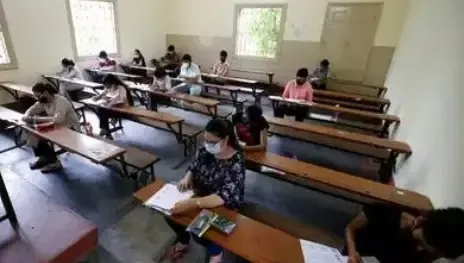
Under the new rules, every visitor must first record their details in the institution's visitors' register. Access to classrooms, laboratories, libraries, hostels, playgrounds, toilets and other areas where student activities are in progress is permitted only with the principal's prior written permission and when the visitor is accompanied by the principal, a teacher or another authorised school official.
Notably, government officials carrying out duly authorised official duties are exempt from the prior written permission requirement for entry. All other external visitors — including members of the media — fall within the ambit of the new restrictions.
Photography and Data Collection Prohibited Without Approval
The circular explicitly bars photography, videography, interviews, audio recording and live streaming involving students, teachers or school activities unless the principal has given prior written permission and the purpose is lawful. School authorities have been directed to ensure that photographs, videos and personal data of students are not collected, published or circulated in ways that could compromise their privacy, dignity or safety.
Visitors are similarly barred from collecting information about individual children or publishing their identities or photographs without written permission, particularly where such action is not in the child's best interests or could affect their safety, dignity or privacy.
Constitutional and Legal Basis
The department grounded the circular in Article 21 of the Constitution, which protects the right to life and personal liberty, and in the Supreme Court's landmark ruling in K. S. Puttaswamy (Retd.) vs Union of India, which recognised privacy as a fundamental right. It also invoked the doctrine of in loco parentis, under which the state assumes parental responsibilities towards children in government schools.
The circular additionally references school safety policies and guidelines issued by the National Commission for Protection of Child Rights (NCPCR), which call for safe, secure and child-friendly school environments.
Consequences for Violations
Principals are empowered to refuse entry to visitors whose presence is likely to affect school security, privacy, discipline or the educational environment. Where a person enters without permission, refuses to leave, attempts unauthorised photography or videography, or obstructs school functioning, the principal must immediately alert the local police and the relevant education authorities — including the district education officer, district primary education officer, administrative officer or taluka primary education officer, as applicable.
Depending on facts and circumstances, legal proceedings may be initiated under the Bharatiya Nyaya Sanhita, 2023, the Protection of Children from Sexual Offences (POCSO) Act, 2012, the Juvenile Justice (Care and Protection of Children) Act, 2015, the Information Technology Act, 2000, and other applicable laws. Inspecting officers have been asked to ensure strict compliance across all institutions.
Why This Matters
The circular arrives as concerns over student privacy and school-level media intrusion have grown nationally. Gujarat's move to formalise access rules mirrors similar frameworks in other states and aligns with the Centre's broader push on child protection norms. With legal consequences now explicitly tied to violations, the circular signals a shift from advisory guidance to enforceable policy — and schools that previously had no formal visitor protocol now have a clear compliance obligation.
Point of View
The Bharatiya Nyaya Sanhita and the IT Act, the state has converted a discretionary principal's call into a legally binding framework with criminal consequences. The harder question is implementation: schools in rural Gujarat often lack the staffing to maintain visitor registers or accompany guests, and the exemption for 'duly authorised government officials' could become a carve-out large enough to swallow the rule. The real test is whether compliance is tracked uniformly or applied selectively when inconvenient — particularly against journalists and opposition politicians visiting schools for legitimate scrutiny.
NationPress
22 Oct 2026
Frequently Asked Questions
What are Gujarat's new rules for school visitors?
From 21 October 2026, external visitors to Gujarat's primary, secondary and higher secondary schools must obtain prior written permission from the principal before entering areas such as classrooms, labs, libraries and playgrounds. They must also register in the visitors' register and be accompanied by an authorised school official.
Is photography or filming of students now banned in Gujarat schools?
Photography, videography, audio recording, interviews and live streaming involving students, teachers or school activities are prohibited without the principal's prior written permission and a lawful purpose. School authorities must also ensure student data and images are not published in ways that could harm privacy or safety.
Who is exempt from the new Gujarat school visitor rules?
Government officials who are duly authorised to carry out official duties are exempt from the requirement to obtain prior written permission for entry. All other external visitors, including media personnel, are subject to the new restrictions.
What legal action can be taken against violators?
Principals must alert the local police and district education authorities if someone enters without permission, refuses to leave or attempts unauthorised filming. Depending on circumstances, proceedings can be initiated under the Bharatiya Nyaya Sanhita 2023, POCSO Act 2012, Juvenile Justice Act 2015 and the IT Act 2000.
What is the legal basis for Gujarat's school visitor circular?
The circular is grounded in Article 21 of the Constitution (right to life and personal liberty), the Supreme Court's K. S. Puttaswamy ruling recognising privacy as a fundamental right, the doctrine of in loco parentis, and NCPCR school safety and child protection guidelines.