Gujarat expands CM Fellowship Programme to 47 fellows, 45 projects for better scheme delivery
Synopsis
Gujarat has quietly doubled its governance fellowship programme — not just in headcount but in ambition. By roping in IIM-A and expanding to 45 projects across healthcare, nutrition, natural farming and urban services, Chief Minister Bhupendra Patel is institutionalising structured policy evaluation at the district level, with AI tools permitted under strict verification rules.
Key Takeaways
Gujarat's Sardar Patel Good Governance CM Fellowship Programme has expanded from 41 to 47 fellows and from 20 to 45 projects .
IIM Ahmedabad has been named the programme's knowledge partner, with a senior faculty member in a defined role.
Fellows will work with state departments for one to two years , covering eight sectors including healthcare, agriculture, nutrition and urban development.
Focus areas include the PMJAY-MA scheme , PM POSHAN Mid-Day Meal scheme , ICDS , natural farming and civic services in Rajkot and Bhavnagar .
AI-based tools may be used for analysis, but all AI-generated outputs must be verified against original documents.
The expansion was formalised by the General Administration Department under Chief Minister Bhupendra Patel .
The Gujarat government has expanded its Sardar Patel Good Governance CM Fellowship Programme, increasing the number of fellows from 41 to 47 and scaling up projects from 20 to 45, with a clear mandate to plug gaps in the delivery of government schemes across sectors including healthcare, agriculture, nutrition, and urban development. The decision was announced on 29 October 2026 from Gandhinagar.
Key Expansion Details
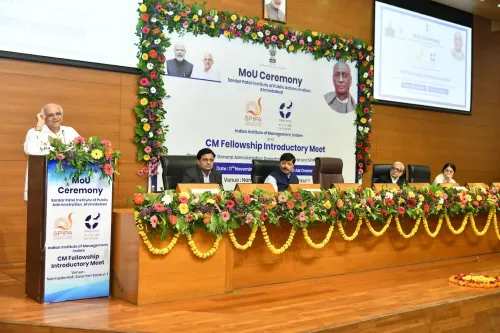
The expansion was formalised through a resolution issued by the General Administration Department (GAD), which operates under the leadership of Chief Minister Bhupendra Patel. Under the revised framework, the Indian Institute of Management Ahmedabad (IIM-A) will serve as the programme's knowledge partner, with a senior faculty member appointed by the institute taking on a defined role in the initiative.
The fellowship is designed to bring young professionals with research and analytical skills into state administration for a period of one to two years, providing them practical exposure to government functioning while enabling departments to identify service delivery gaps.
Sectors and Projects Covered
The expanded programme now spans eight broad sectors: education, healthcare, nutrition, agriculture, social development, urban administration, environment, and public administration. Fellows will examine obstacles in scheme implementation, assess resource utilisation, and recommend operational improvements.
Among the specific focus areas are Anganwadi services, anaemia reduction, early childhood education, and interconnected library networks. The programme will also study the expansion of centralised kitchen facilities to strengthen the PM POSHAN Mid-Day Meal scheme and the Integrated Child Development Services (ICDS).
In healthcare, fellows will investigate claim-related challenges under the PMJAY-MA scheme at government hospitals and analyse the utilisation of public health infrastructure. Agriculture-related projects will examine hurdles in rolling out natural farming practices and ensuring farmers receive entitled scheme benefits.
Technology and Governance Tools
Notably, the programme permits the use of artificial intelligence-based tools to classify information, prepare summaries, and flag key issues — though all AI-generated outputs must be verified against original documents and data before use. This marks a cautious but forward-looking integration of technology into state governance assessment.
Urban development projects will focus on improving civic services within the Rajkot Municipal Corporation, analysing complaint patterns to prevent recurrence and enabling proactive data-driven problem identification. In Bhavnagar, projects will address solid and wet waste recycling and resource reuse.
What the Programme Aims to Achieve
The broader goal is to generate evidence-based policy research and data analysis aligned with Gujarat's long-term development vision. Fellows will also evaluate the functioning of district-level committees, track follow-up on government decisions, and assess inter-departmental coordination. The findings are intended to streamline procedures, enhance operational efficiency, and provide departments with actionable recommendations. The expansion signals the Gujarat government's intent to institutionalise structured policy evaluation as a regular feature of its administrative machinery.
Point of View
But the real test will be whether departmental recommendations produced by fellows are actually acted upon — or filed away. The cautious integration of AI tools, with a hard verification requirement, reflects a pragmatic approach, but the programme's impact will ultimately depend on the political will to operationalise uncomfortable findings about scheme failures.
NationPress
29 Oct 2026
Frequently Asked Questions
What is the Sardar Patel Good Governance CM Fellowship Programme?
It is a Gujarat government initiative that places young professionals with research and analytical skills within state departments for one to two years. The programme aims to identify gaps in government scheme delivery and produce evidence-based recommendations to improve public services.
How has the programme been expanded in 2026?
The Gujarat government has increased the number of fellows from 41 to 47 and scaled up the number of projects from 20 to 45. IIM Ahmedabad has also been brought in as the programme's knowledge partner under the revised framework.
Which sectors will the expanded fellowship cover?
The expanded programme spans eight sectors: education, healthcare, nutrition, agriculture, social development, urban administration, environment, and public administration. Specific focus areas include the PMJAY-MA scheme, PM POSHAN Mid-Day Meal scheme, ICDS, natural farming, and civic services in Rajkot and Bhavnagar.
What role will IIM Ahmedabad play in the fellowship?
IIM-A will serve as the knowledge partner for the programme, with a senior faculty member appointed by the institute taking on a specified role. The partnership is intended to strengthen the research and analytical rigour of the fellows' work.
How will artificial intelligence be used in the programme?
AI-based tools may be deployed to classify information, prepare summaries, and identify key issues where required. However, the programme mandates that any AI-generated output must be verified against original documents and data before being used in recommendations.