Delhi Speaker Vijender Gupta: Character Builds Viksit Bharat, Not Degrees Alone
Synopsis
Delhi Assembly Speaker Vijender Gupta told PGDAV College students that degrees alone cannot build a Viksit Bharat — it takes character. Citing India's Moon landing, UPI's global rise, and Operation Sindoor as proof, he urged youth to root ambition in integrity and cultural pride as India races toward its 2047 centenary vision.
Key Takeaways
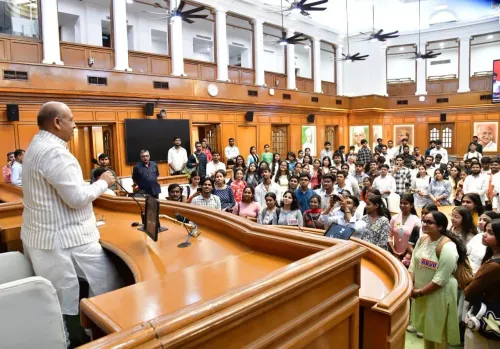
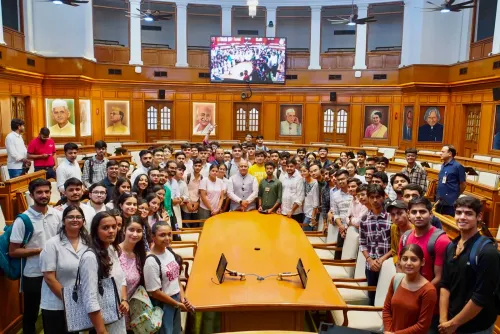
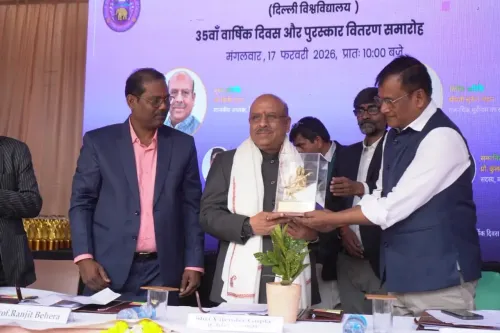
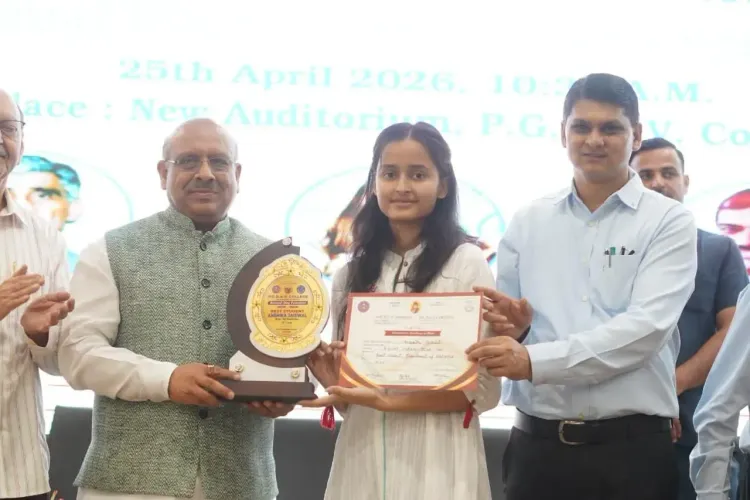
Delhi Assembly Speaker Vijender Gupta addressed the Annual Prize Distribution Ceremony at P.G.D.A.V.
College (Morning), University of Delhi on April 25, 2025 .
Gupta declared that Viksit Bharat by 2047 requires both education and character, stating that education shows the path but character gives the strength to stay on it.
He cited India's Chandrayaan-3 Moon landing , the global rise of UPI , and Operation Sindoor as proof that national character drives national achievement.
Invoking Swami Vivekananda , Gupta emphasized that true education must awaken the human being within, going beyond academic degrees.
He urged students to fear dishonesty over failure , noting that failure teaches but dishonesty leaves a lifelong mark on character.
The event was attended by Ajay Suri (Chairman, Governing Body), Sanjeev Kumar Tiwari (Principal, Maharaja Agrasen College), and Darvinder Kumar (Principal, P.G.D.A.V.
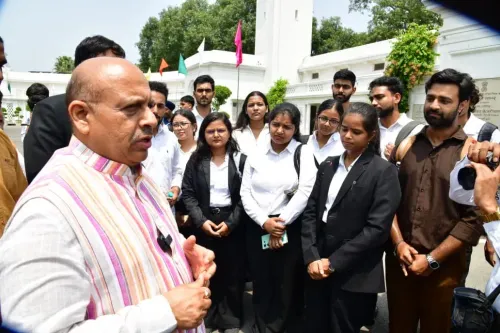
New Delhi, April 25: Delhi Assembly Speaker Vijender Gupta on Saturday delivered a powerful message to students at the Annual Prize Distribution Ceremony of P.G.D.A.V. College (Morning), University of Delhi, urging the youth to cultivate strong character alongside academic excellence to lead India toward its vision of a Viksit Bharat by 2047. Gupta stressed that degrees alone cannot build a developed nation — it is integrity, discipline, and cultural rootedness that will define the next generation of nation-builders.
Character Over Credentials: The Core Message
Vijender Gupta told the assembled students and faculty, "When India marks 100 years of Independence, the responsibility of the nation will rest with your generation. A Viksit Bharat cannot be built by degrees alone; it requires both education and character — education shows the path, but character gives the strength to remain on it."
Drawing from the philosophy of Swami Vivekananda, Gupta reminded students that true education is the manifestation of the perfection already within an individual — a concept that goes far beyond classroom learning. He emphasized that real knowledge must awaken the human being within, not merely produce certificate-holders.
The Speaker noted that P.G.D.A.V. College is not just an academic institution but a living legacy of Maharshi Dayanand Saraswati, whose foundational values have guided generations of Indians. The very concept of Dayanand Anglo Vedic, he said, represents the ideal confluence of modernity and tradition — a balance that today's youth must carry forward.
India's Global Rise: From Moon to Digital Revolution
Gupta pointed to India's recent landmark achievements as proof that national character translates into national greatness. He highlighted that India became the first country to land near the southern pole of the Moon — a historic feat achieved through the scientific integrity of ISRO's workforce.
He also cited UPI (Unified Payments Interface) as a homegrown digital revolution that has now emerged as a global model, with multiple countries adopting or studying India's payments infrastructure. These milestones, Gupta argued, are not accidents — they are the direct result of disciplined, character-driven professionals across sectors.
Referring to Operation Sindoor, the Speaker declared that a new India does not compromise on its security, signaling that the country's assertive posture on national defense reflects the same values of strength and resolve he was urging students to internalize.
Lessons in Resilience and Roots
Gupta used a compelling metaphor to drive home his message on ambition and foundation: "The higher a tree grows, the deeper its roots must be." He urged students to dream without limits while building unshakeable foundations in values, culture, and knowledge.
He also issued a striking challenge: "Do not fear failure — fear dishonesty. Failure teaches, but dishonesty stays for a lifetime." This framing positions moral courage above academic performance in the hierarchy of life skills.
The Speaker further stressed the importance of mother tongue, cultural identity, and national pride, warning that those who forget their roots cannot stand firm in an increasingly competitive world. He called upon students to embrace both technological advancement and civilisational wisdom simultaneously.
Ceremony and Felicitation
The event was attended by prominent dignitaries including Ajay Suri, Chairman, Governing Body, P.G.D.A.V. College; Sanjeev Kumar Tiwari, Principal, Maharaja Agrasen College; and Darvinder Kumar, Principal, P.G.D.A.V. College.
Meritorious students were felicitated for outstanding academic achievements, with Speaker Gupta personally congratulating each award recipient. The ceremony served as both a recognition of past excellence and a call to future responsibility.
Why This Message Matters Beyond the Auditorium
Gupta's address comes at a time when India is navigating a critical demographic window — with over 65% of its population under the age of 35, the country holds one of the world's largest youth populations. How this generation is educated, motivated, and morally grounded will directly determine whether India achieves its 2047 centenary development goals.
Notably, this speech aligns with a broader national discourse around the NEP 2020 (National Education Policy), which itself emphasizes holistic development, Indian languages, and values-based learning alongside academic rigor. Gupta's message reinforces that institutional reform alone is insufficient without a corresponding cultural and moral shift among students themselves.
As India continues to expand its global footprint — economically, technologically, and diplomatically — the character of its youth workforce will be the decisive variable. Events like this prize ceremony, while modest in scale, are part of a larger national conversation about what kind of citizens India needs to build the future it envisions.
Point of View
His invocation of Vivekananda's philosophy and Dayanand's legacy signals a push to reclaim education's deeper purpose. The references to Operation Sindoor and UPI are deliberate — they connect abstract values to concrete national pride, a rhetorical strategy that resonates with India's post-2014 assertiveness. The real test, however, is whether these messages translate into institutional reform or remain inspirational oratory.
NationPress
19 Sept 2026
Frequently Asked Questions
What did Delhi Speaker Vijender Gupta say at PGDAV College?
Delhi Assembly Speaker Vijender Gupta urged students at PGDAV College's Annual Prize Distribution Ceremony to build strong character alongside education to contribute to India's vision of Viksit Bharat by 2047. He said degrees alone cannot build a developed nation — integrity, discipline, and cultural roots are equally essential.
What is Viksit Bharat and why did Vijender Gupta mention it?
Viksit Bharat refers to India's national goal of becoming a fully developed nation by 2047, when the country marks 100 years of Independence. Gupta invoked it to stress that the current generation of students will be the primary architects of this vision, making their education and character formation critical.
Which achievements did Vijender Gupta highlight in his speech?
Gupta highlighted India's Chandrayaan-3 Moon landing near the lunar south pole, the global adoption of UPI as a digital payments model, and Operation Sindoor as examples of India's growing strength. He attributed these achievements to the character — integrity, discipline, and dedication — of the professionals involved.
What is the significance of PGDAV College in this context?
P.G.D.A.V. College, University of Delhi, is associated with the legacy of Maharshi Dayanand Saraswati and the Dayanand Anglo Vedic tradition. Speaker Gupta described it as a living embodiment of values that blend modernity with tradition, making it symbolically relevant to his message about education and character.
What was Vijender Gupta's message about failure and dishonesty?
Gupta told students not to fear failure but to fear dishonesty, stating that failure teaches valuable lessons while dishonesty leaves a permanent mark on one's character. This was part of his broader call for moral courage and integrity as foundational qualities for India's future leaders.