HP CM Office Launches 'Apna Parivar Sukhi Parivar' for 1.8 Lakh Families
Synopsis
The Chief Minister's Office of Himachal Pradesh has announced 'Apna Parivar Sukhi Parivar', a welfare scheme launching on Gandhi Jayanti (2 October) targeting 1,80,000 extremely poor families with a two-year mandate to improve their economic condition.
Key Takeaways
The Chief Minister's Office of Himachal Pradesh announced the 'Apna Parivar Sukhi Parivar' scheme on 15 August 2026 .
The scheme will launch on 2 October — Gandhi Jayanti — a date traditionally used for welfare programme launches in India.
The stated target is 1,80,000 extremely poor families in Himachal Pradesh.
The government has set a two-year timeline to improve the economic condition of these households.
The Chief Minister personally pledged dedication to serving the beneficiary families.
Operational details — specific interventions, funding, and beneficiary identification methodology — have not yet been disclosed.
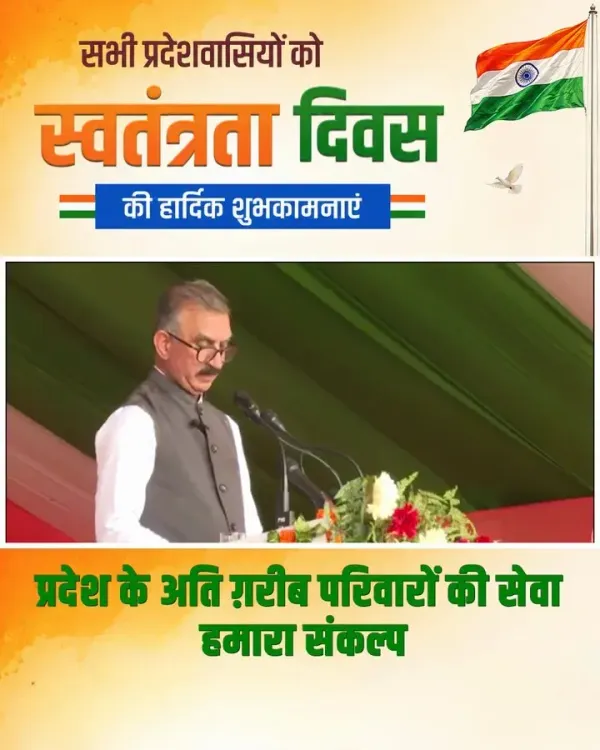
On Gandhi Jayanti, 2 October, the hills of Himachal Pradesh will see the launch of a welfare scheme aimed squarely at the state's most vulnerable — 1,80,000 extremely poor families who are the direct target of the newly announced 'Apna Parivar Sukhi Parivar' ('Our Family, Happy Family') initiative. The Chief Minister's Office of Himachal Pradesh announced the programme on 15 August 2026, framing it as a two-year mission to lift these households out of economic distress.
'Apna Parivar Sukhi Parivar': What the Scheme Promises
The CMO's post states plainly: 'Our effort is that in the next 2 years, the economic condition of these 1,80,000 families improves and happiness comes into their lives.' The announcement carries a personal pledge — 'I will remain completely dedicated to serving these families' — signalling that the Chief Minister intends to keep the scheme's progress in the political spotlight. The choice of 2 October as the launch date is deliberate: Gandhi Jayanti has long served as the preferred date for Indian state governments to unveil poverty-alleviation programmes, invoking Mahatma Gandhi's philosophy of service to the last person in line.
Why 1,80,000 Families — and How They Were Identified
Himachal Pradesh is a relatively small Himalayan state, and a target cohort of 1,80,000 households represents a concentrated, named population — not a vague 'below poverty line' sweep. The specificity matters: it implies a prior identification exercise, likely through existing beneficiary databases or a fresh survey. The critical questions now are how these families were selected, what interventions the scheme will actually deliver — income support, skill training, asset transfer, or a combination — and how the two-year progress will be measured and reported. None of those operational details have been made public yet.
A Pattern Across Indian States — and What Sets This Apart
Time-bound, household-targeted welfare drives are a fixture of Indian state politics, but the explicit two-year deadline and the named beneficiary count give this announcement more accountability architecture than most. If the government publishes baseline data before 2 October and tracks outcomes against it, the scheme could become a model; if it does not, the deadline will simply expire. The Independence Day timing of the announcement — and the Gandhi Jayanti timing of the launch — suggest the Chief Minister's Office is building a political narrative around the scheme from day one.
One hundred and eighty thousand families. Two years. One public pledge. The clock starts 2 October.
Point of View
While the explicit two-year deadline and named beneficiary count create a rare accountability frame that the opposition can — and likely will — hold the government to. Himachal Pradesh has historically oscillated between Congress and BJP governments, making visible welfare delivery a key electoral currency. Whether 'Apna Parivar Sukhi Parivar' becomes a credible poverty-reduction exercise or a launch-day headline will depend almost entirely on whether baseline data is published before 2 October and whether the scheme's interventions are substantive enough to move measurable economic indicators within the promised window.
NationPress
16 Aug 2026
Frequently Asked Questions
What is the 'Apna Parivar Sukhi Parivar' scheme in Himachal Pradesh?
'Apna Parivar Sukhi Parivar' — meaning 'Our Family, Happy Family' — is a welfare scheme announced by the Himachal Pradesh government targeting 1,80,000 extremely poor families, with a two-year goal of improving their economic condition. It is set to launch on 2 October 2026.
When does the Himachal Pradesh 'Apna Parivar Sukhi Parivar' scheme start?
The scheme is scheduled to launch on 2 October 2026 , which is Gandhi Jayanti, the birth anniversary of Mahatma Gandhi.
How many families will benefit from the HP 'Apna Parivar Sukhi Parivar' scheme?
The Himachal Pradesh government has stated that 1,80,000 extremely poor families are the intended beneficiaries of the scheme.
Why is the scheme being launched on Gandhi Jayanti (2 October)?
Gandhi Jayanti is widely used by Indian state governments to launch welfare and poverty-alleviation programmes, invoking Mahatma Gandhi's philosophy of service to the most marginalised sections of society.
What will the 'Apna Parivar Sukhi Parivar' scheme actually provide to poor families?
The specific interventions — such as income support, skill training, or asset transfers — have not yet been publicly detailed. The government has committed to a two-year timeline for measurable economic improvement among the 1,80,000 identified families.