HP CM Office Pays Tribute to Milkha Singh, Flying Sikh
Synopsis
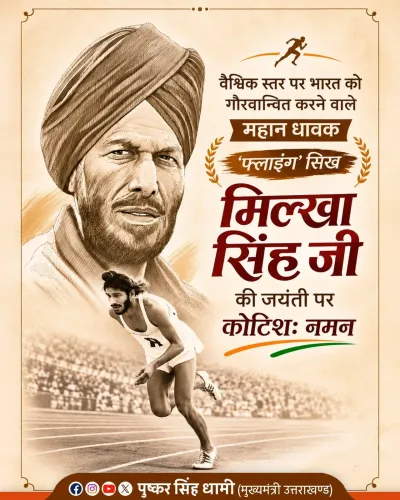
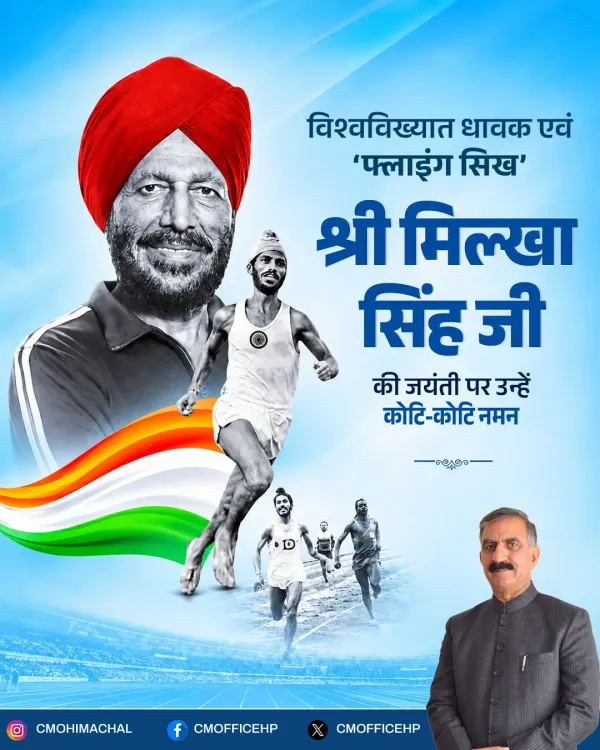
The Chief Minister's Office of Himachal Pradesh paid tribute to legendary sprinter Milkha Singh on 20 November 2026, honouring the 'Flying Sikh' as a timeless symbol of perseverance, dedication, and national pride.
Key Takeaways
The Chief Minister's Office of Himachal Pradesh posted a tribute to Milkha Singh on 20 November 2026 .
Milkha Singh, nicknamed the 'Flying Sikh', was born around 1929 and survived Partition before becoming India's greatest sprinter of his era.
He won gold at the 1958 Commonwealth Games (Cardiff) and the 1958 Asian Games (Tokyo) in the 400-metre/440-yard event.
He competed in three Olympic Games , narrowly missing a bronze at the 1960 Rome Olympics in the 400 metres final.
Milkha Singh passed away on 18 June 2021 , aged 91 .
State governments routinely invoke his legacy in official communications to inspire youth and aspiring athletes.
A life forged in tragedy, defined by speed, and remembered across generations — the Chief Minister's Office of Himachal Pradesh on Friday, 20 November 2026 paid tribute to legendary Indian sprinter Milkha Singh, honouring the 'Flying Sikh' as an enduring symbol of struggle, dedication, and national pride.
The post, shared in Hindi, describes Milkha Singh's life as 'संघर्ष, समर्पण और दृढ़ संकल्प की मिसाल' — 'an example of struggle, dedication, and unwavering resolve' — and credits his relentless effort with writing history and elevating India's name across the world. It closes by calling his extraordinary journey a source of inspiration for every individual, even today.
From Partition's Ashes to Olympic Glory
Milkha Singh's story is one of India's most remarkable sporting biographies. Born around 1929, he survived the horrors of Partition, losing family members in the violence before enlisting in the Indian Army — where he discovered his extraordinary gift for speed. His training under military discipline transformed raw talent into a force that announced itself to the world stage.
At the 1958 Commonwealth Games in Cardiff, he won gold in the 440 yards event, and that same year claimed gold at the Asian Games in Tokyo. He went on to compete in three Olympic Games. His fourth-place finish in the 400 metres final at the 1960 Rome Olympics — missing a bronze medal by a fraction of a second — became one of the most bittersweet moments in Indian sports history, yet it did nothing to diminish his stature. Indian Prime Minister Jawaharlal Nehru himself bestowed the nickname 'Flying Sikh' upon him after a stunning victory over Pakistani rival Abdul Khaliq in a race held in Lahore. Milkha Singh passed away on 18 June 2021, at the age of 91.
Why State Governments Keep Invoking His Name
State government accounts across India routinely mark the anniversaries and birth anniversaries of national sporting icons, and Milkha Singh holds a particularly resonant place in that tradition. His narrative — refugee to champion, adversity to gold — maps neatly onto official messaging around perseverance and patriotism directed at youth and aspiring athletes.
Himachal Pradesh, while not Milkha Singh's home state — his primary association was with Punjab, where he spent most of his life — joins a broader national chorus in keeping his legacy in public consciousness. The post arrives as state governments periodically discuss naming sports infrastructure after icons of his stature, ensuring his story remains tied to living institutions rather than archived memory alone.
Decades after his fastest race, Milkha Singh's life continues to outpace the limits of time — and official India keeps reminding its next generation why.
Point of View
Not merely a Punjab or Army narrative. At a time when India's sports infrastructure ambitions are expanding, official invocations of Milkha Singh also carry an implicit policy subtext: the country has not yet produced a successor of equivalent global resonance in track and field, and his legacy quietly presses that gap into public view.
NationPress
20 Nov 2026
Frequently Asked Questions
Why is Milkha Singh called the Flying Sikh?
Prime Minister Jawaharlal Nehru gave Milkha Singh the nickname 'Flying Sikh' after he defeated Pakistani sprinter Abdul Khaliq in a race held in Lahore, in recognition of his extraordinary speed.
What medals did Milkha Singh win in his career?
Milkha Singh won gold in the 440 yards at the 1958 Commonwealth Games in Cardiff and gold at the 1958 Asian Games in Tokyo. He finished fourth at the 1960 Rome Olympics , narrowly missing a bronze medal.
When did Milkha Singh die?
Milkha Singh passed away on 18 June 2021 , aged approximately 91 , after a brief illness.
Why did the Himachal Pradesh CM Office post a tribute to Milkha Singh?
State government social media accounts in India routinely pay tribute to national sporting icons on commemorative dates. The HP CM Office posted this tribute on 20 November 2026 in keeping with this practice, honouring his life as an inspiration for youth.
How did Milkha Singh overcome hardship to become a champion?
Milkha Singh survived the violence of Partition as a child, losing family members, before joining the Indian Army. It was through military training and relentless personal discipline that he developed the athletic ability that made him a Commonwealth and Asian Games gold medallist.