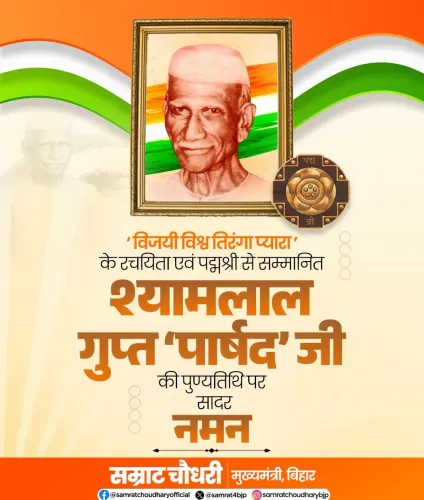
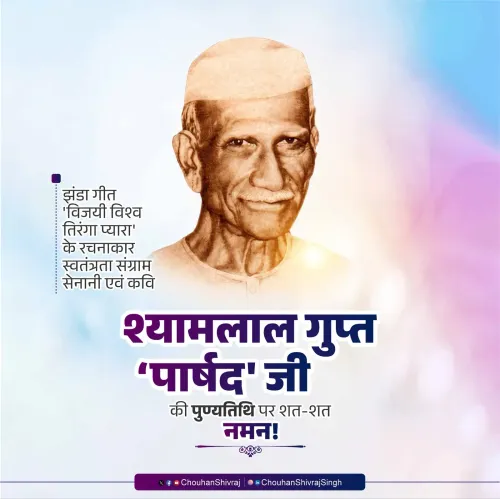
HP CM Office Pays Tribute to Shyamlal Gupta 'Parshad'
Synopsis
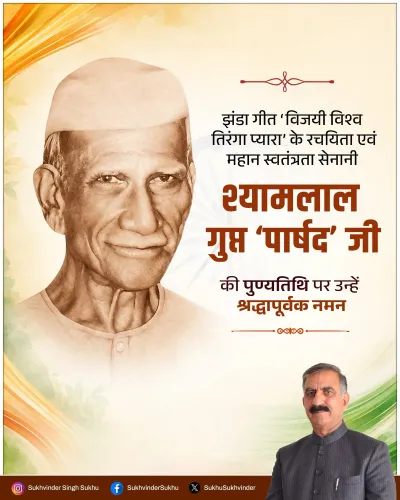
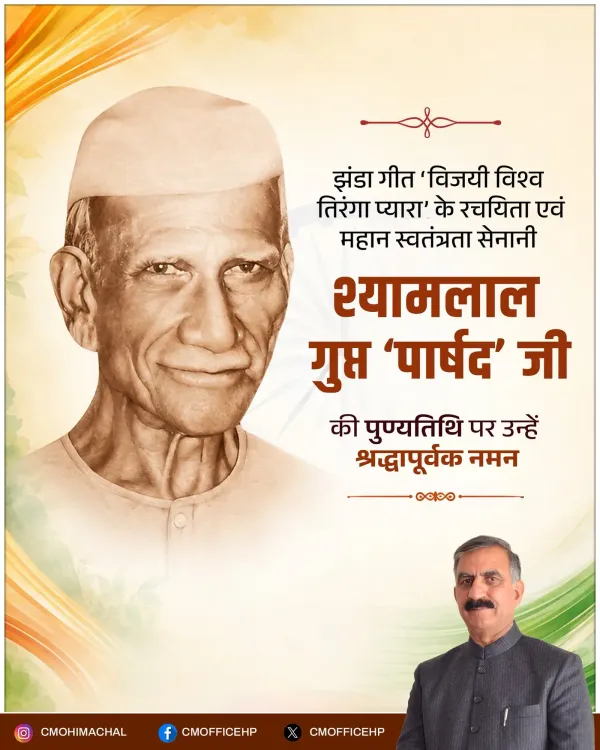
The Chief Minister's Office of Himachal Pradesh honoured Shyamlal Gupta 'Parshad' on his death anniversary, paying tribute to the freedom fighter and journalist who composed the celebrated patriotic flag song 'Vijayi Vishwa Tiranga Pyara' during India's independence movement.
Key Takeaways
The Chief Minister's Office of Himachal Pradesh issued a tribute to Shyamlal Gupta 'Parshad' on his death anniversary on 10 August 2026 .
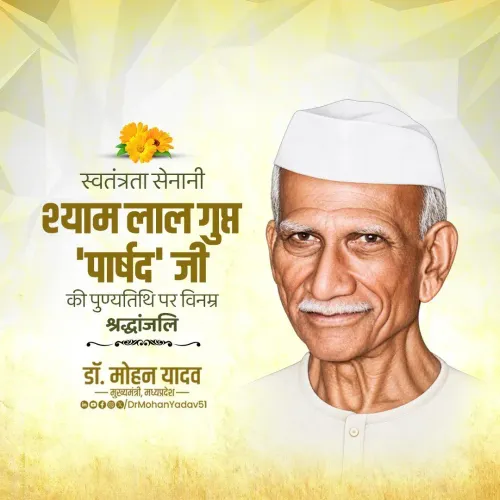
Parshad was a freedom fighter and journalist who composed the patriotic song 'Vijayi Vishwa Tiranga Pyara' during India's independence movement.
The CMO described his love for the nation and his contribution as 'eternally worthy of remembrance.' State governments across India routinely mark independence-era figures' anniversaries with official public tributes.
The man who gave voice to India's tricolour in song is remembered today. On his death anniversary, the Chief Minister's Office of Himachal Pradesh paid tribute to freedom fighter and journalist Shyamlal Gupta 'Parshad', honouring the poet whose immortal lines 'Vijayi Vishwa Tiranga Pyara' became one of the defining anthems of India's independence movement.
'Vijayi Vishwa Tiranga Pyara' — the flag song that endured
Shyamlal Gupta 'Parshad' composed 'Vijayi Vishwa Tiranga Pyara' — rendered in English as 'Victorious is our beloved tricolour of the world' — during the years of India's freedom struggle. The song became a rallying cry, fusing patriotic fervour with the symbolism of the national flag at a time when that flag itself was a declaration of defiance. It remains one of the most recognised flag songs in Indian cultural memory.
Beyond verse, Parshad was also a journalist, wielding the pen across two registers — political commentary and patriotic poetry — in service of the same cause. The CMO's post, in Hindi, offered him shata-shata naman — a hundredfold salute — calling his love for the nation and his contribution 'eternally worthy of remembrance.'
State tributes and the politics of national memory
Indian state governments routinely mark the birth and death anniversaries of independence-era figures with official statements, keeping their legacies woven into contemporary public life. For Himachal Pradesh, such tributes connect the present administration to a broader national heritage — a gesture that transcends party lines and speaks to shared foundational values.
The CMO's acknowledgement of Parshad on 10 August 2026 is a reminder that the figures who shaped India's symbolic vocabulary — its songs, its slogans, its flags — continue to be claimed by the republic they helped build. Parshad's song did not just celebrate the tricolour; it helped make the tricolour feel like something worth celebrating.
As long as the flag flies, the song endures — and so does the man who wrote it.
Frequently Asked Questions
Who was Shyamlal Gupta 'Parshad'?
Shyamlal Gupta 'Parshad' was an Indian freedom fighter and journalist best known for composing the patriotic song 'Vijayi Vishwa Tiranga Pyara,' one of the most celebrated flag songs from India's independence movement.
What is 'Vijayi Vishwa Tiranga Pyara'?
'Vijayi Vishwa Tiranga Pyara,' meaning 'Victorious is our beloved tricolour of the world,' is a patriotic Hindi song composed by Shyamlal Gupta 'Parshad' that became an anthem of India's freedom struggle and remains a widely recognised flag song.
Why did the Himachal Pradesh CMO pay tribute to Shyamlal Gupta Parshad?
The Chief Minister's Office of Himachal Pradesh marked his death anniversary on 10 August 2026 with an official tribute, honouring his contributions as a freedom fighter, journalist, and composer of the immortal patriotic flag song.
What does 'shata-shata naman' mean?
'Shata-shata naman' is a Hindi expression meaning 'a hundredfold salute' or 'deepest respects,' commonly used in India to honour the memory of revered figures, especially freedom fighters.
Do Indian state governments regularly pay tribute to freedom fighters?
Yes, Indian state governments routinely issue official tributes on the birth and death anniversaries of independence-era figures, keeping their legacies part of contemporary public discourse and national memory.