HP CM Office Reiterates 7.19% Chandigarh Stake Claim
Synopsis
The Himachal Pradesh Chief Minister's Office has reiterated the state's claim to a 7.19 per cent share in Chandigarh, invoking the Punjab Reorganisation Act, 1966, which designated HP as a successor state of the erstwhile undivided Punjab. The demand, listed among key state interests, is likely to be taken up with the Ministry of Home Affairs.
Key Takeaways
The Chief Minister's Office of Himachal Pradesh reiterated the state's 7.19 per cent stake claim in Chandigarh on June 26, 2026 .
The claim is based on the Punjab Reorganisation Act, 1966 , which designates Himachal Pradesh as a successor state of the erstwhile undivided Punjab.
Chandigarh was established as a Union Territory under the 1966 reorganisation to serve as joint capital of Punjab and Haryana .
Himachal Pradesh gained full statehood in 1971 , having previously been a Union Territory carved from Punjab's hill districts.
Inter-state disputes over Chandigarh's assets and administrative shares have remained unresolved for over six decades.
Any formal resolution would likely require engagement with the Ministry of Home Affairs or an inter-state council process.
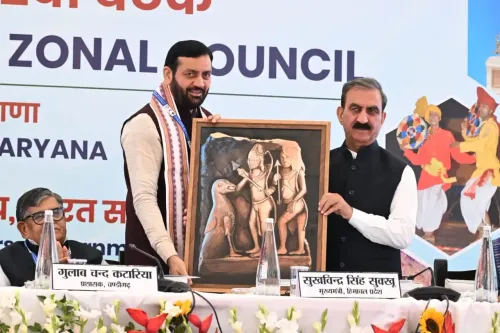
The Chief Minister's Office of Himachal Pradesh on Friday, June 26, 2026, reiterated the state's claim to a 7.19 per cent share in the Union Territory of Chandigarh, asserting that Himachal Pradesh is a legitimate successor state of the erstwhile undivided Punjab under the Punjab Reorganisation Act, 1966.
Context
The post, shared on the official CMO Himachal Pradesh account, listed the Chandigarh stake as one of the 'प्रमुख मुद्दे' ('key issues') linked to the interests of Himachal Pradesh. The office stated that the claim to 7.19 per cent of Chandigarh's assets and administrative share has been 'reiterated', signalling that the demand has been raised formally with the relevant authorities.
The assertion is grounded in the argument that Himachal Pradesh qualifies as a successor state to the pre-1966 undivided Punjab, which was bifurcated by the Punjab Reorganisation Act, 1966 — the same legislation that created Haryana and designated Chandigarh as a Union Territory serving as joint capital for both Punjab and Haryana.
Policy Backdrop
The Punjab Reorganisation Act, 1966 is the central piece of legislation that redrew the map of the former Punjab state, transferring assets, liabilities, and administrative rights among the successor entities — Punjab, Haryana, and Himachal Pradesh. Himachal Pradesh had been carved out as a Union Territory from Punjab's hill districts before gaining full statehood in 1971.
Disputes over the division of shared assets — including river waters, capital infrastructure in Chandigarh, and administrative stakes — have persisted among the successor states since the reorganisation. The Ministry of Home Affairs has historically served as the final arbiter in such inter-state and state-union territory disputes, with no permanent resolution reached on several outstanding claims.
Stakeholders and Impact
The principal stakeholders in this assertion are the governments of Himachal Pradesh, Punjab, Haryana, and the Chandigarh Administration. Any recognition of Himachal Pradesh's claimed share could affect the administrative and financial structure of the Union Territory, with implications for revenue, infrastructure ownership, and governance arrangements in Chandigarh.
Residents and institutions in Chandigarh, as well as state-level bureaucracies in all three successor states, would be directly affected by any formal negotiation or settlement arising from this claim. The broader pattern of such inter-state assertions suggests that resolution, if pursued, would require engagement at the level of an inter-state council or a central government-mediated process.
What's Next
The reiteration by the Himachal Pradesh CMO is likely to be followed by formal communication to the Ministry of Home Affairs or a reference to the appropriate inter-state forum. Observers of federal governance in India will watch for whether this assertion prompts a structured dialogue among Punjab, Haryana, Himachal Pradesh, and the Centre on the long-pending question of Chandigarh's asset-sharing framework.
With multiple successor-state claims from the 1966 reorganisation still unresolved after six decades, any forward movement on Himachal Pradesh's 7.19 per cent stake demand could set a precedent for how similar legacy disputes are adjudicated in Indian federalism.
Point of View
Likely ahead of formal engagement with the Centre. The invocation of the Punjab Reorganisation Act, 1966 is legally significant — it frames the demand not as a political aspiration but as a statutory entitlement, raising the stakes for any inter-ministerial response. Such assertions from hill states often serve dual purposes: applying pressure in ongoing Centre-state negotiations and signalling to the domestic electorate that the government is pursuing long-standing state interests. After six decades of ambiguity, a structured resolution on Chandigarh's asset-sharing formula could reopen a broader conversation about unfinished business from India's 1966 linguistic reorganisation of states.
NationPress
26 Jun 2026
Frequently Asked Questions
What is Himachal Pradesh's claim over Chandigarh?
Himachal Pradesh claims a 7.19 per cent share in the Union Territory of Chandigarh, arguing that it is a successor state of the erstwhile undivided Punjab under the Punjab Reorganisation Act, 1966.
Why does Himachal Pradesh consider itself a successor state of Punjab?
The Punjab Reorganisation Act, 1966 bifurcated the former Punjab state and established Himachal Pradesh — along with Haryana — as a successor entity, giving it legal standing to claim a share of shared assets including Chandigarh.
What is the Punjab Reorganisation Act, 1966?
The Punjab Reorganisation Act, 1966 is a central legislation that divided the former Punjab into the states of Punjab and Haryana, and designated Chandigarh as a Union Territory to serve as joint capital for both states.
Who decides inter-state disputes over Chandigarh assets?
The Ministry of Home Affairs has historically served as the primary arbiter in disputes between successor states and the Chandigarh administration, with inter-state councils also playing a role in formal negotiations.
Has Himachal Pradesh's Chandigarh claim been resolved?
No. Like several other legacy disputes arising from the 1966 Punjab reorganisation, Himachal Pradesh's stake claim in Chandigarh remains unresolved and has been periodically reiterated by successive state governments.