HP CM Office Asserts Chandigarh Share Based on Population
Synopsis
The Chief Minister's Office of Himachal Pradesh has publicly claimed a population-proportionate share in Chandigarh, arguing that the Union Territory was built on undivided Punjab's collective resources but has exclusively benefited Punjab and Haryana for over five decades.
Key Takeaways
The CM Office of Himachal Pradesh posted on 26 June 2026 asserting a rightful share in Chandigarh based on population of transferred territories.
The post argues that Chandigarh was developed using resources of undivided Punjab , which included areas now in Himachal Pradesh .
Only Punjab and Haryana have benefited from Chandigarh 's land, assets, and administration for the past five decades , according to the post.
The dispute has roots in the Punjab Reorganisation Act of 1966 , which created Haryana , transferred hill areas to Himachal Pradesh , and made Chandigarh a Union Territory.
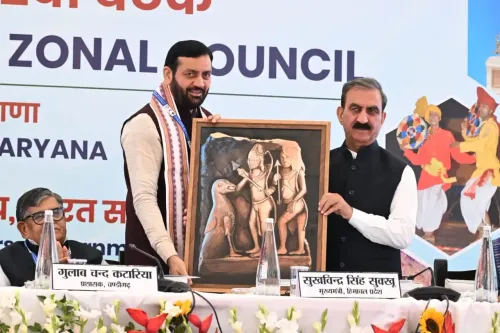
Any resolution would require intervention by the Union Ministry of Home Affairs or the Northern Zonal Council .
The Chief Minister's Office of Himachal Pradesh on Friday, 26 June 2026, publicly asserted that the state holds a rightful share in Chandigarh proportionate to the population of territories transferred to it during the 1966 Punjab reorganisation, reigniting a long-standing interstate resource dispute over the Union Territory.
Context
The post, written in Hindi, states that Himachal Pradesh 'हस्तांतरित क्षेत्रों की जनसंख्या के अनुपात में चंडीगढ़ में हिस्सेदारी का अधिकार रखता है' ('holds the right to a share in Chandigarh in proportion to the population of transferred territories'). It further argues that Chandigarh's development was financed by the combined resources of undivided Punjab, yet for the past five decades, only Punjab and Haryana have benefited from its land, assets, and administrative machinery.
The assertion draws a direct line between historical resource contribution and present-day administrative entitlement — a framing that challenges the current bilateral arrangement between Punjab and Haryana over the Union Territory.
Policy Backdrop
The Punjab Reorganisation Act of 1966 bifurcated the former Punjab state, carved out Haryana, and designated Chandigarh as a Union Territory to serve as joint capital for both successor states. Certain hill districts were simultaneously transferred to what was then the Union Territory of Himachal Pradesh, which attained full statehood in 1971.
Because Chandigarh was built using the collective resources of undivided Punjab — which included the hill regions that later became Himachal Pradesh — the Himachal Pradesh government's position is that its exclusion from the city's governance and asset base is historically inequitable. Disputes over Chandigarh's status, land, and administrative benefits have recurred since 1966, primarily between Punjab and Haryana, with Himachal Pradesh periodically raising claims grounded in this historical contribution argument.
Stakeholders and Impact
Three state governments — Himachal Pradesh, Punjab, and Haryana — along with the Union Ministry of Home Affairs, which directly administers Chandigarh as a Union Territory, are the primary stakeholders in any resolution of this dispute. A formal recognition of Himachal Pradesh's population-proportionate claim could have significant implications for land allocation, revenue sharing, and administrative representation in the city.
Residents and institutions in Chandigarh itself could be affected by any restructuring of governance arrangements, while the broader precedent could influence asset-sharing negotiations in other states that emerged from post-independence linguistic reorganisation.
What's Next
Any substantive movement on this claim would require engagement with the Union Ministry of Home Affairs or a formal agenda item at the Northern Zonal Council, the inter-state body that coordinates governance issues among northern Indian states. The Himachal Pradesh government's public assertion via the official CM Office account signals an intent to keep the issue in the political discourse ahead of any such multilateral forum.
If the Centre or the affected states respond formally, the debate could escalate into a structured negotiation — or a legal challenge — over one of India's most enduring post-reorganisation administrative legacies.
Point of View
The state is framing an equity-based case that is harder to dismiss than a purely political demand. This move fits a broader pattern of smaller states using official social-media channels to stake positions ahead of zonal council or Centre-mediated negotiations. Whether this translates into a formal legal or administrative challenge will depend on New Delhi's willingness to revisit the 1966 settlement.
NationPress
11 Aug 2026
Frequently Asked Questions
Why does Himachal Pradesh claim a share in Chandigarh?
Himachal Pradesh argues that Chandigarh was built using the collective resources of undivided Punjab, which included territories later transferred to Himachal Pradesh, and that the state therefore deserves a share proportionate to those transferred populations.
What is the history of the Chandigarh dispute between Punjab, Haryana, and Himachal Pradesh?
The Punjab Reorganisation Act of 1966 created Haryana, transferred hill areas to Himachal Pradesh, and made Chandigarh a Union Territory serving as joint capital for Punjab and Haryana. Himachal Pradesh has periodically raised claims based on its historical connection to undivided Punjab's resources.
Who administers Chandigarh today?
Chandigarh is a Union Territory administered directly by the central government through the Union Ministry of Home Affairs, while serving as the joint capital of Punjab and Haryana.
What did the HP CM Office say about Chandigarh on 26 June 2026?
The CM Office of Himachal Pradesh stated that the state holds a rightful share in Chandigarh in proportion to the population of territories transferred to it in 1966, and that Punjab and Haryana have exclusively benefited from the city's assets for over five decades.
What body could resolve the Chandigarh resource-sharing dispute?
The Union Ministry of Home Affairs, which directly administers Chandigarh, or the Northern Zonal Council, the inter-state coordination body for northern India, would be the appropriate forums to address any formal claim on Chandigarh's assets.