HP CM Sukhu Clears Long-Pending Compassionate Appointments

Synopsis
The Himachal Pradesh Chief Minister's Office says CM Sukhu's government has prioritised clearing years-pending compassionate ground appointments for dependents of deceased state employees, framing it as a shift from struggle to dignity.
Key Takeaways
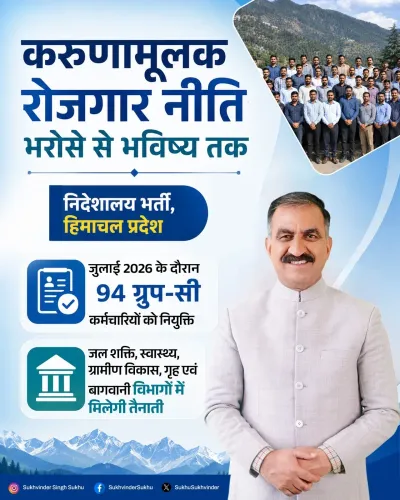
The Chief Minister's Office of Himachal Pradesh announced on 30 July 2026 that long-pending compassionate appointments are being cleared as a government priority.
Compassionate appointments provide state government jobs to dependents of deceased government employees outside the normal competitive process.
CM Thakur Sukhvinder Singh Sukhu , in office since December 2022 , framed the move as addressing concerns of families that have waited years for relief.
Backlogs in compassionate appointments are a common administrative challenge across Indian states, driven by fiscal limits and cadre strength rules.
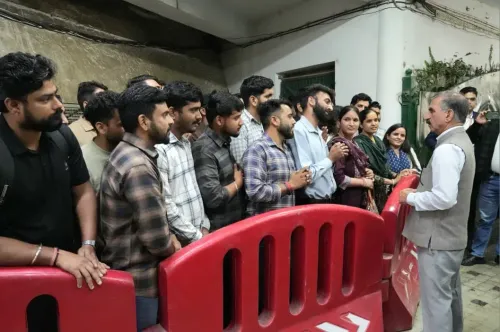
The government is using individual beneficiary testimonials to communicate the human impact of the policy.
For families that lost their sole breadwinner in government service, the wait has sometimes stretched years — even decades. The Chief Minister's Office of Himachal Pradesh announced on Thursday, 30 July 2026 that the Sukhu government has made clearing long-pending compassionate ground appointments a stated priority, sharing what it called a story of 'struggle to dignity.'
Posting in Hindi, Chief Minister Thakur Sukhvinder Singh Sukhu said: 'Our government, understanding the concerns of such families, has prioritised compassionate appointments that have been pending for years. Listen to the story — from struggle to dignity.' The message was accompanied by an appeal to hear directly from a beneficiary, framing the policy not as bureaucratic housekeeping but as a human reckoning.
What compassionate appointments actually mean
Under Himachal Pradesh's compassionate appointment rules — a framework common across Indian states — a dependent of a deceased government employee can apply for a state job outside the normal competitive process. The intent is immediate relief: the family loses its income, and the state steps in with employment rather than just a one-time payment. In practice, however, backlogs accumulate. Fiscal constraints, cadre strength ceilings, and procedural layers mean applications pile up across successive governments, sometimes for years.A backlog inherited, now being addressed
The Congress government that took office in December 2022 under Sukhu inherited a queue of such pending cases from previous administrations. Announcing priority clearance of these appointments is a visible welfare signal — it costs the state a relatively modest outlay in new positions while delivering direct, named relief to identifiable families. New administrations across India have repeatedly used such drives to demonstrate responsiveness in the early years of a term. The specific number of cases cleared or pending since the current government took office has not been officially confirmed in public records, but the Chief Minister's Office framing — 'years-long pending' — signals the scale is significant enough to warrant a public communications campaign built around individual testimonials. For the families involved, the kicker is not a policy document. It is a salary slip arriving where there was none before.Point of View
High-visibility welfare move that directly benefits an identifiable constituency — families of deceased government employees — making it a reliable early-term signal for any state government. For the Sukhu administration, which has governed Himachal Pradesh since December 2022, prioritising these cases also implicitly contrasts its record with predecessor governments under whose watch the backlog accumulated. The testimonial-driven communication strategy suggests the government sees this not just as an administrative fix but as a narrative asset heading into the political cycle. Whether the actual numbers cleared are commensurate with the scale of pending cases will be the real measure of delivery.
NationPress
13 Sept 2026
Frequently Asked Questions
What is a compassionate appointment in Himachal Pradesh?
A compassionate appointment is a provision under Himachal Pradesh state service rules that allows a dependent of a deceased government employee to be appointed to a government job without going through the normal competitive recruitment process, providing immediate financial support to the bereaved family.
Why were compassionate appointments pending for years in Himachal Pradesh?
Backlogs in compassionate appointments typically build up due to fiscal constraints, limits on cadre strength, and procedural delays in state personnel departments — a pattern seen across multiple Indian states and across successive governments in Himachal Pradesh.
Who is CM Sukhvinder Singh Sukhu?
Thakur Sukhvinder Singh Sukhu is the Chief Minister of Himachal Pradesh, leading a Congress government that came to power in December 2022 .
How many compassionate appointments has the Sukhu government cleared?
The exact number of cases cleared since the current government took office has not been confirmed in official public records. The Chief Minister's Office has described the pending cases as 'years-long' without specifying a figure.
What is the significance of the 'struggle to dignity' framing used by the CM's office?
The phrase 'sangharsh se samman tak' (struggle to dignity) is a communications framing that personalises a policy action, shifting the narrative from bureaucratic clearance to human relief — a common strategy used by state governments to highlight welfare delivery through individual beneficiary stories.