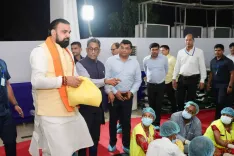
HP CM Office: Govt school students second to none, reforms underway
Synopsis
The Himachal Pradesh Chief Minister's Office on 3 July 2026 declared that government school students are second to none and announced comprehensive education reforms aimed at systemic transformation, going beyond infrastructure to holistic student development.
Key Takeaways
The Chief Minister's Office of Himachal Pradesh posted on 3 July 2026 asserting that government school students are 'second to none in any field.' The state government has announced comprehensive education reforms framed as 'system transformation,' not merely infrastructure upgrades.
The stated goal is to equip every student — not just improve school buildings — signalling a shift toward outcome-focused policy.
Himachal Pradesh has historically maintained above-average literacy rates, giving the state a foundation for deeper quality reforms.
The reforms align with the National Education Policy 2020 and the Samagra Shiksha scheme, both of which direct states to narrow the quality gap between government and private schools.
Concrete budget allocations and NEP-aligned curriculum rollouts will be the next indicators of whether the reform commitment is backed by action.
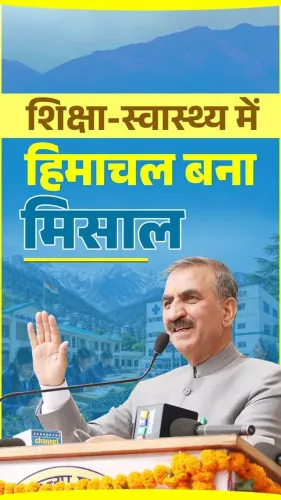
The Chief Minister's Office of Himachal Pradesh on Friday, 3 July 2026 reaffirmed the state government's commitment to sweeping education reforms, declaring that students in government schools are 'second to none in any field' and that the administration has launched comprehensive changes in the sector with a resolve to transform the system.
The post, shared on the official CMO Himachal Pradesh X account, stated in Hindi: 'तो सरकारी स्कूलों के बच्चे किसी भी क्षेत्र में किसी से कम नहीं हैं' ('So children of government schools are no less than anyone in any field'). It added that the government's objective is not merely to strengthen the basic infrastructure of schools, but to equip every student with the tools needed to compete and excel.
Context
Himachal Pradesh has historically maintained literacy rates above the national average, backed by decades of public investment in schooling across its mountainous terrain. The state's government school network serves a significant share of the student population, particularly in rural and remote hill districts where private alternatives are scarce or unaffordable.
The CMO's statement signals a deliberate effort to reframe public schooling — not as a fallback option, but as a quality choice — at a time when perceptions of a quality gap between government and private institutions continue to influence enrolment patterns across India.
Policy Backdrop
The assertion aligns with the National Education Policy (NEP) 2020, the central framework that replaced the 1986 policy and directed states to shift focus from rote learning to holistic, multidisciplinary and equitable education. NEP 2020 explicitly tasked state governments with upgrading government school infrastructure and narrowing outcome gaps with private institutions.
Samagra Shiksha, the integrated centrally sponsored scheme operational since 2018-19, has been a key financial instrument for this effort. By subsuming earlier schemes covering elementary and secondary education as well as teacher training, it provided states including Himachal Pradesh with consolidated funding to address both physical infrastructure and pedagogical quality.
Multiple Indian states have made similar public commitments to positioning government schools as competitive on outcomes after 2020, reflecting a nationwide pattern of policy signalling in the education sector.
Stakeholders and Impact
The primary beneficiaries of the stated reforms are government school students and their families across Himachal Pradesh, many of whom depend on the public school system as their only accessible option. Public school teachers stand as both implementers and stakeholders, with any curriculum or pedagogical reform directly affecting their professional responsibilities and training needs.
For rural and economically weaker families, a credible improvement in government school quality can reduce the financial pressure of seeking private schooling, with downstream effects on household spending and student retention rates.
What's Next
Observers will watch Himachal Pradesh's upcoming state budget presentations for concrete education allocations that back the reform rhetoric. Formal rollout of NEP-aligned curriculum, teacher recruitment drives, and infrastructure upgrade timelines will be the measurable indicators of whether the stated 'system transformation' translates into policy action on the ground.
The government's ability to demonstrate tangible outcomes — improved learning levels, reduced dropout rates, and stronger board examination results from government schools — will determine how this reform narrative is received by parents, educators, and the broader electorate.
Point of View
A framing that has gained traction across several Indian states since NEP 2020 raised the political stakes of public education outcomes. The statement's emphasis on 'system transformation' rather than incremental upgrades suggests the government is aware that infrastructure spending alone no longer satisfies an electorate that benchmarks schools by results. However, with the post text truncated and no specific scheme, budget figure, or timeline cited, the declaration remains aspirational until backed by measurable policy action. The broader pattern across India shows that such positioning announcements tend to precede budget cycles or election seasons, making the timing worth watching.
NationPress
1 Oct 2026
Frequently Asked Questions
What did the Himachal Pradesh CMO say about government schools?
The Chief Minister's Office of Himachal Pradesh stated on 3 July 2026 that children in government schools are 'second to none in any field' and that the government has launched comprehensive education reforms with a resolve to transform the system, going beyond basic infrastructure.
What education reforms is Himachal Pradesh planning?
The CMO announced that the state's objective is not merely to strengthen school infrastructure but to equip every student comprehensively. Specific schemes and timelines were not detailed in the post, but the reforms are framed within the broader context of NEP 2020 and the Samagra Shiksha scheme.
How does NEP 2020 affect Himachal Pradesh schools?
The National Education Policy 2020 directed all states, including Himachal Pradesh, to shift from rote learning to holistic education, upgrade government school infrastructure, and narrow the quality gap with private institutions. Himachal Pradesh has been implementing components of this policy through the Samagra Shiksha scheme.
What is the Samagra Shiksha scheme?
Samagra Shiksha is a centrally sponsored integrated scheme launched in 2018-19 that merged earlier elementary and secondary education programmes to provide consolidated funding for school infrastructure, teacher training, and quality improvement across India, including in Himachal Pradesh.
Are government schools in Himachal Pradesh better than private schools?
Himachal Pradesh has historically maintained literacy rates above the national average, reflecting sustained public investment in schooling. The state government's latest statements assert that government school students are competitive with peers from any background, though independent outcome comparisons depend on board results and learning assessments that are tracked over time.