HP CM Office: Women's Property Ownership Builds Confidence
Synopsis
The Chief Minister's Office of Himachal Pradesh has highlighted property ownership as a cornerstone of women's economic security and self-confidence, signalling the state government's focus on translating legal inheritance rights into real asset control for women and rural households.
Key Takeaways
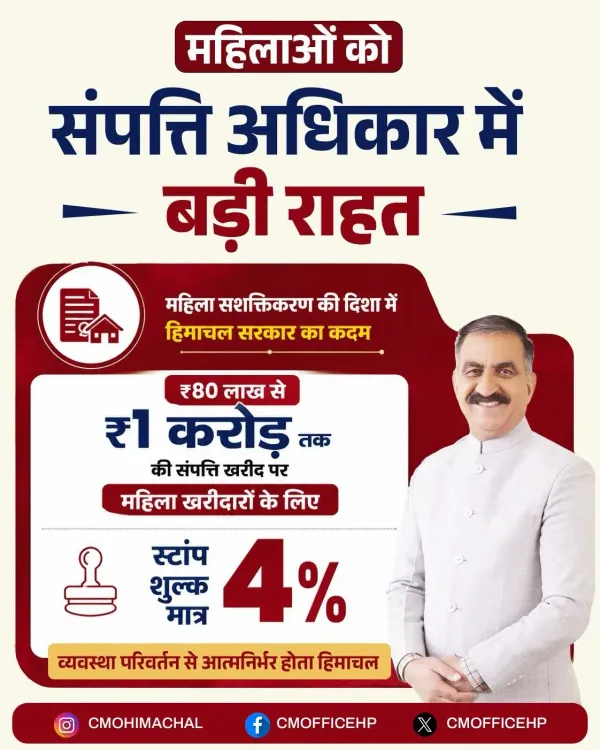
The Chief Minister's Office of Himachal Pradesh posted on 6 June 2026 emphasising women's property ownership as key to family economic security.
The post states that adding a woman's name to a property increases her self-confidence and contributes to household stability.
The message builds on the Hindu Succession (Amendment) Act, 2005 , which gave daughters equal inheritance rights in ancestral property.
A gap persists between legal entitlement and actual property registration in women's names, particularly in rural Himachal Pradesh .
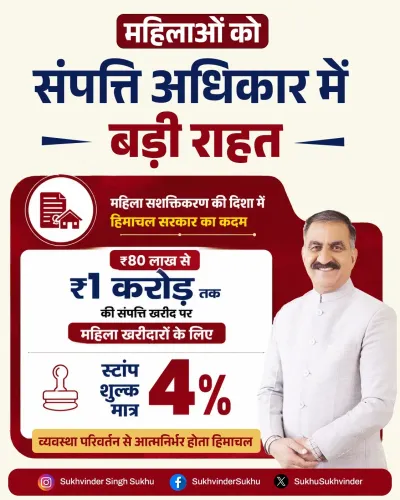
Analysts will watch for follow-up measures such as stamp-duty concessions , joint-titling drives, or budget incentives for female property registration.
The initiative aligns with UN SDG-5 targets on gender equality and women's economic empowerment.
The Chief Minister's Office of Himachal Pradesh on Saturday, 6 June 2026 underscored the centrality of property ownership to women's economic security and self-confidence, sharing a message that positions asset titling in a woman's name as a pillar of household stability and female empowerment.
Context
The post, shared in Hindi, states: 'Ghar-parivaar ki aarthik suraksha aur bhavishy ki sthirta mein sampatti ka swamitva mahatvapurn bhumika nibhata hai. Jab kisi sampatti mein mahila ka naam judta hai, to uska aatmavishwas badhta hai.' In English: 'Property ownership plays an important role in the economic security of the family and the stability of the future. When a woman's name is added to a property, her self-confidence grows.' The statement, while general in nature, signals the Himachal Pradesh government's continued emphasis on translating women's legal rights into tangible asset control.
Policy Backdrop
The message draws its legal foundation from the Hindu Succession (Amendment) Act, 2005, which granted daughters equal coparcenary rights in ancestral Hindu joint-family property — a landmark shift in inheritance law across India. Despite this national legislation, the gap between legal entitlement and actual property registration in women's names has remained wide in many states, including in rural Himachal Pradesh.
Several Indian states have periodically introduced stamp-duty concessions and joint-titling drives to bridge this gap, aligning with UN Sustainable Development Goal 5 on gender equality and women's economic empowerment. Such measures aim to move female ownership from paper rights to real household decision-making power.
Stakeholders and Impact
The primary beneficiaries of stronger female property rights are women in rural households, who historically have had limited control over family assets despite contributing substantially to agricultural and domestic labour. When a woman holds title to land or a home, research consistently links this to improved access to credit, greater bargaining power within the household, and better outcomes for children's education and health.
For Himachal Pradesh — a predominantly hilly, rural state — formalising women's names on property records can also serve as a gateway to government welfare schemes that use land ownership as an eligibility criterion. District administrations and revenue departments are key institutional actors in making such transitions happen on the ground.
What's Next
Observers will watch whether this statement from the Chief Minister's Office is followed by concrete district-level drives for joint titling or reduced registration fees for properties registered in women's names. Any inclusion of property-linked incentives for female ownership in Himachal Pradesh's next state budget would be a direct policy translation of this stated intent. The government's messaging aligns with a broader national pattern of using awareness campaigns to complement legal reform — the next step is institutional action that ensures the sentiment becomes a measurable shift in property records across the state.
Point of View
The CMO is attempting to make a dry administrative subject emotionally resonant for rural women voters. The statement, however, remains aspirational until backed by specific schemes, and its real significance will only be measurable if district-level registration data shows a meaningful uptick in female-named titles. In the broader arc of Indian state politics, welfare messaging around women's economic rights has proven electorally effective, making this post as much a political signal as a policy one.
NationPress
21 Oct 2026
Frequently Asked Questions
Why is property ownership important for women in Himachal Pradesh?
Property ownership gives women in Himachal Pradesh direct control over a household asset, which boosts their self-confidence, improves access to credit, and strengthens their bargaining power within the family — as highlighted by the Chief Minister's Office on 6 June 2026.
What law gives women equal property rights in India?
The Hindu Succession (Amendment) Act, 2005 grants daughters equal coparcenary rights in ancestral Hindu joint-family property, forming the legal backbone for women's property ownership across India including Himachal Pradesh.
Does the Himachal Pradesh government offer any scheme for women's property registration?
As of the CMO's post on 6 June 2026, no specific new scheme was announced; the statement was a general affirmation of the value of female property ownership. Observers are watching for possible stamp-duty concessions or joint-titling drives in the next state budget.
How does registering property in a woman's name benefit the family?
When a woman's name is on a property title, it enhances household economic security, can unlock eligibility for government welfare schemes that require land ownership, and is linked to better outcomes in children's education and health, according to broader research on female asset control.
What is the HP CMO's stance on women's economic empowerment?
The Chief Minister's Office of Himachal Pradesh has publicly stated that property ownership plays an important role in family financial security and that adding a woman's name to a property increases her self-confidence, signalling a pro-empowerment policy direction.