HP CM Office Cuts Stamp Duty for Women Buying Property
Synopsis
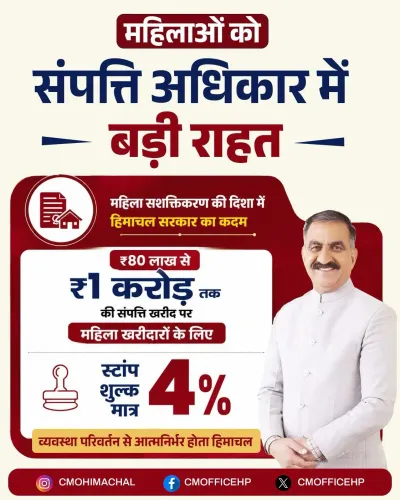
The Himachal Pradesh government has announced a special stamp duty concession for women, fixing the rate at 4 per cent for property purchases valued between Rs 80 lakh and Rs 1 crore, in a bid to strengthen female economic empowerment through asset ownership.
Key Takeaways
The Chief Minister's Office of Himachal Pradesh announced the concession on 6 June 2026 .
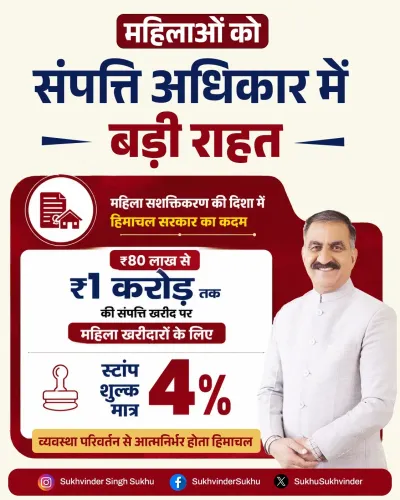
Women buying property worth between Rs 80 lakh and Rs 1 crore will pay stamp duty at a flat 4 per cent rate.
The stated objective is to economically empower women through increased property ownership.
The move aligns with a broader national pattern of Indian states using stamp duty relief as a financial-inclusion tool for women.
A formal government notification with the effective date and eligibility details is yet to be issued.
The Chief Minister's Office of Himachal Pradesh announced on Saturday, 6 June 2026, that the state government has decided to grant a special concession on stamp duty for women purchasing property, with the explicit aim of advancing their economic empowerment.
What the Announcement Says
The post, shared by the Chief Minister's Office of Himachal Pradesh, states: 'महिलाओं को आर्थिक रूप से सशक्त बनाने के उद्देश्य से हमारी सरकार ने संपत्ति खरीदने पर स्टाम्प ड्यूटी में विशेष छूट देने का निर्णय लिया है' — 'With the objective of economically empowering women, our government has decided to grant a special concession on stamp duty for the purchase of property.' Under the scheme, women buying property valued between Rs 80 lakh and Rs 1 crore will be liable to pay stamp duty at a reduced flat rate of only 4 per cent. The government says the initiative will strengthen women's economic standing.
Context
Stamp duty is a state-levied tax on property registration and is typically one of the largest transaction costs a homebuyer faces. In Himachal Pradesh, as in most Indian states, the rate has historically been higher than the 4 per cent now proposed for this category of women buyers. The Rs 80 lakh–Rs 1 crore band targets the mid-to-upper segment of the residential property market — a range increasingly relevant in urban and semi-urban pockets of the state such as Shimla, Dharamsala, and Solan.
Policy Backdrop
Stamp duty concessions for women homebuyers are not new to India's policy landscape. Several states — including Delhi, Uttar Pradesh, Punjab, and Rajasthan — have at various points offered reduced rates when property is registered in a woman's name, as part of broader financial-inclusion and gender-equity drives. These measures are widely regarded as low-cost fiscal tools that simultaneously boost female asset ownership and incentivise formal property registration. The Government of Himachal Pradesh's move fits squarely within this national pattern, extending the practice to a hill state where female labour-force participation and asset ownership have historically lagged urban plains counterparts.
Stakeholders and Impact
The primary beneficiaries are women homebuyers in Himachal Pradesh who are in the market for properties priced between Rs 80 lakh and Rs 1 crore. For a property at the upper end of that band, a 4 per cent rate instead of a higher prevailing rate translates into meaningful savings — potentially several lakh rupees — at the point of registration. Property developers, co-registrants, and financial institutions active in the state's housing market are also indirect stakeholders, as the concession could stimulate demand in this value segment. Women's rights advocates and financial-inclusion practitioners are likely to view the move as a positive, if incremental, step toward closing the gender gap in asset holding.
What's Next
The state government is expected to issue a formal notification specifying the effective date of the concession, eligibility conditions, and the registration process women buyers must follow to avail the reduced rate. Observers will watch whether the concession is extended to properties above Rs 1 crore or below Rs 80 lakh in subsequent revisions. Longer-term, the share of properties in this value band registered in women's names will serve as a practical metric of the policy's reach and effectiveness.
Point of View
The move signals intent to bring mid-market women buyers into formal property ownership, a segment often overlooked by welfare schemes aimed at the economically weaker sections. The announcement fits a decade-long national arc of state governments competing to improve female asset-ownership metrics, partly driven by central government nudges on financial inclusion. The real test will be uptake data: whether the concession is substantial enough to shift buyer behaviour in a market where women's independent property purchases remain the exception rather than the norm.
NationPress
24 Sept 2026
Frequently Asked Questions
What is the new stamp duty rate for women buying property in Himachal Pradesh?
The Himachal Pradesh government has announced a stamp duty rate of 4 per cent for women purchasing property valued between Rs 80 lakh and Rs 1 crore.
Who is eligible for the stamp duty concession in Himachal Pradesh?
The concession is aimed at women homebuyers in Himachal Pradesh purchasing property in the Rs 80 lakh to Rs 1 crore price range. A formal government notification with full eligibility details is awaited.
Why is Himachal Pradesh reducing stamp duty for women?
The stated purpose is to economically empower women by making property ownership more affordable, thereby helping close the gender gap in asset holding.
When will the reduced stamp duty for women in Himachal Pradesh come into effect?
The exact implementation date has not been officially confirmed yet. The government is expected to release a formal notification with the effective date and registration process.
Do other Indian states offer stamp duty concessions for women?
Yes, several states including Delhi, Uttar Pradesh, Punjab, and Rajasthan have at various points offered reduced stamp duty rates when property is registered in a woman's name, as part of financial-inclusion efforts.