HP CM Office launches 3-Tesla MRI at Shimla's Chamiana Hospital
Synopsis
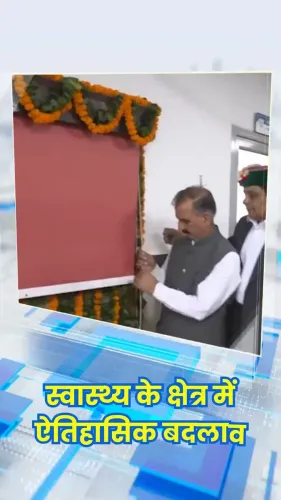
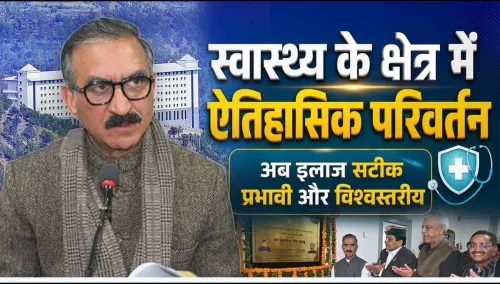
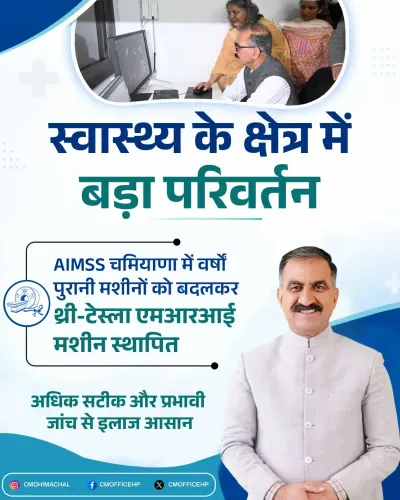
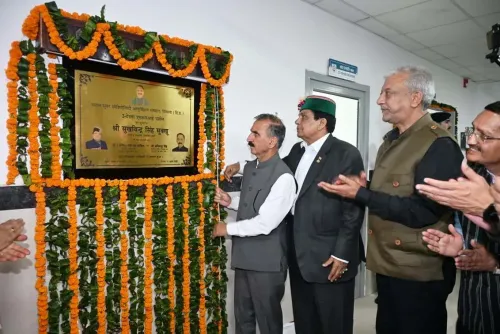
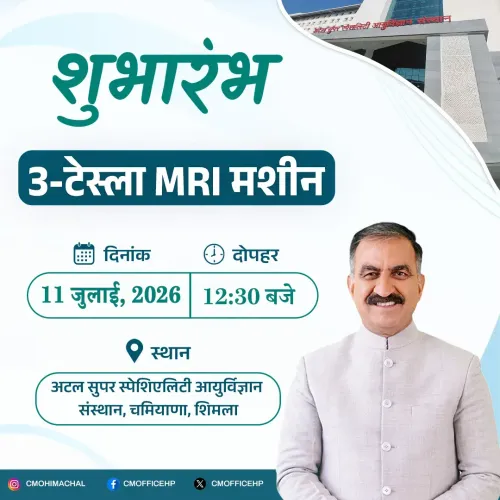
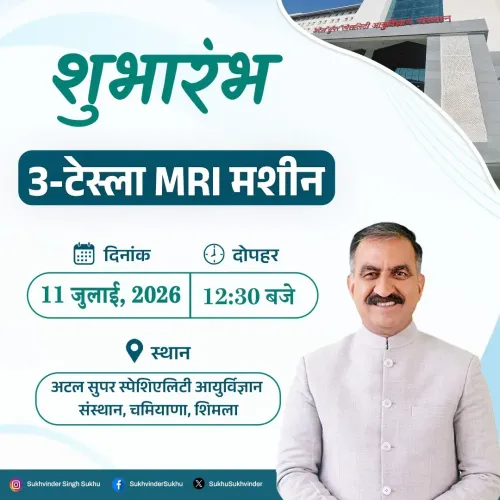
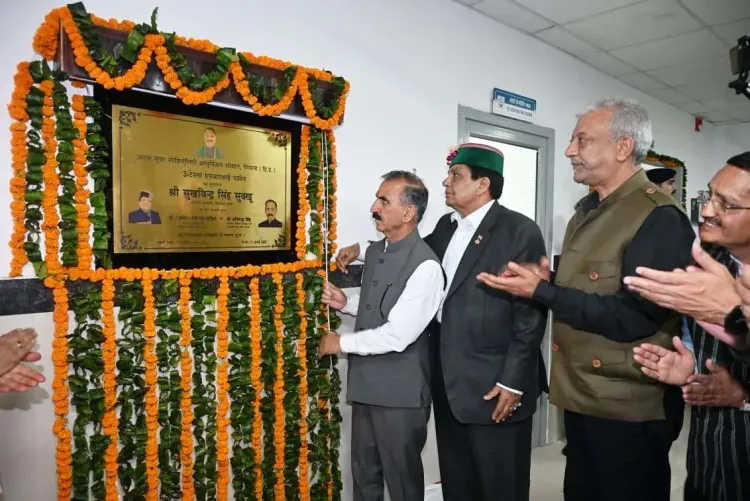
The Chief Minister's Office of Himachal Pradesh announced the inauguration of a 3-Tesla MRI facility at Super Specialty Hospital Chamiana, Shimla on 11 July 2026, making AIMSS the second government institution in the state after IGMC Shimla to offer this advanced diagnostic technology.
Key Takeaways
A 3-Tesla MRI facility was inaugurated at Super Specialty Hospital, Chamiana, Shimla on 11 July 2026 .
AIMSS Chamiana is now the second government health institution in Himachal Pradesh to offer 3-Tesla MRI, after IGMC Shimla .
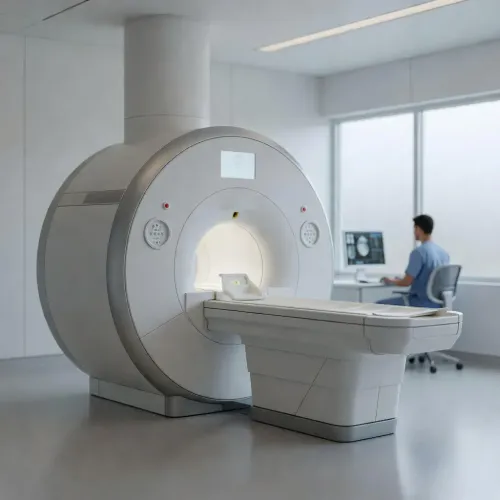
3-Tesla MRI delivers sharper imaging than standard 1.5-Tesla units, aiding diagnosis of neurological, oncological, and musculoskeletal conditions.
Public availability of this technology reduces dependence on costly private-sector scans for patients in Shimla district .
The development extends Himachal Pradesh's two-tier public referral model for advanced diagnostics within the state capital region.
Integration with state health insurance schemes and expansion to district-level hospitals remains the next policy milestone to watch.
The Chief Minister's Office of Himachal Pradesh announced on Saturday, 11 July 2026 the inauguration of a state-of-the-art 3-Tesla MRI facility at the Super Specialty Hospital, Chamiana, Shimla, marking a significant upgrade to public healthcare infrastructure in the hill state.
What Was Launched
The CMO's post, originally in Hindi, states: 'Aaj Shimla ke Super Speciality Aspatal, Chamiana mein atyaadhoonik 3-Tesla MRI suvidha ka shubhaarambh kiya' — 'Today, a state-of-the-art 3-Tesla MRI facility was inaugurated at the Super Specialty Hospital, Chamiana, Shimla.' The announcement identifies AIMSS (Advanced Institute of Medical Sciences and Super Speciality) as now becoming the second government health institution in Himachal Pradesh to offer this advanced imaging technology.
The first was Indira Gandhi Medical College and Hospital (IGMC), Shimla, the state's premier public medical institution. With Chamiana now equipped, patients in and around Shimla district gain a second public-sector option for high-field MRI diagnostics without being referred to private facilities.
Context: What Is a 3-Tesla MRI?
A 3-Tesla MRI scanner produces a magnetic field twice as strong as the more common 1.5-Tesla units, delivering sharper images of soft tissue, the brain, spine, joints, and abdominal organs. This level of detail is critical for diagnosing neurological conditions, cancers, and musculoskeletal disorders — conditions that require precision before surgical or treatment decisions are made.
Until recently, such high-field scanners in India were largely confined to large private hospital chains, making access expensive and often geographically distant for patients in hilly or semi-urban regions. Public-sector availability at Chamiana directly addresses this gap for residents of Himachal Pradesh.
Policy Backdrop
Himachal Pradesh has followed the broader national trend of progressively equipping apex government hospitals with diagnostic technology previously available only in the private sector. Since the 2010s, successive state administrations have prioritised infrastructure upgrades at institutions like IGMC Shimla before extending them to newer facilities.
The addition of a 3-Tesla MRI at AIMSS Chamiana represents an extension of this two-tier public referral model for advanced diagnostics — with IGMC serving as the primary apex centre and Chamiana now functioning as a secondary super-specialty node within the same district.
Stakeholders and Impact
The most immediate beneficiaries are patients in Shimla district who require advanced neurological, oncological, or orthopaedic imaging. By providing this service within the public system, the state reduces out-of-pocket expenditure for patients who would otherwise pay private-sector rates — typically ranging from several thousand to over ten thousand rupees per scan.
Doctors at both AIMSS Chamiana and IGMC Shimla will now be able to refer patients to either facility, potentially reducing waiting times and easing the diagnostic load concentrated at IGMC. The broader population of Himachal Pradesh, which relies heavily on public healthcare given the state's dispersed geography, stands to benefit as referral pathways become more robust.
What's Next
The key question for policymakers is whether this upgrade will be integrated into the state's health insurance and referral network, making 3-Tesla MRI scans cashless or subsidised for beneficiaries of state and central health schemes. Observers will also watch whether similar high-field imaging equipment is eventually rolled out to district-level hospitals beyond Shimla, extending the benefit to patients in more remote parts of the state.
With two government institutions in Shimla now offering 3-Tesla MRI, Himachal Pradesh has set a benchmark that other hill states with comparable public health networks may look to replicate in the years ahead.
Point of View
The state government reduces the bottleneck at IGMC and signals a shift from single-apex-centre dependence toward a distributed super-specialty model. The political salience is real: expensive diagnostics are a leading driver of household health debt in India, and making 3-Tesla MRI accessible through government hospitals directly addresses that pressure. The durability of this upgrade, however, will depend on whether the equipment is adequately staffed, maintained, and linked to health entitlement schemes — factors that have historically determined whether such launches translate into sustained public benefit.
NationPress
10 Oct 2026
Frequently Asked Questions
What is a 3-Tesla MRI and why is it important?
A 3-Tesla MRI scanner uses a magnetic field twice as powerful as standard 1.5-Tesla machines, producing significantly clearer images of the brain, spine, joints, and soft tissue. This precision is essential for diagnosing neurological disorders, cancers, and complex musculoskeletal conditions, and was previously available mainly in private hospitals in India.
Which is the first government hospital in Himachal Pradesh to have a 3-Tesla MRI?
Indira Gandhi Medical College and Hospital (IGMC) in Shimla was the first government institution in Himachal Pradesh to receive a 3-Tesla MRI. The Super Specialty Hospital at Chamiana (AIMSS) is now the second.
Where is Super Specialty Hospital Chamiana located?
Super Specialty Hospital Chamiana, also known as AIMSS, is located in the Chamiana area of Shimla, Himachal Pradesh, and functions as a tertiary-care government facility.
Will the 3-Tesla MRI at Chamiana be free or subsidised for patients?
The announcement does not specify pricing or insurance coverage. Whether the service will be available under state or central health schemes is a key policy question that has not yet been confirmed officially.
How does this development benefit patients in Himachal Pradesh?
Patients in Shimla district now have a second public-sector option for advanced MRI diagnostics, reducing dependence on expensive private hospitals and potentially cutting waiting times at IGMC Shimla.