HP CMO Sanctions 912 Health Posts Across Key Categories
Synopsis
The Chief Minister's Office of Himachal Pradesh has sanctioned 912 posts across six health categories — including 300 Medical Officers, 200 Staff Nurses, and 76 Operation Theatre Assistants — in a major push to address chronic staffing gaps in state public health facilities.
Key Takeaways
912 total posts sanctioned across six health categories by the Chief Minister's Office of Himachal Pradesh on 12 June 2026 .
300 Medical Officer posts form the largest single category, targeting primary and community health coverage.
200 Staff Nurse posts and 76 Operation Theatre Assistant posts signal a focus on secondary-care capacity.
50 Lab Technician (Grade II) and 36 Radiographer posts aim to strengthen diagnostic services at the block and district level.
250 MTS posts will address hospital administration and logistics gaps in government facilities.
Formal recruitment notification by HPSSC or the Health Department is the expected next step before candidates can apply.
The Chief Minister's Office of Himachal Pradesh announced on Friday, 12 June 2026, the sanction of 912 posts across six categories in the state's public health system, signalling a significant push to address long-standing staffing shortages in government medical facilities.
What Was Announced
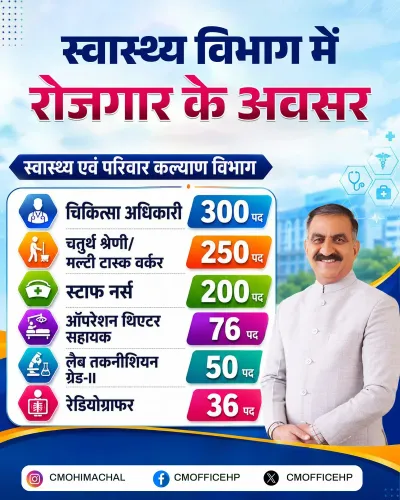
The official post lists the following sanctioned positions: 300 Medical Officers, 250 Multi-Tasking Staff (MTS), 200 Staff Nurses, 76 Operation Theatre Assistants, 50 Lab Technicians (Grade II), and 36 Radiographers. The announcement, shared directly by the Chief Minister's Office, frames these as approved positions ready to be filled through the formal recruitment process.
In the original Hindi, the post is titled 'स्वीकृत पदों का विवरण' ('Details of Sanctioned Posts'), indicating these are formally approved vacancies rather than a proposal or intent.
Context
Himachal Pradesh, a northern hill state with a dispersed rural population spread across difficult terrain, has historically struggled with healthcare staffing — particularly in remote and tribal blocks where geographic constraints make postings unattractive. The Himachal Pradesh Health and Family Welfare Department manages a network of district hospitals, community health centres, and primary health centres that serve communities often hours away from specialist care.
Vacancy rates in government health facilities have been a persistent concern, with Medical Officer and nursing positions among the hardest to fill in hard-to-reach districts. A sanction of this scale, covering both clinical and para-clinical roles, addresses multiple layers of the staffing pyramid simultaneously.
Policy Backdrop
Indian states are required to maintain prescribed doctor-to-population and nurse-to-bed ratios under national health mission norms. Periodic sanction of additional posts is a standard mechanism states use to align their workforce with these norms and with actual facility loads. Announcements of sanctioned posts typically precede a formal recruitment advertisement issued either by the Himachal Pradesh Staff Selection Commission (HPSSC) or directly by the Health Department.
The inclusion of Operation Theatre Assistants and Radiographers alongside the larger Medical Officer and nursing cohorts suggests an intent to strengthen secondary-care surgical and diagnostic capacity — not just primary health delivery. Lab Technicians (Grade II) are critical for diagnostics at the block and district level, where under-staffing often delays patient management.
Stakeholders and Impact
The most immediate beneficiaries are medical graduates and paramedical professionals in Himachal Pradesh who have been awaiting government employment opportunities. For rural and tribal patients, filled vacancies translate directly into reduced referral distances and shorter wait times at local facilities.
With 300 Medical Officer posts alone — the single largest category in this sanction — the state is signalling that primary and community health coverage remains its top priority. The 250 MTS posts will support hospital administration and logistics, an often-overlooked bottleneck in facility functioning.
What's Next
The formal advertisement of these posts by the HPSSC or the Health Department is the critical next step. Observers will watch whether the recruitment process moves swiftly and, crucially, whether joining rates in remote postings meet expectations once selections are made. Past recruitment cycles in the state have seen candidates prefer urban postings, leaving hard-to-reach centres under-staffed even after vacancies are technically filled.
If the state pairs this sanction with incentive-based posting policies for remote areas — a step that has been discussed in health policy circles — the actual impact on rural healthcare access in Himachal Pradesh could be substantially greater than the headline numbers suggest.
Point of View
Given the state's chronic vacancy problem in remote health facilities. The breadth of categories — from Medical Officers to MTS — suggests a deliberate attempt to address the full staffing chain rather than just headline clinical roles. However, sanction alone does not equal deployment: the state's track record on filling remote postings will be the real test of whether this announcement translates into improved rural healthcare access. The move fits a broader national pattern of state governments using health workforce expansion as both a governance deliverable and an employment stimulus in a competitive job market.
NationPress
26 Oct 2026
Frequently Asked Questions
How many health posts has Himachal Pradesh sanctioned in 2026?
The Chief Minister's Office of Himachal Pradesh sanctioned 912 health posts across six categories in June 2026, including Medical Officers, Staff Nurses, Lab Technicians, Radiographers, Operation Theatre Assistants, and MTS.
How many Medical Officer posts are sanctioned in Himachal Pradesh?
300 Medical Officer posts have been sanctioned, making it the largest single category in the latest announcement by the HP Chief Minister's Office.
When will HPSSC release the recruitment notification for these health posts?
A formal recruitment advertisement from HPSSC or the Himachal Pradesh Health Department is the expected next step; no specific date has been announced yet by the government.
Which categories are included in the HP health department recruitment 2026?
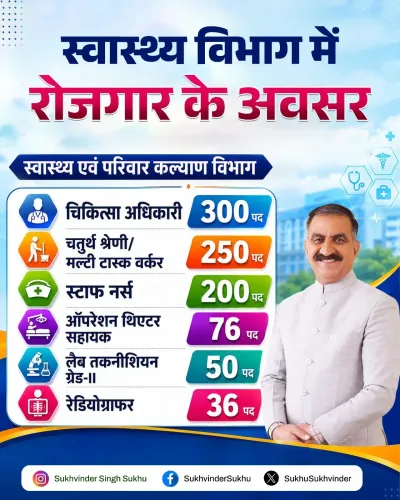
The six sanctioned categories are: Medical Officer (300) , MTS (250), Staff Nurse (200), Operation Theatre Assistant (76), Lab Technician Grade II (50), and Radiographer (36).
Why does Himachal Pradesh face healthcare staffing shortages?
The state's dispersed rural population and difficult mountain terrain make postings in remote and tribal blocks unattractive, historically leading to high vacancy rates even when posts are sanctioned.