HP CM Office Approves 400 Multi-Task Worker Posts Across Gram Panchayats
Synopsis
The Himachal Pradesh cabinet has approved filling 400 Multi-Task Worker posts across all gram panchayats in the state. The decision, announced by the CM Office on 21 July 2026, aims to strengthen panchayat functioning and improve rural service delivery across the hill state's dispersed settlements.
Key Takeaways
The Himachal Pradesh cabinet has approved 400 Multi-Task Worker posts to be filled across all gram panchayats in the state.
The decision was announced by the Chief Minister's Office of Himachal Pradesh on 21 July 2026 .
The move is intended to strengthen panchayat administration and improve delivery of services in rural areas.
Himachal Pradesh has a dispersed, hilly rural geography that has historically challenged uniform service delivery at the village level.
The recruitment aligns with the devolution framework of the 73rd Constitutional Amendment Act of 1992 , which empowers Panchayati Raj Institutions.
Formal recruitment notifications, eligibility criteria, and salary provisions are expected to be issued in subsequent official communications.
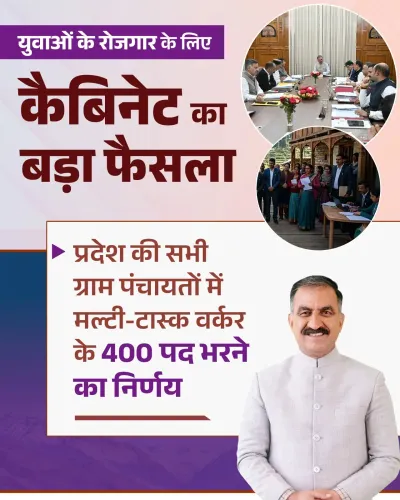
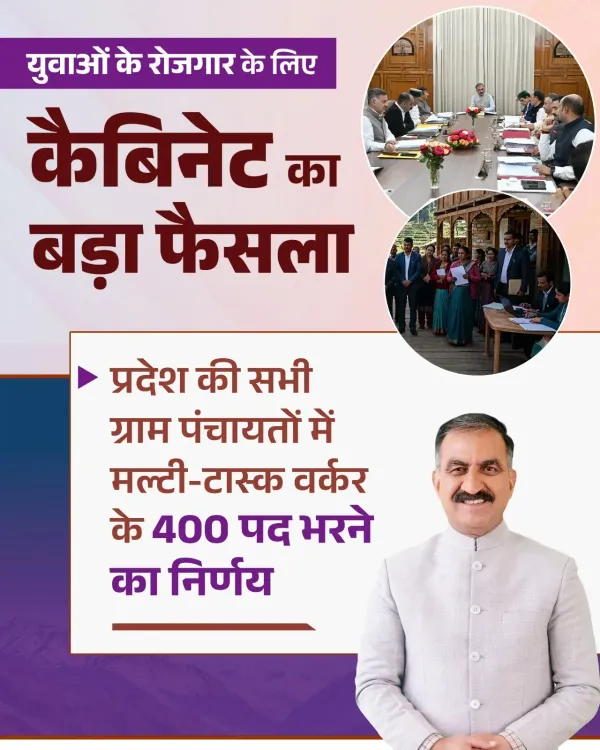
The Chief Minister's Office of Himachal Pradesh announced on Tuesday, 21 July 2026 that the state cabinet has resolved to fill 400 posts of Multi-Task Workers across all gram panchayats in the state, a move aimed at strengthening village-level administration and improving rural service delivery.
The official post stated: 'हमारी सरकार ने कैबिनेट बैठक में प्रदेश की सभी ग्राम पंचायतों में मल्टी-टास्क वर्कर के 400 पदों को भरने का निर्णय लिया है।' ('Our government has decided in the cabinet meeting to fill 400 posts of Multi-Task Workers in all gram panchayats of the state.') The announcement further noted that this step will 'strengthen the functioning of panchayats and help improve services and systems in rural areas.'
Context
Himachal Pradesh is a predominantly rural, hilly state where dispersed settlements have historically made uniform service delivery a challenge. The state's gram panchayats — the foundational units of the Panchayati Raj system — are responsible for a wide range of functions including local planning, sanitation, maintenance of records, and coordination of government welfare schemes. Thin administrative staffing at this level has long been identified as a bottleneck.
The cabinet's decision to recruit 400 Multi-Task Workers directly addresses this gap by placing dedicated personnel within panchayat offices to handle operational and administrative tasks that currently fall on elected representatives or go unattended.
Policy Backdrop
India's 73rd Constitutional Amendment Act of 1992 devolved substantial powers to Panchayati Raj Institutions, mandating that village bodies take charge of local self-governance and rural development. However, the effectiveness of these bodies has consistently depended on adequate human resources — a variable that differs sharply across states.
Chief Minister Sukhvinder Singh Sukhu, who has led the state since December 2022, has positioned decentralised governance as a priority. The recruitment of multi-task workers fits within a broader national pattern in which state governments periodically augment panchayat staff to translate constitutional mandates into on-ground outcomes.
Stakeholders and Impact
The most immediate beneficiaries are rural residents across Himachal Pradesh's thousands of gram panchayats, who stand to receive faster, more consistent access to government services. Elected panchayat members and secretaries are also expected to benefit from reduced administrative burden, allowing them to focus on planning and oversight functions.
The 400 new positions also represent direct employment opportunities for local candidates in rural areas, a consideration of significance in a hill state where government jobs remain highly sought after. Recruitment notifications, salary provisions, and any training frameworks for these workers are expected to follow in subsequent official communications.
What's Next
The cabinet decision marks the policy sanction stage; formal recruitment notifications, eligibility criteria, and budget allocations will need to be issued before positions can actually be filled. Observers will watch for the speed of implementation, given that similar recruitment drives in other states have sometimes faced delays in notification and selection processes.
If executed efficiently, the induction of Multi-Task Workers into every gram panchayat could meaningfully raise the administrative baseline of rural Himachal Pradesh — and potentially serve as a model for other hill states grappling with similar staffing deficits in their local governance structures.
Point of View
Fragmented rural geography, staffing at the panchayat level carries outsized significance. For the Sukhu government, this decision serves a dual purpose: it signals commitment to grassroots governance while also generating direct public-sector employment in rural constituencies ahead of future electoral cycles. The move fits into a broader national arc in which state governments have used panchayat staffing as a lever to operationalise the three-decade-old constitutional promise of local self-governance. The real test, however, will be the pace and transparency of the recruitment process — a stage where similar drives have historically stalled.
NationPress
20 Oct 2026
Frequently Asked Questions
What did the Himachal Pradesh cabinet decide about gram panchayats?
The Himachal Pradesh cabinet decided to fill 400 posts of Multi-Task Workers across all gram panchayats in the state to strengthen their functioning and improve rural service delivery.
How many Multi-Task Worker posts are being created in HP panchayats?
The cabinet has approved filling 400 Multi-Task Worker posts distributed across all gram panchayats in Himachal Pradesh .
Who is the Chief Minister of Himachal Pradesh in 2026?
Sukhvinder Singh Sukhu is the Chief Minister of Himachal Pradesh, having assumed office in December 2022 .
What is a Multi-Task Worker in a gram panchayat?
A Multi-Task Worker is a government employee posted at the panchayat level to handle a range of operational and administrative duties, helping elected representatives and secretaries manage day-to-day panchayat functions more efficiently.
What is the legal basis for empowering gram panchayats in India?
The 73rd Constitutional Amendment Act of 1992 established the legal framework for Panchayati Raj Institutions, devolving powers to village-level bodies for local self-governance and rural development across India.