Is India Surpassing Atmanirbhar Bharat to Become a Global Reliance?
Synopsis
India is moving beyond the Atmanirbhar Bharat initiative, becoming a global hub of reliance. Dr. Jitendra Singh emphasizes the shift from import dependence to exports, showcasing the government's support for startups, especially women-led initiatives. This transformation marks a significant step in India's journey towards innovation and global collaboration.
Key Takeaways
India is moving towards global reliance beyond Atmanirbhar Bharat.
Shift from import dependence to significant exports .
Support for startups is being enhanced, especially for deep-tech innovations.
Women participation in innovation is growing, with thousands benefiting from DSIR schemes.
Fiscal incentives are making collaboration with government R&D attractive.
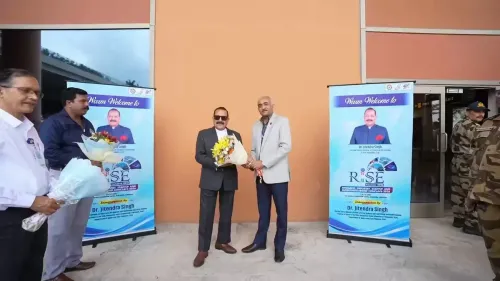
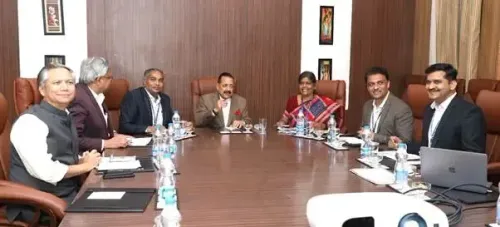
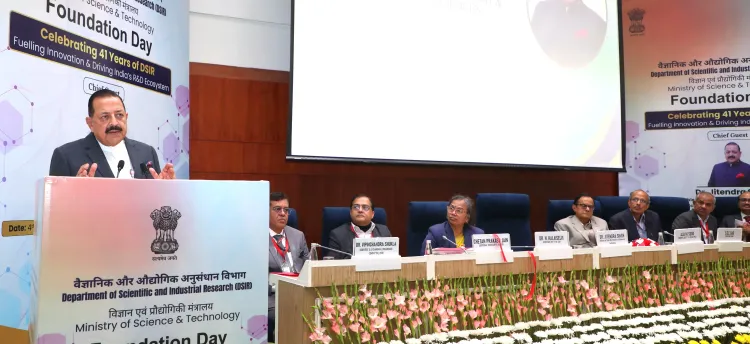
New Delhi, Jan 5 (NationPress) India has transcended the objective of ‘Atmanirbhar Bharat’ and is now embarking on a journey where global economies are increasingly leaning on the nation's capabilities, stated Dr. Jitendra Singh, Union Minister of State (Independent Charge) for Science and Technology.
During the 42nd Foundation Day celebration of the Department of Scientific and Industrial Research (DSIR), Singh highlighted that India has shifted from being import-dependent to generating exports worth crores.
By citing advancements in vaccines, medical devices, and indigenous technologies, he pointed out the growing global acknowledgment of Indian science and technology. “We are not just self-reliant; we are becoming a source of reliance for others,” he emphasized.
Focusing on DSIR’s foundational pillars—science, industry, R&D, and technology transfer—the Minister asserted that significant research initiatives cannot thrive without industry as a vital partner.
He remarked that DSIR's responsibilities have expanded from mere certification to offering fiscal incentives like customs duty exemptions, making collaboration with government-supported R&D more appealing for industries, MSMEs, and startups.
Singh also introduced a crucial amendment, lifting the mandatory three-year operational requirement for deep-tech startups seeking recognition under the DSIR's Industrial Research and Development Promotion Programme.
This initiative aims to boost India’s startup ecosystem by providing early-stage support to nascent projects as well as promising innovators and entrepreneurs.
“A diverse range of schemes already exists for early-stage innovators across departments like DST, CSIR, TDB, and more. The removal of the three-year operational condition serves as a significant motivator for deep-tech startups to scale rapidly, even before they are fully independent,” he stated.
This reform reflects the government's faith in Indian innovators and their sustainability.
The Minister explained that the CSIR has previously extended financial support to startups, offering loans up to Rs 1 crore. However, these were contingent upon demonstrating sustainability and viability through a minimum three-year existence.
“That stipulation has now been eliminated,” he continued, labeling this reform as a substantial incentive with a commendable intent to accelerate and maintain new deep-tech startups even before they are fully established while ensuring appropriate evaluation standards linked to technological maturity.
Furthermore, the Minister highlighted the significant involvement of women, noting that over 10,000 women beneficiaries are currently utilizing DSIR schemes, including more than 55 women-led Self-Help Groups, marking a positive and irreversible shift in India’s innovation culture.
Point of View
I recognize this pivotal moment for India. The transition from Atmanirbhar Bharat to becoming a global reliance is not just about economic growth; it's a testament to India's innovation potential. The government’s support for startups, particularly those led by women, signifies a progressive approach towards building a sustainable and inclusive economy. It is crucial for us to stay engaged with these developments as they shape the future of our nation.
NationPress
5 Oct 2026
Frequently Asked Questions
What is Atmanirbhar Bharat?
Atmanirbhar Bharat, or 'Self-Reliant India', is an initiative aimed at promoting self-sufficiency in various sectors including manufacturing and technology.
What are DSIR's roles?
The Department of Scientific and Industrial Research (DSIR) focuses on fostering scientific research, industry collaboration, and technology transfer.
How does the removal of the three-year condition benefit startups?
It allows deep-tech startups to gain recognition and support earlier in their development, fostering innovation and growth.
What fiscal incentives does DSIR offer?
DSIR provides customs duty exemptions and other financial incentives to encourage industry collaboration with research and development efforts.
How is the participation of women in innovation being encouraged?
The government has initiated various schemes to support women-led startups, with over 10,000 women currently benefiting from DSIR programs.