Is the India-EU Trade Deal Shaping a New World Order?
Synopsis
The EU-India free trade agreement signals a shift in the global order as the US retreats. This deal, described as the 'mother of all deals,' could reshape international relations and trade dynamics. What does this mean for the future of global cooperation?
Key Takeaways
The EU-India FTA is a significant trade agreement that emphasizes economic cooperation.
It represents a move towards a multipolar world as the US withdraws.
The partnership could reshape international relations and trade dynamics.
Experts anticipate increased collaboration in the Indo-Pacific region.
India's agreements with the UK and New Zealand highlight its growing global engagement.
New Delhi, Feb 11 (NationPress) The EU-India free trade agreement (FTA), hailed as the “mother of all deals”, reveals the evolving landscape of a post-US world order in light of ongoing threats to territorial integrity, punitive tariffs, and the dilution of multilateral organizations, as stated in a recent report by The Guardian.
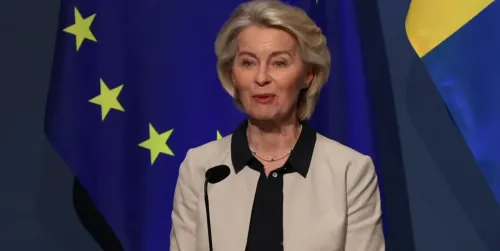
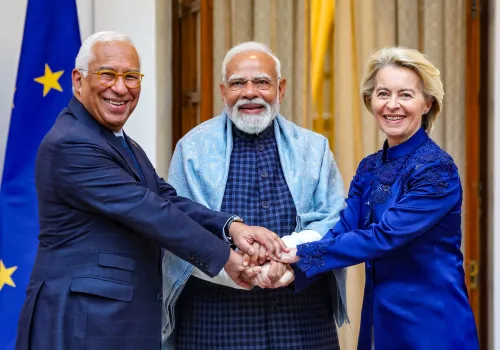
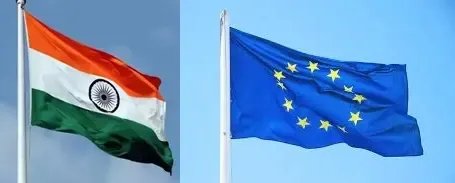
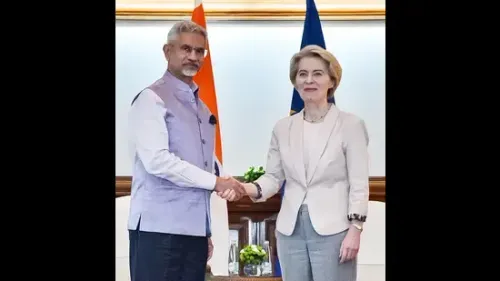
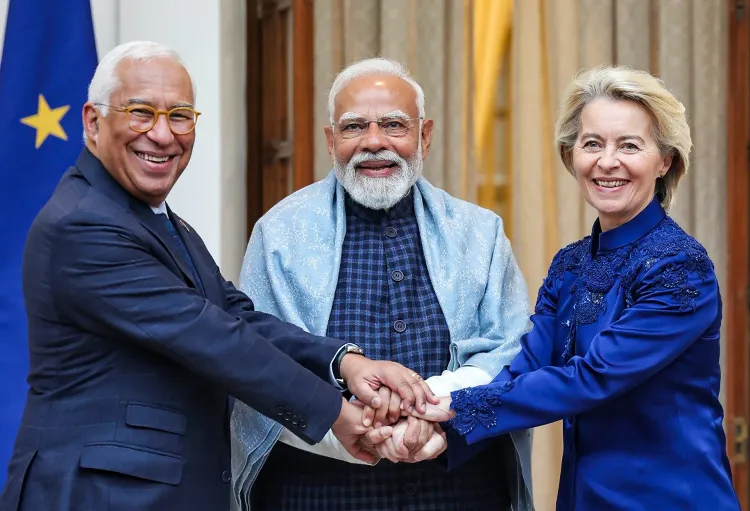
The trade agreement, recently announced by President of the European Commission Ursula von der Leyen, President of the European Council Antonio Costa, and Prime Minister Narendra Modi, is set to unite around two billion consumers and account for 25% of the world’s GDP.
According to Ravinder Kaur, a professor of Asian studies at the University of Copenhagen, the broad scope of the developing India-EU collaboration indicates a trend toward increased alignment regarding commitment to multilateral institutions, along with cooperation in security, defense, research, mobility, and connectivity, particularly in the Indo-Pacific region.
As the US pivots back to the western hemisphere, the Indo-Pacific region—once the focal point of US engagement in Asia—is now more receptive to partnerships with the EU, she notes.
“The post-US world is already in formation,” and the significant EU-India trade agreement stands as a prime illustration of this change.
Brussels has also recently finalized a trade deal with the South American Mercosur trade bloc, with several other agreements in progress. The report highlights that India has entered into agreements with the UK and New Zealand in recent months.
“While the processes of ratification and implementation may encounter delays—such as seen with the EU-Mercosur deal—it is clear that a noticeable shift is underway,” Kaur comments, adding that the “world that many beyond the west have long envisioned—a multipolar landscape, strategic autonomy, and even de-dollarisation—is materializing, initially at a slow pace but now accelerating.”
In the meantime, India’s FTA with the EU concluded last month, which may have prompted the US to expedite its trade negotiations with India, according to a South Asia expert from the Asia Society in New York.
“Although discussions between India and the US have been ongoing for some time, the deal with the EU could have catalyzed the US’s urgency,” remarked Farwa Aamer, the Director of South Asia Initiatives at the Asia Society Policy Institute (ASPI). “The timing is intriguing, as this deal follows closely after the EU-FTA,” she added.
Point of View
The EU-India trade deal represents not just an economic alliance but a strategic pivot towards a multipolar world. This partnership could challenge the traditional dominance of the US and reshape international relations, emphasizing the need for nations to adapt to a rapidly changing global environment.
NationPress
19 Sept 2026
Frequently Asked Questions
What is the EU-India free trade agreement?
The EU-India free trade agreement is a comprehensive trade deal aimed at enhancing economic cooperation between the European Union and India, covering various sectors including trade, investment, and services.
Why is the EU-India FTA significant?
The FTA is significant because it unites around two billion consumers and represents about 25% of the world's GDP, highlighting a shift in global trade dynamics.
How does this deal affect US-India relations?
The deal may have prompted the US to accelerate its own trade discussions with India, as the EU's engagement signals a changing landscape in international trade.
What are the implications for multilateral institutions?
The agreement suggests a move towards greater convergence in multilateral commitments and cooperation, challenging the current dominance of traditional powers.
What is the future of the Indo-Pacific region?
With the US retreating, the Indo-Pacific region is becoming more open to collaboration with the EU, indicating a potential shift in geopolitical alliances.