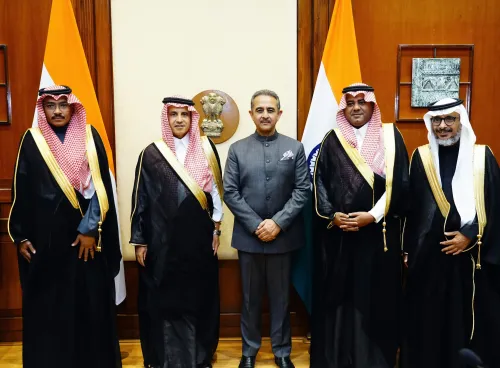
India-Saudi Arabia push ahead on Electrical Interconnection Initiative

Synopsis
India and Saudi Arabia are moving from intent to action on their landmark Electrical Interconnection Initiative, with senior power ministry officials holding a dedicated virtual review meeting. Set against a bilateral trade relationship worth USD 41.07 billion and USD 10 billion in Saudi investment in India, the grid linkage could redefine the energy dimension of one of India's most strategically important partnerships.
Key Takeaways
India and Saudi Arabia held a high-level virtual meeting on 19 October 2026 to advance the bilateral Electrical Interconnection Initiative .
Pankaj Agarwal (Ministry of Power Secretary) met with Nasser Al-Qahtani (Saudi Assistant Minister of Energy) for the review.
Saudi Arabia expressed interest in cooperation on EHV transmission , renewable energy grid integration, data centre power needs, and updated grid codes.
Bilateral trade reached USD 41.07 billion in FY 2025–26 ; Saudi Arabia is India's 5th largest trading partner.
Total Saudi investment in India stands at approximately USD 10 billion ; Indian investment in Saudi Arabia is around USD 3 billion .
Over 6,000 Indian companies are registered in the Kingdom across diverse sectors.
India and Saudi Arabia on 19 October 2026 held a high-level virtual bilateral meeting to advance the India–Saudi Arabia Electrical Interconnection Initiative, reaffirming their commitment to deepening energy ties and expanding power-sector collaboration. The talks mark a concrete step in translating a long-discussed cross-border grid linkage into operational progress.
Key Discussions at the Bilateral Meeting
Pankaj Agarwal, Secretary, Ministry of Power, led the Indian side in a virtual meeting with Nasser Al-Qahtani, Assistant Minister of Energy for Electricity Affairs, Kingdom of Saudi Arabia. According to an official statement issued after the meeting, both sides reviewed the progress of the proposed electrical interconnection and exchanged views on the way forward, underscoring the importance of sustained engagement to advance the initiative.
Beyond the interconnection project itself, the two countries explored avenues to broaden cooperation across other areas of mutual interest in the power sector, with particular emphasis on technical collaboration, knowledge sharing, and the exchange of best practices.
Saudi Arabia's Areas of Interest
The Saudi side expressed specific interest in enhanced cooperation on several technical fronts: Extra High Voltage (EHV) transmission systems, addressing challenges arising from higher penetration of renewable energy in the grid, strategies for managing the rapidly growing power demands of data centres, and updating grid codes to keep pace with evolving power system requirements. These priorities reflect the Kingdom's own energy transition agenda under Vision 2030, which targets 50% of electricity generation from renewables by 2030.
The Broader Economic Relationship
The energy initiative sits within a deepening bilateral economic relationship. India is the 2nd largest trade partner of Saudi Arabia, while Saudi Arabia is India's 5th largest trading partner. In FY 2025–26, bilateral trade stood at USD 41.07 billion, with Indian exports at USD 10.28 billion and imports at USD 30.79 billion — the latter dominated by crude oil, LPG, fertilisers, chemicals, and plastics.
India's major exports to the Kingdom include engineering goods, rice, petroleum products, chemicals, textiles, food products, and ceramic tiles. This asymmetry underscores India's energy dependence on Saudi Arabia and explains New Delhi's strategic interest in a power interconnection that could, over time, diversify the energy trade's composition.
Investment Flows and Industrial Presence
Total Saudi investment in India — including that of the sovereign wealth fund PIF, other Saudi companies, and the Saudi-backed Vision Fund — stands at approximately USD 10 billion. Major Saudi investors include ARAMCO (energy), Zamil Group (steel), Al Fanar (renewable energy), SABIC (chemicals), SALIC (food sector), Abdul Latif Jameel (auto sector), and Petromin (automobile solutions).
Indian investment in Saudi Arabia has grown in parallel, reaching approximately USD 3 billion as of August 2023, spanning consultancy services, construction, telecommunications, information technology, financial services, pharmaceuticals, and software development. More than 6,000 Indian companies are registered in the Kingdom.
What Comes Next
Both sides reaffirmed their commitment to constructive dialogue and pledged to continue engagement to deepen the partnership. No formal timeline for the electrical interconnection's completion was announced, but the meeting signals that technical and diplomatic groundwork is actively progressing. With India's power demand expected to surge in the coming decade and Saudi Arabia accelerating its renewable energy buildout, the interconnection could eventually become a flagship element of the bilateral relationship.
Point of View
But the convening of a dedicated ministerial-level technical review suggests it is moving beyond concept. What is notable is the Saudi agenda: EHV systems, renewable integration, and data centre load management are precisely the pain points of a grid undergoing rapid decarbonisation — and India, with its own hard-won experience scaling renewable capacity, has genuine technical currency to offer. The asymmetry in bilateral trade (India imports nearly three times what it exports) gives New Delhi a strategic incentive to deepen energy interdependence in ways that give India leverage, not just dependence. Whether the interconnection project has a binding timeline and a funded execution plan — details absent from this meeting's readout — will determine if it remains a diplomatic fixture or becomes infrastructure reality.
NationPress
19 Oct 2026
Frequently Asked Questions
What is the India–Saudi Arabia Electrical Interconnection Initiative?
The India–Saudi Arabia Electrical Interconnection Initiative is a proposed cross-border power grid linkage between the two countries aimed at deepening bilateral energy cooperation. It is being developed through high-level technical and diplomatic engagement between India's Ministry of Power and Saudi Arabia's Ministry of Energy.
Who represented India and Saudi Arabia at the 19 October 2026 meeting?
India was represented by Pankaj Agarwal , Secretary of the Ministry of Power, while Saudi Arabia was represented by Nasser Al-Qahtani , Assistant Minister of Energy for Electricity Affairs. The meeting was held virtually.
What are the key areas of power-sector cooperation Saudi Arabia is interested in?
Saudi Arabia expressed interest in cooperation on Extra High Voltage (EHV) transmission systems, managing higher penetration of renewable energy in the grid, meeting the growing power demands of data centres, and updating grid codes to address evolving requirements.
How large is the India–Saudi Arabia trade relationship?
Bilateral trade between India and Saudi Arabia stood at USD 41.07 billion in FY 2025–26, with Indian exports at USD 10.28 billion and imports — primarily crude oil, LPG, and fertilisers — at USD 30.79 billion. Saudi Arabia is India's 5th largest trading partner.
How much has Saudi Arabia invested in India?
Total Saudi investment in India, including through the sovereign wealth fund PIF and other entities, stands at approximately USD 10 billion. Major investors include ARAMCO, SABIC, Al Fanar, and Zamil Group, spanning energy, chemicals, steel, and renewable energy sectors.