What Does the Arrival of INS Anjadip Mean for the Indian Navy?
Click to start listening
Synopsis
The Indian Navy's acquisition of INS Anjadip, a cutting-edge anti-submarine warfare vessel, represents a significant leap in indigenous shipbuilding and defense capabilities. With advanced systems to enhance maritime security, this vessel is a testament to India’s commitment to a self-reliant defense ecosystem. Discover how this milestone shapes the future of naval warfare.
Key Takeaways
- INS Anjadip is the third ASW SWC for the Indian Navy.
- Built indigenously in Kolkata.
- Enhances anti-submarine warfare and coastal surveillance.
- Over 80% indigenous content reinforces self-reliance in defense.
- Reflects the growing domestic defense manufacturing ecosystem.
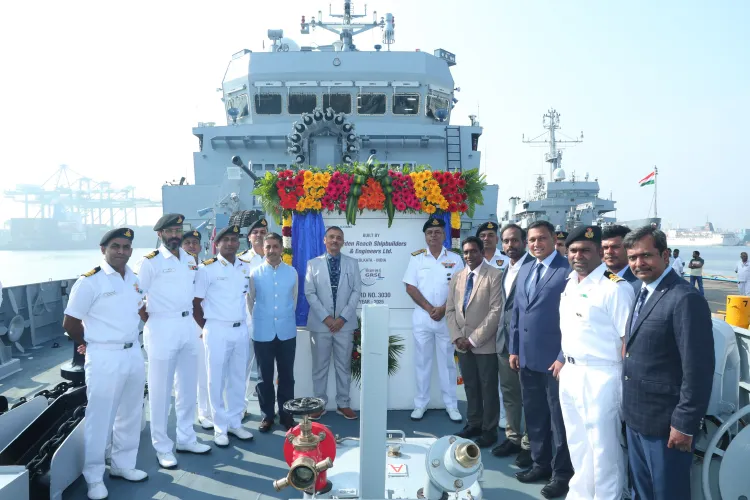
Chennai, Dec 22 (NationPress) On Monday, the Indian Navy proudly took possession of INS Anjadip, marking the delivery of the third vessel in a series of eight Anti-Submarine Warfare Shallow Water Crafts (ASW SWC), which have been indigenously designed and constructed in Kolkata, according to an official statement.
The ship is a modern iteration of the original INS Anjadip, a Petya class Corvette that was decommissioned in 2003, and is set to enhance the Navy’s capabilities in anti-submarine warfare, coastal surveillance, and mine-laying.
The name Anjadip is derived from Anjadip Island, situated off the coast of Karwar, Karnataka, reflecting India's dedication to protecting its vast maritime interests, as stated by the Ministry of Defence.
Constructed following the Classification Rules of the Indian Register of Shipping (IRS) under a Public-Private Partnership (PPP) model, the ASW SWC vessels showcase the success of collaborative defence manufacturing.
Each ship, measuring approximately 77 meters in length, stands as the largest Indian Naval warships powered by Waterjets and are equipped with advanced Lightweight Torpedoes, homegrown Anti-Submarine Rockets, and sophisticated shallow water SONAR systems that facilitate effective detection and neutralization of underwater threats.
The delivery of Anjadip signifies another achievement in the Indian Navy’s pursuit of indigenous shipbuilding, aligning with the government’s vision of Aatmanirbhar Bharat with over 80 percent indigenous content.
This ship exemplifies the burgeoning domestic defence manufacturing ecosystem, reducing reliance on imports, as noted in an official statement.
Last month saw the commissioning of INS Mahe, the first of the indigenously designed Mahe-class ASW SWC, at a ceremony held at the Naval Dockyard in Mumbai.
The event, led by Vice Admiral Krishna Swaminathan, Flag Officer Commanding-in-Chief of the Western Naval Command, was attended by Army Chief General Upendra Dwivedi, senior naval staff, and representatives from Cochin Shipyard, among others.
This occasion highlighted the unprecedented synergy, mutual trust, and cohesive jointness that is currently shaping the Indian Armed Forces, symbolizing how the services collaborate, think, and progress together toward a fully integrated force, stated the Ministry of Defence.
The ship’s name honors the historic coastal town of Mahe on the Malabar Coast, whose rich maritime heritage and serene estuary reflect the vessel’s blend of elegance and strength.
Point of View
The induction of INS Anjadip into the Indian Navy not only enhances our maritime capabilities but also showcases India's growing prowess in defense manufacturing. This aligns with the nation's strategic goals of self-sufficiency and strengthening our naval forces against potential threats, reinforcing our commitment to national security.
NationPress
23/12/2025
Frequently Asked Questions
What is INS Anjadip?
INS Anjadip is the third vessel in the series of Anti-Submarine Warfare Shallow Water Crafts (ASW SWC) built indigenously for the Indian Navy.
Where was INS Anjadip built?
INS Anjadip was designed and constructed in Kolkata, India.
What capabilities does INS Anjadip enhance?
INS Anjadip enhances the Navy's capabilities in anti-submarine warfare, coastal surveillance, and mine-laying.
What is the significance of the name INS Anjadip?
The name INS Anjadip is derived from Anjadip Island, reflecting India's commitment to safeguarding its maritime interests.
What is the length of INS Anjadip?
INS Anjadip measures approximately 77 meters in length.