What is the Growth Rate of India’s Agriculture GVA in 2024-25?
Synopsis
In a significant announcement, India's agriculture sector has achieved a remarkable 10.4 percent growth in GVA for 2024-25. This growth reflects a broader strategy aimed at enhancing farmers' incomes and ensuring sustainable agricultural practices. Learn how the government’s initiatives are reshaping the agricultural landscape.
Key Takeaways
10.4 percent growth in agriculture GVA for 2024-25 .
Food grain production projected at 3,577.32 lakh metric tonnes .
Government strategies aim to enhance farmers' incomes.
Significant budget increase for agriculture sector.
Focus on sustainable practices and climate adaptation.
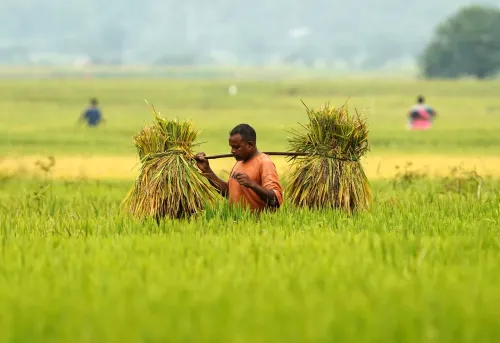
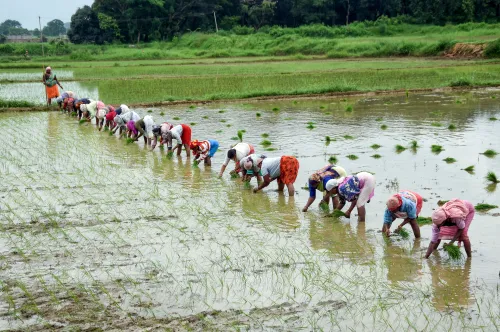
New Delhi, Feb 3 (NationPress) The Gross Value Added (GVA) within India's agriculture and associated sectors, which includes crops, livestock, fisheries, and horticulture at current prices, has been reported at 10.4 percent for the fiscal year 2024-25, as informed to the Parliament on Tuesday.
The Minister of State for Agriculture and Farmers Welfare, Ramnath Thakur, shared in a written statement to the Lok Sabha that the total foodgrain output for the country during 2024-25 is projected to reach a historic 3,577.32 lakh metric tonnes (LMT), marking a 7.65 percent rise compared to the 3,322.98 LMT recorded in 2023-24.
He highlighted that the government is continuously assessing the critical factors impacting agricultural development, such as farm incomes, input costs, climate variations, irrigation provisions, credit accessibility, and market connections. This ongoing evaluation is conducted through various studies, field visits by officials, and periodic high-level reviews.
The government is implementing a cohesive strategy aimed at boosting farmers' incomes and ensuring comprehensive growth of the agricultural sector. This strategy encompasses enhancing crop production, lowering production costs, and ensuring better price realizations for farmers’ products to improve their earnings.
Additionally, agricultural diversification, enhancing post-harvest value addition, adapting to climate change for sustainable farming, and minimizing crop losses are key components of this strategy.
Furthermore, the minister noted that the government has significantly increased the budget for the Department of Agriculture & Farmers Welfare from Rs 21,933.50 crore in the 2013-14 budget to Rs 1,27,290.16 crore for the fiscal year 2025-26. The government has also raised the Minimum Support Prices (MSPs) for all mandated kharif, rabi, and other commercial crops, ensuring a minimum return of 50 percent over the weighted average cost of production since 2018-19.
In addition, various policies, reforms, developmental programs, and initiatives have been launched to cover the full range of agriculture, aiming at enhancing the welfare and income of farmers by increasing production, ensuring profitable returns, and providing income support. This comprehensive approach includes aspects like farm incomes, input costs, climate variability, irrigation, credit access, market linkages, insurance, infrastructure, crops including horticulture, seeds, mechanization, organic and natural farming, farmer collectives, extension services, and digital agriculture, according to his response.
Point of View
The growth of 10.4 percent in India's agricultural GVA is a promising sign for the economy. It indicates the government's commitment to enhancing farmers' welfare and fostering sustainable agricultural practices. Continuous evaluation and strategic planning are crucial for maintaining this positive trend.
NationPress
19 Sept 2026
Frequently Asked Questions
What does GVA stand for?
GVA stands for Gross Value Added, which measures the value of goods and services produced in an economic sector.
What was the GVA growth rate for agriculture in 2024-25?
The GVA growth rate for India's agriculture sector was 10.4 percent in 2024-25 .
What is the estimated food grain production for 2024-25?
The estimated food grain production for 2024-25 is 3,577.32 lakh metric tonnes .
What strategies is the government implementing for farmers?
The government is implementing strategies focused on increasing crop production, reducing costs, and ensuring better price realizations for farmers.
How has the budget for agriculture changed over the years?
The budget for the Department of Agriculture & Farmers Welfare has significantly increased from Rs 21,933.50 crore in 2013-14 to Rs 1,27,290.16 crore in 2025-26 .