India's National Highway network grows 61% in 12 years, hits 1.46 lakh km
Synopsis
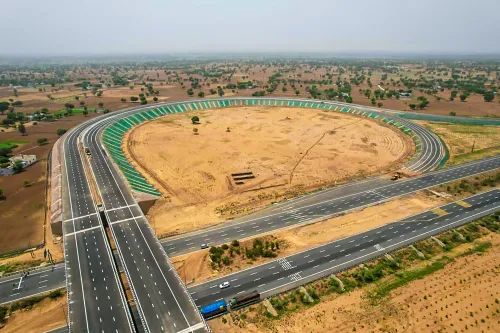
India's highway network has grown 61% in 12 years and construction pace has tripled to 34 km per day — but the more telling shift is qualitative: the focus has moved from adding kilometres to building access-controlled expressways that cut travel times by half or more, with the Delhi–Mumbai corridor alone costing ₹1 lakh crore and still not fully complete.
Key Takeaways
India's National Highway network expanded from 91,287 km in 2014 to over 1,46,572 km in FY 2025-26 — a 61% increase .
Highway construction pace tripled from 11.6 km per day in 2013-14 to nearly 34 km per day in 2025.
Bharatmala Pariyojana has awarded 26,425 km of projects and constructed 22,590 km as of March 2026 , against a total target of 34,800 km at an outlay of ₹5.35 lakh crore .
The Delhi–Mumbai Expressway (approx.
1,386 km , ₹1 lakh crore ) is under phased inauguration, with the latest sections opened on 5 June 2026 .
The Delhi–Dehradun Economic Corridor ( 213 km , ₹12,000 crore ), inaugurated on 14 April 2026 , cut travel time from over 6 hours to around 2.5 hours .
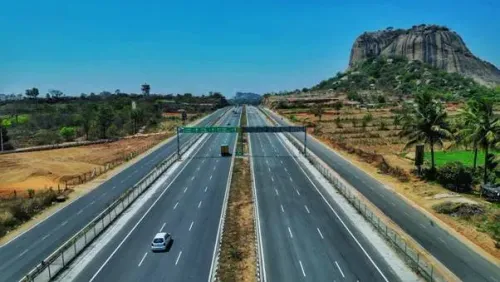
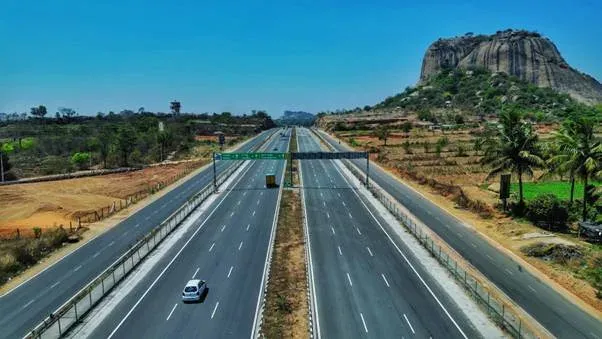
The Bengaluru–Mysuru Expressway reduced travel time between the two cities from nearly 3 hours to about 75 minutes .
India's National Highway network has expanded from 91,287 kilometres in 2014 to over 1,46,572 kilometres in FY 2025-26 — a growth of nearly 61 per cent in 12 years — according to an official factsheet issued by the Ministry of Road Transport and Highways on 14 June 2026. Construction pace has more than tripled, rising from 11.6 km per day in 2013-14 to nearly 34 km per day in 2025.
Bharatmala Pariyojana: The Backbone of the Expansion
The flagship Bharatmala Pariyojana, approved by the Government of India in October 2017, remains the centrepiece of this transformation. The programme envisions the development of 34,800 kilometres of National Highway corridors at an estimated outlay of ₹5.35 lakh crore. As of March 2026, projects covering 26,425 kilometres had been awarded and 22,590 kilometres had been constructed, according to the ministry's factsheet.
The programme has, according to the government, significantly reduced logistics costs, improved access to remote and strategically important regions, and contributed to regional economic balance and national integration.
Delhi–Mumbai Expressway: India's Longest Access-Controlled Corridor
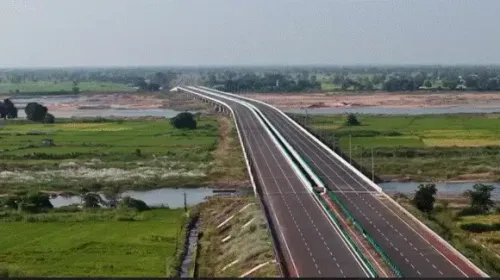
The Delhi–Mumbai Expressway, with a planned length of approximately 1,386 kilometres and an estimated project cost of around ₹1 lakh crore, is set to become the country's longest access-controlled expressway upon completion. The corridor links Delhi, Haryana, Rajasthan, Madhya Pradesh, Gujarat, and Maharashtra.
Prime Minister Narendra Modi inaugurated the first completed section — the 246-km Delhi–Dausa–Lalsot stretch in Rajasthan — on 12 February 2023, at a cost of over ₹12,000 crore. The 87-km Vadodara–Bharuch stretch in Gujarat followed on 22 February 2024. Most recently, on 5 June 2026, the Prime Minister inaugurated two additional Gujarat sections: the 36-km Kim–Ena section and the 27.5-km Gandeva–Ena section.
Key Expressways Reshaping Regional Connectivity
Several other expressways have materially altered travel times and logistics across India's major corridors. The Delhi–Meerut Expressway, spanning approximately 82 kilometres and developed at a cost of around ₹8,346 crore, has significantly cut commute times within the National Capital Region (NCR).
The Dwarka Expressway, stretching approximately 29 kilometres at a cost of nearly ₹9,000 crore, has improved connectivity between Delhi and Gurugram. In southern India, the Bengaluru–Mysuru Expressway — 118 kilometres long, built at approximately ₹8,480 crore and inaugurated on 12 March 2023 — has cut travel time between the two cities from nearly three hours to about 75 minutes.
The Delhi–Dehradun Economic Corridor, a 213-km six-lane access-controlled highway developed at a cost of ₹12,000 crore, was inaugurated on 14 April 2026. The corridor has reduced travel time between Delhi and Dehradun from over 6 hours to around 2.5 hours.
What the Numbers Signal
The tripling of daily construction pace — from under 12 km to 34 km per day — is among the more striking operational metrics in the factsheet. This comes amid broader government efforts to reduce India's logistics costs as a share of GDP, which remain higher than in advanced economies. Notably, the expansion has been concentrated on access-controlled expressways and economic corridors, reflecting a shift from mere network length to quality and freight efficiency.
With the Delhi–Mumbai Expressway still under partial completion and Bharatmala's remaining kilometres to be awarded, the pace and scale of India's highway build-out is expected to continue through the next planning cycle.
Point of View
But the more consequential metric is whether logistics costs as a share of GDP are actually falling — the stated goal of Bharatmala. Network length and construction speed are inputs; freight cost reduction is the output, and that data is conspicuously absent from the ministry's factsheet. The shift toward access-controlled expressways is the right strategic call, but with Bharatmala still roughly 11,000 km short of its 34,800-km target and the Delhi–Mumbai Expressway still incomplete after nearly a decade of planning, execution risk remains the central question the headline numbers do not answer.
NationPress
20 Sept 2026
Frequently Asked Questions
How much has India's National Highway network grown in the last 12 years?
India's National Highway network has grown from approximately 91,287 kilometres in 2014 to over 1,46,572 kilometres in FY 2025-26, an increase of nearly 61 per cent. The construction pace has also tripled, rising from 11.6 km per day in 2013-14 to nearly 34 km per day in 2025, according to the Ministry of Road Transport and Highways.
What is Bharatmala Pariyojana and what is its current status?
Bharatmala Pariyojana is a flagship government programme approved in October 2017 to develop 34,800 kilometres of National Highway corridors at an estimated outlay of ₹5.35 lakh crore. As of March 2026, projects covering 26,425 kilometres had been awarded and 22,590 kilometres had been constructed.
What is the Delhi–Mumbai Expressway and when will it be complete?
The Delhi–Mumbai Expressway is a planned 1,386-km access-controlled expressway costing approximately ₹1 lakh crore, set to be India's longest upon completion. It is being inaugurated in phases — the most recent sections, in Gujarat, were opened on 5 June 2026 — though a full completion date has not been officially confirmed.
Which expressways have been inaugurated recently and how have they reduced travel time?
The Delhi–Dehradun Economic Corridor (213 km, ₹12,000 crore), inaugurated on 14 April 2026, cut travel time between Delhi and Dehradun from over 6 hours to around 2.5 hours. The Bengaluru–Mysuru Expressway (118 km, ₹8,480 crore), inaugurated on 12 March 2023, reduced travel time between the two cities from nearly 3 hours to about 75 minutes.
How does India's highway construction pace in 2025 compare to 2013-14?
India's highway construction pace has nearly tripled over the past decade, rising from approximately 11.6 km per day in 2013-14 to nearly 34 km per day in 2025, according to official data. This acceleration is attributed to improved project execution under Bharatmala Pariyojana and increased budgetary allocation to road infrastructure.