Is India Leading the Charge in Global Health with Traditional Medicine?
Synopsis
India is at the forefront of a global resurgence in traditional medicine, hosting the WHO Global Summit on Traditional Medicine. With a wealth of ancient knowledge, modern regulations, and digital innovations, the country is establishing itself as a leader in this crucial health sector. Discover how India is transforming the future of healthcare.
Key Takeaways
India is a leader in traditional medicine, combining ancient practices with modern science.
The WHO Global Summit on Traditional Medicine focuses on evidence-based integration.
Over 1.5 million records will be available in the WHO Traditional Medicine Global Library.
Ayurveda, Siddha, and Unani are deeply embedded in Indian culture and health.
India's vision aligns with global health equity and accessibility.
New Delhi, Dec 16 (NationPress) As traditional medicine reasserts its significance in global health discussions, India is emerging as a pivotal player in this evolution. The country's extensive reservoir of traditional knowledge, combined with modern regulatory frameworks, digital innovations, and scientific rigor, distinguishes India as a global frontrunner in this domain, the government announced on Tuesday.
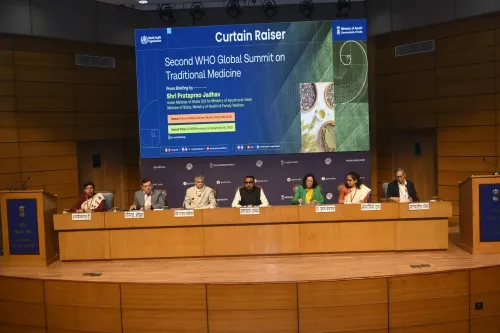
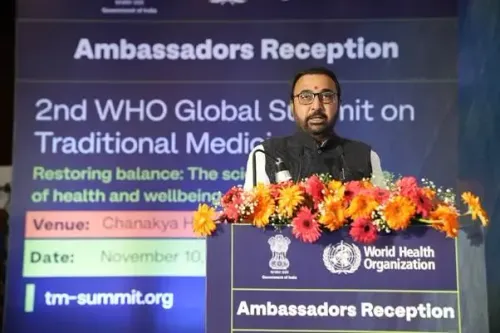
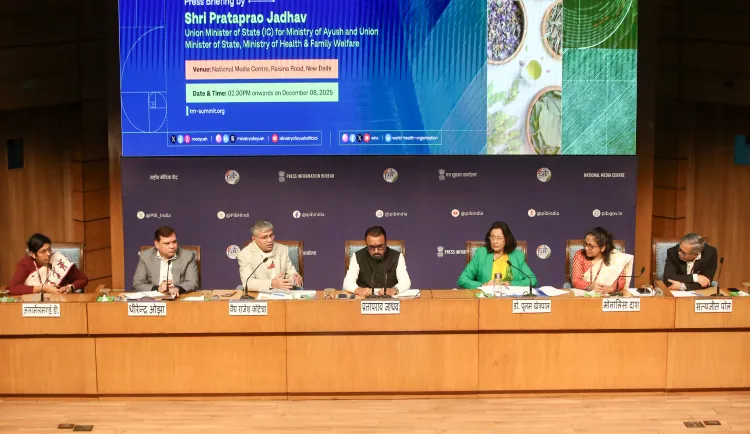
The nation will host the second ‘WHO Global Summit on Traditional Medicine’ from December 17–19, focusing on the theme “Restoring Balance for People and Planet: The Science and Practice of Well-Being.”
During the summit, the launch of the WHO Traditional Medicine Global Library (TMGL) is expected. This library will serve as the world’s most extensive digital database on traditional, complementary, and integrative medicine, featuring over 1.5 million records.
According to official data, India boasts 3,844 Ayush hospitals, 36,848 dispensaries, 886 undergraduate and 251 postgraduate institutions, along with over 750,000 registered practitioners.
This upcoming summit further highlights India's capability to influence international discussions aimed at enhancing standards and establishing frameworks for evidence-based traditional healthcare. This initiative aligns with the vision for Viksit Bharat by 2047, as stated by the government.
Traditional medicine systems such as Ayurveda, Siddha, and Unani in India hold immense cultural, health, and economic significance, being deeply integrated into daily life.
These systems promote holistic, preventive, and person-centered approaches to health and wellness.
Under the Ministry of AYUSH, modalities like Ayurveda, Yoga and Naturopathy, Unani, Siddha, Sowa-Rigpa, and Homoeopathy are officially recognized within India’s public health framework, thriving through national institutions, service networks, and community practices.
The World Health Organization (WHO) recognizes traditional, complementary, and integrative medicine as a vital source of primary healthcare, prized for its cultural relevance, accessibility, and personalized approach.
With growing interest in scientifically validated traditional practices, the WHO and regional health organizations are increasingly recognizing these systems as essential contributors to health equity, especially in scenarios where affordability and cultural familiarity influence healthcare choices.
The WHO organizes Traditional Medicine Global Summits to advocate for the evidence-based integration of traditional, complementary, and integrative medicine (TCIM) within global health systems.
The inaugural summit took place in Gujarat in 2023, exploring methodologies for global research agendas. The WHO has also introduced its WHO Traditional Medicine Strategy 2025-2034.
India is guiding the future of traditional medicine, blending ancient wisdom with contemporary science to promote human well-being. In this endeavor, the country is not only enhancing its own healthcare landscape but also positioning itself as a significant voice in crafting a more holistic, inclusive, and culturally attuned global health framework, as stated by the government.
Point of View
It's evident that India's leadership in traditional medicine is not merely an assertion of cultural pride; it's a strategic move towards a more inclusive and effective global health framework. This initiative aligns with global trends emphasizing integrative approaches to healthcare, ensuring that India remains a pivotal player in the health discourse.
NationPress
19 Sept 2026
Frequently Asked Questions
What is the significance of the WHO Global Summit on Traditional Medicine?
The summit aims to promote the integration of traditional medicine into global health systems, highlighting its importance for health equity and accessibility.
How many Ayush hospitals are there in India?
India has 3,844 Ayush hospitals, reflecting the country's commitment to traditional healthcare.
What is the WHO Traditional Medicine Global Library?
It is the world's largest digital repository for traditional, complementary, and integrative medicine, containing over 1.5 million records.
What traditional medicine systems are recognized in India?
Ayurveda, Siddha, Unani, Yoga, Naturopathy, and Homoeopathy are officially recognized within India's public health framework.
Why is traditional medicine important?
Traditional medicine offers holistic and culturally relevant healthcare options, enhancing accessibility and personalization in health services.