Is India’s Next-Generation Submarine Set to Address Regional Threats?
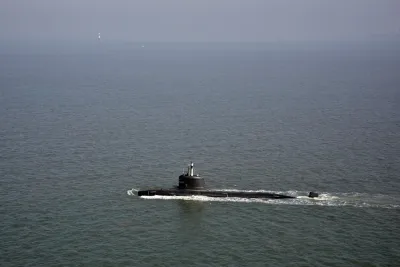
Synopsis
Discover how India's S5 SSBN submarine is set to revolutionize its defense strategy against regional threats. This state-of-the-art vessel is not just about deterrence; it's about asserting India's maritime dominance and safeguarding crucial sea routes against adversaries like China and Pakistan.
Key Takeaways
S5 SSBN enhances India’s nuclear deterrence.
Strategic response to regional threats from China and Pakistan.
Plans for at least four S5 submarines by the 2030s.
Advanced stealth and indigenous technology features.
Blue-water capabilities signify operational reach beyond coastal waters.
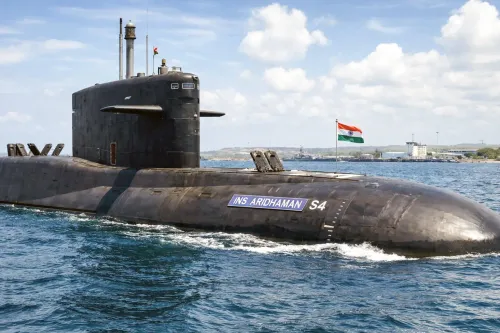
New Delhi, Jan 8 (NationPress) The S5 SSBN, India's latest large-displacement nuclear-powered ballistic missile submarine, is a key component of the nation's strategy to enhance its maritime presence and safeguard vital sea lanes against escalating threats, particularly from China and Pakistan.
The S5-class submarine marks a significant leap in India's nuclear deterrence capabilities, weighing in at approximately 13,500 tonnes, making it larger than the earlier Arihant-class submarines.
Construction commenced in late 2025, with plans for a minimum of four S5 SSBNs, ensuring that at least one submarine remains on deterrent patrol, confirming ongoing deterrence in the seas by the 2030s.
This initiative is part of the Indian Navy's broader objective to expand its fleet significantly by 2035. The submarine is engineered to deliver a reliable sea-based second-strike capability, reinforcing New Delhi's blue-water aspirations.
Beyond deterrence, the S5s bolster India’s blue-water operational capacity, complicating naval strategies for adversaries and backing maritime diplomacy throughout the Indian Ocean Region.
Blue-water capabilities refer to the Indian Navy's ability to safeguard personnel, vessels, cargo, and other interests far beyond its coastal waters and operate across deep oceans.
Consequently, a blue-water navy can conduct sustained operations in open seas, encompassing long-range deployments, amphibious warfare, maritime strike capabilities, and a global presence.
The operational area of the Indian Navy spans from the Persian Gulf to the Malacca Strait, and from the Bay of Bengal to the Indian Ocean, reaching the eastern coast of Africa.
A primary concern in these regions is the combined naval strength of China and Pakistan. The submarines will be equipped with cutting-edge stealth technologies and a 190 MW Pressurised Water Reactor (PWR), developed domestically by the Bhabha Atomic Research Centre (BARC).
These submarines are expected to carry up to 12 K6 submarine-launched ballistic missiles, each capable of deploying multiple independently targetable reentry vehicles (MIRVs).
Currently under development for the Indian Navy, this initiative represents a crucial step towards establishing a robust blue-water navy that can contend with China’s People’s Liberation Army Navy, even well beyond India's coast.
The diplomatic landscape in South Asia has become increasingly securitized and multipolar. The enhancement of India’s military capabilities, including the S5 project, coincides with changing alliances, increasing cooperation between China and Pakistan, and fluctuating relations with neighboring countries, some of which have distanced themselves from New Delhi.
India’s SSBN program both reflects and bolsters this environment, conveying strategic autonomy to partners, deterring coercion, and providing New Delhi with leverage in maritime security discussions and collaborations in the Indian Ocean Region.
A blue-water navy allows India to extend its reach deeper into the oceans, unlike a green-water navy that remains closer to its coastline.
Therefore, with a blue-water navy, India can operate extensively in the open ocean for prolonged periods. This not only enhances underwater capabilities but also necessitates additional resources for the defense forces, including aircraft carriers, various naval vessels, and comprehensive logistical support for operational needs over such extended journeys.
In essence, this represents an extension of India’s influence across vast maritime territories, enabling control over key regions far from its shores.
Point of View
The development of India's S5 SSBN submarine is crucial for maintaining national security and asserting dominance in the Indian Ocean Region. It reflects India's commitment to safeguarding its maritime interests amidst growing regional threats, and reinforces its strategic position in a multipolar world.
NationPress
15 Oct 2026
Frequently Asked Questions
What is the S5 SSBN?
The S5 SSBN is India's next-generation nuclear-powered ballistic missile submarine designed to enhance the country's maritime defense capabilities.
Why is the S5 important for India's defense?
It strengthens India's nuclear deterrent and enables continuous deterrent patrols, crucial for national security against threats from China and Pakistan.
How many S5 submarines are planned?
At least four S5 SSBNs are planned, ensuring one is on patrol at all times by the 2030s.
What technologies will the S5 feature?
The S5 submarines will incorporate advanced stealth technologies and a 190 MW Pressurised Water Reactor developed by BARC.
What is blue-water capability?
Blue-water capability refers to the navy's ability to operate across vast oceanic distances, ensuring maritime security far from its coast.