Is India's Services-Led Growth Becoming More Balanced and Inclusive?

Synopsis
Discover how India's services-led growth is evolving into a more balanced and inclusive landscape, according to the latest NITI Aayog report. With insights into the economic transformation and employment dynamics, this article highlights the pivotal role of the services sector in achieving the nation's vision for 2047.
Key Takeaways
Services sector growth is becoming more regionally balanced.
States with lower service contributions are catching up.
The sector contributes 55% to national GVA.
A quadrant-based framework supports differentiated strategies.
Four-part policy roadmap outlines pathways for improvement.
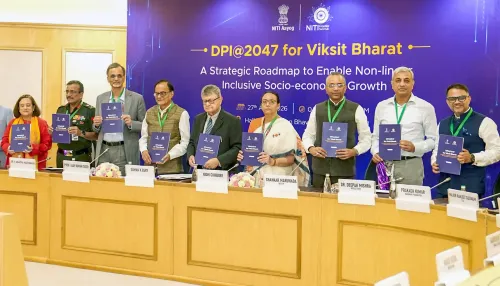
New Delhi, Oct 28 (NationPress) According to a report by NITI Aayog, the services-led growth in India's economy is increasingly becoming more regionally balanced. States with initially lower contributions to the services sector are now catching up with their more developed counterparts.
“There's compelling evidence that structurally lagging states are beginning to converge with advanced ones. This emerging trend indicates that India's transformation driven by the services sector is progressively becoming more broad-based and spatially inclusive,” the report notes.
The services sector has emerged as the backbone of India's economic advancement, accounting for nearly 55 percent of the national GVA (Gross Value Added) for the fiscal year 2024-25.
To guide policy initiatives, the report presents a quadrant-based framework categorizing 15 major service sub-sectors into four distinct categories: Engines of Growth, Emerging Stars, Mature Giants, and Struggling Segments. This classification aims to support targeted strategies across various states.
The recommendations emphasize the importance of prioritizing digital infrastructure, logistics, innovation, finance, and skilling to enhance diversification and competitiveness within the sector.
Moreover, at the state level, it is essential to formulate customized service strategies that leverage local strengths, bolster institutional capacity, integrate services with industrial ecosystems, and promote urban and regional service clusters.
Collectively, these insights provide a strategic policy roadmap for establishing the services sector as a pivotal growth engine across India, reinforcing its crucial role in the vision of Viksit Bharat @2047.
A supplemental report titled India's Services Sector: Insights from Employment Trends and State-Level Dynamics focuses on employment within the services domain, utilizing data from the NSS (2011-12) and PLFS (2017-18 to 2023-24).
This report presents a comprehensive and multi-faceted view of India's services workforce across sub-sectors, gender, regions, education, and occupations. It explores beyond mere aggregate trends to uncover the sector's dual nature: modern, high-productivity segments that are globally competitive yet limited in employment intensity, and traditional segments that accommodate significant numbers of workers but primarily remain informal and low-paying.
By correlating historical and contemporary data, it situates these trends within a larger framework of structural transformation, offering a cohesive understanding of the opportunities and divides that influence India's services-led employment transition.
Findings indicate that while the services sector remains a cornerstone for India's employment growth and post-pandemic recovery, challenges are still prevalent. Employment generation varies across sub-sectors, informality is widespread, and job quality continues to lag behind output growth. Gender disparities, rural-urban divides, and regional inequalities highlight the need for an employment strategy that encompasses formalization, inclusion, and productivity enhancement.
To address these challenges, the report outlines a four-part policy roadmap focusing on the formalization and social protection of gig, self-employed, and MSME workers; targeted skilling and digital access to broaden opportunities for women and rural youth; investment in emerging and green economy skills; and balanced regional development through service hubs in Tier-2 and Tier-3 cities.
By positioning the services sector as a dedicated driver of high-quality and inclusive jobs, the report emphasizes its significance in India's employment transition and its critical role in achieving the vision of Viksit Bharat @2047.
The report stresses the necessity to enhance digital infrastructure, expand skilled human capital, cultivate innovation ecosystems, and integrate services across value chains, positioning India as a reliable global leader in digital, professional, and knowledge-based services.
Point of View
I believe this comprehensive NITI Aayog report illuminates the critical shifts occurring within India's services sector. The findings not only highlight progress in regional balance but also urge us to confront persistent challenges in employment quality and inclusivity. A focused approach on tailored strategies and digital advancements is essential for harnessing the full potential of this vital sector.
NationPress
7 Oct 2026
Frequently Asked Questions
What is the significance of the NITI Aayog report?
The NITI Aayog report highlights the increasing regional balance in India's services-led growth and provides insights into employment dynamics within the sector, emphasizing the need for tailored strategies to address challenges.
How does the services sector contribute to India's economy?
The services sector is pivotal to India's economy, contributing nearly 55 percent of the national GVA for the fiscal year 2024-25, making it the backbone of economic growth.
What challenges does the services sector face?
Despite its growth, the services sector faces challenges such as uneven employment generation, widespread informality, and job quality that lags behind output growth.
What are the recommendations from the report?
The report recommends prioritizing digital infrastructure, logistics, innovation, and tailored service strategies at the state level to enhance competitiveness and inclusivity.
What is the vision of Viksit Bharat @2047?
Viksit Bharat @2047 is an ambitious vision for India's future, aiming for inclusive growth and development across all sectors, with a strong emphasis on empowering the services sector.