Is India’s Services-Led Growth More Resilient Than China's?

Synopsis
Discover how India's services-led economic model is proving to be more resilient than China's manufacturing-heavy approach. This article delves into the factors that contribute to India's rapid growth and its implications for the global economy.
Key Takeaways
India's services sector is a major contributor to its GDP, surpassing 50%.
The IT-BPM sector has seen significant growth in export revenues.
India's Unified Payments Interface has transformed digital transactions.
Professional services are less vulnerable to supply chain disruptions.
India's adaptability positions it well for the future amid global changes.
New Delhi, Feb 9 (NationPress) India has solidified its position as the fastest-growing major economy globally, with promising growth forecasts suggesting it will surpass many of its counterparts in the upcoming decades, according to a recent media report.
India's services-led framework, driven by advancements in technology, finance, digital infrastructure, and professional services, demonstrates remarkable resilience when juxtaposed with China's manufacturing-centric model. This latter approach is fraught with cyclical vulnerabilities stemming from global trade disruptions and domestic economic imbalances, as highlighted in an article published by One World Outlook.
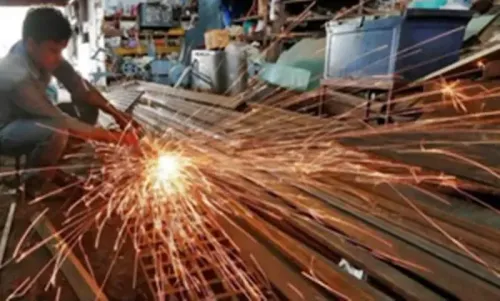
The article reveals that while China's manufacturing sector was pivotal during its ascent—contributing approximately 36-40% of GDP in earlier decades—it is projected to decline to about 25% by 2025, based on national statistics. This shift reflects a conscious transition towards high-value activities and services, which now comprise more than 50-57% of GDP. Nevertheless, manufacturing remains the backbone of China's exports, providing employment to over 100 million people and serving as a tool for geopolitical influence.
China's export-driven factories have managed to navigate challenges such as US tariffs by diversifying into emerging markets, resulting in record trade surpluses in 2025. However, this model also reveals weaknesses: overcapacity, dependence on external demand, struggles within the property sector, and subdued domestic consumption heighten cyclical risks. Although industrial output saw solid growth in 2025, investment in manufacturing noticeably decelerated in the latter half due to trade uncertainties, as the article indicates.
In stark contrast, India's services sector has emerged as the primary growth engine. By 2024-25, services accounted for around 55% of gross value added (GVA), an increase from approximately 51% a decade prior. Key subsectors such as finance, real estate, and professional services contributed nearly 23%, while trade, hotels, transport, and communications made up roughly 18%.
This services-centric approach is attributed to India's early investments in human capital and English language proficiency, which have catalyzed remarkable growth in IT and business process outsourcing.
The technology sector exemplifies India's competitive advantage. The IT-BPM sector has generated significant export revenues, with software services growing at an impressive rate of around 13-14% annually in recent years. Service exports have surged, doubling pre-pandemic growth rates to 14% during FY23-FY25, positioning India as the world’s seventh-largest services exporter (with its share climbing from 2% in 2005 to 4.3% in 2024). Professional consulting and management services have seen even steeper growth, approaching 26%. This strong export performance not only supports stable foreign exchange inflows but also mitigates the impact of merchandise trade deficits, according to the article.
The finance and fintech sectors further enhance this resilience. India's digital infrastructure, particularly the Unified Payments Interface (UPI), has transformed transaction processes. UPI manages billions of transactions monthly, frequently surpassing 20 billion, offering minimal costs, interoperability, and widespread usage (with over 500 million users). This public-driven, open platform stands in contrast to China’s closed systems dominated by private entities like Alipay and WeChat Pay. The rapid expansion of UPI has spurred fintech innovation, improved financial inclusion, and stabilized economic activity, facilitating smooth digital commerce and reducing informality.
Moreover, professional services—including consulting, legal, and advisory—contribute high-value, tradable elements that are less vulnerable to physical supply chain disruptions. Unlike manufacturing, which necessitates substantial capital and is susceptible to tariff barriers or geopolitical strains, these services can scale through digital delivery, taking advantage of India's skilled workforce.
While China's manufacturing model remains formidable in terms of scale and job creation, it is not without risks, such as susceptibility to protectionism (e.g., US tariffs), overreliance on investment (leading to economic imbalances), and sluggish adaptation to service-oriented transitions. Although India faces challenges in job creation within the services sector (which generates fewer mass employment opportunities than manufacturing), it offers a level of adaptability suited for a digital, knowledge-driven future.
Looking forward, India’s dominance in services positions it favorably for future expansion amid advancements in AI, digital transformation, and the global demand for tech-enabled solutions. Continued reforms could further enhance this competitive edge, while China grapples with its own economic rebalancing, as the article concludes.
Point of View
It is vital to recognize the dynamic shifts in global economic structures. India’s services-led growth model showcases the potential for resilience and adaptability in an ever-evolving landscape. This approach not only positions India favorably in the global economy but also offers insights into the future trajectories of major economies.
NationPress
19 Sept 2026
Frequently Asked Questions
What is India's primary economic growth driver?
India's primary economic growth driver is its services sector, which has become the dominant contributor to the country's GDP.
How does India's services sector compare to China's manufacturing sector?
India's services sector is more resilient compared to China's manufacturing sector, which faces cyclical vulnerabilities from global trade disruptions.
What role does technology play in India's economic growth?
Technology plays a crucial role in India's economic growth, particularly in the IT and business process outsourcing sectors, which have seen significant export revenue increases.
What are the challenges facing China's manufacturing model?
China's manufacturing model faces challenges such as overcapacity, dependence on external demand, and slow adaptation to service-oriented transitions.
How is India's digital infrastructure contributing to its economy?
India's digital infrastructure, especially through the Unified Payments Interface (UPI), has revolutionized transactions and facilitated fintech innovation, enhancing economic resilience.