India's Strategic FTAs: A Blueprint for Economic Growth
Synopsis
India is strategically enhancing its economic landscape by signing free trade agreements (FTAs) with key global partners, fostering trade growth and supporting local industries. This proactive approach aims to protect domestic interests while expanding market access for Indian products.
Key Takeaways
92% increase in trade with strategic partners.
FTAs cover 38 countries .
Focus on protecting sensitive sectors.
Support for women-led MSMEs and local farmers.
Unique agreements recognizing India's market potential.
New Delhi, April 11 (NationPress) India is actively pursuing free trade agreements (FTAs) with nations where trade routes are already growing and supply chains are being established, according to a recent report.
These FTAs serve as catalysts for enhancing current economic dynamics, as noted in the report published by Trade Finance Global.
In a fragmented landscape of global trade, this focused strategy shows remarkable resilience.
As tariff threats become prevalent in other parts of the world, India is carefully navigating trade by expanding its service offerings and converting investment opportunities into new industrial capabilities, writes Anna Mahjar-Barducci.
The report reveals that from fiscal year 2020-21 to FY 2024-25, India’s trade with strategic FTA partners surged by 92 percent, significantly outpacing the 41.5 percent growth in India’s total merchandise trade with other global markets.
Over the past few years, the country has progressively broadened its network of FTAs, now totaling nine agreements covering 38 countries.
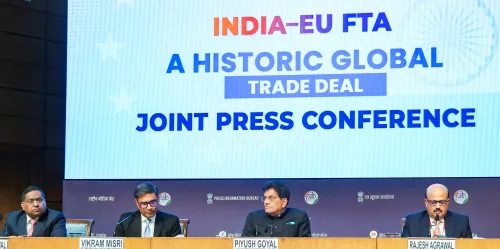
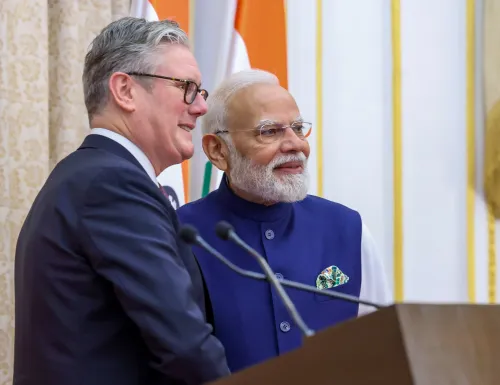
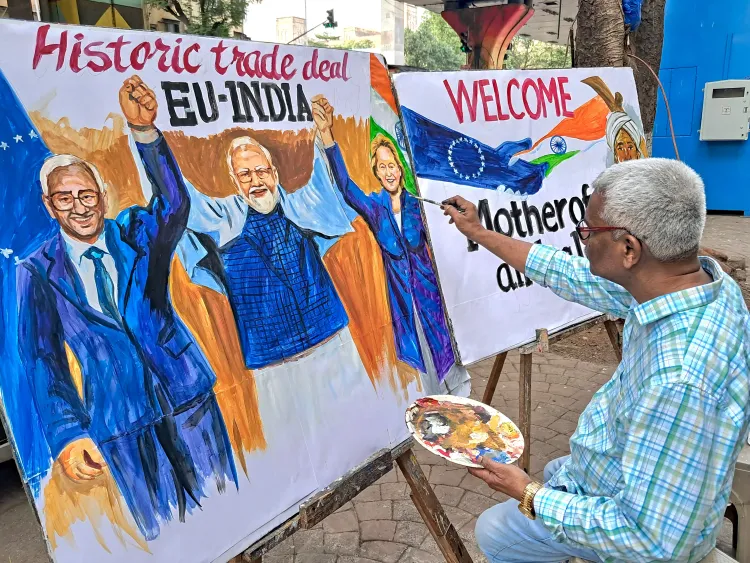
Beginning with the India–Mauritius FTA in 2021, the India–UAE Comprehensive Economic Partnership Agreement was introduced in May 2022. This was followed by the India–Australia Economic and Trade Agreement in December 2022. The India–EFTA TEPA was signed on March 10, 2024, and will take effect on October 1, 2025. Additionally, the India–UK CETA was signed in July 2025, and the India–Oman CEPA in December 2025. The India–New Zealand FTA was announced on December 22, 2025, followed by the India–EU FTA on January 27, 2026.
On February 7, 2026, we established a framework for an interim agreement with the United States, solidifying our global trade presence, as stated by an official.
These agreements aim to support farmers whose products will now reach developed markets. They also benefit entrepreneurs, particularly women-led MSMEs, in sectors like garments, leather, and handicrafts, enhancing their competitiveness.
The interests of all sensitive sectors—including dairy, agriculture, and domestic industries—have been protected, ensuring market access is maintained. India has negotiated with strength to usher in a transformative era in trade. Each agreement is distinctive, reflecting the vast scale of the nation’s market and its economic potential.
Point of View
It's evident that India's focused strategy on free trade agreements is a calculated move to enhance its economic standing globally. This approach not only supports domestic sectors but also positions India as a resilient player in the evolving global trade landscape.
NationPress
19 Sept 2026
Frequently Asked Questions
What are free trade agreements (FTAs)?
Free trade agreements (FTAs) are treaties between two or more countries that reduce or eliminate trade barriers, promoting easier trade and economic cooperation.
How have FTAs impacted India's trade growth?
FTAs have significantly boosted India's trade, with a reported 92% increase in trade with strategic partners, compared to a 41.5% growth in overall merchandise trade.
Who benefits from India's FTAs?
Farmers, entrepreneurs, and particularly women-led MSMEs exporting garments, leather, and handicrafts stand to gain from increased market access and competitiveness.
What sectors are protected in these agreements?
The agreements protect sensitive sectors such as dairy, agriculture, and domestic industries, ensuring their interests are safeguarded.
What is the significance of India's approach to FTAs?
India's careful and committed approach to FTAs positions the country as a resilient participant in global trade, focusing on sustainable economic growth.